I am going to save you three minutes of reading and give you the answer right now: you need both horizontal and vertical video for every listing. There. Done. Article over.
Just kidding. If I ended the article there, you would not understand why both formats matter, which platforms require which format, or how to create both without doubling your production time and budget. And those details are the difference between an agent who posts one video to one platform and an agent who distributes across every channel where buyers are actually looking.
The horizontal vs. vertical debate has been raging since Instagram introduced Stories in 2016, and somehow the real estate industry is still confused about it ten years later. Every week I get emails from agents asking "Should I shoot horizontal or vertical?" as if there is one correct answer. There is not. The correct answer depends on where the video is going, and since you should be distributing to multiple platforms, the correct answer is almost always "both."
This guide breaks down exactly when to use each format, which platforms demand which aspect ratio, the engagement data behind format choices, and how to create multi-format content without wanting to throw your computer out the window.
The Basics: What Do These Numbers Even Mean?
Before we go further, let me make sure we are speaking the same language. If you already know what 16:9 and 9:16 mean, skip ahead. If terms like "aspect ratio" make your eyes glaze over (no judgment, you sell houses, not aspect ratios), here is the quick version.
Aspect Ratio Explained (Without the Math Class Vibe)
Aspect ratio is just the relationship between width and height. A 16:9 video is 16 units wide for every 9 units tall. A 9:16 video flips that: 9 units wide for every 16 units tall. That is it. No calculus required.
| Aspect Ratio | Common Name | Pixel Dimensions | Orientation | Looks Like |
|---|---|---|---|---|
| 16:9 | Widescreen / Horizontal | 1920 x 1080 (1080p) | Landscape | Your TV, YouTube, MLS |
| 9:16 | Vertical / Portrait | 1080 x 1920 | Portrait | Instagram Reels, TikTok |
| 1:1 | Square | 1080 x 1080 | Neither | Old Instagram, some Facebook |
| 4:5 | Tall Vertical | 1080 x 1350 | Portrait (shorter) | Instagram feed posts |
| 4:3 | Standard | 1440 x 1080 | Landscape | Old TV, some tablets |
For real estate in 2026, you really only need to care about two: 16:9 (horizontal) and 9:16 (vertical). Everything else is either outdated, niche, or both.
Where Each Format Wins (And Where It Fails Spectacularly)
The most common mistake agents make is creating a video in one format and trying to force it onto platforms designed for the other. It is like wearing a tuxedo to the beach. Technically possible, deeply inappropriate, and everyone notices.
Horizontal (16:9): The MLS and Portal Champion
Where it dominates:
- MLS: Every MLS system in the United States displays video in a 16:9 player. No exceptions that I am aware of.
- Zillow: Horizontal player on both desktop and mobile. Your video fills the entire player area.
- Realtor.com: Same as Zillow. Horizontal player, 16:9 format.
- Redfin: Horizontal player via MLS syndication.
- YouTube (long-form): YouTube's player is designed for 16:9. This is the native format.
- Email campaigns: Most email clients display embedded video thumbnails in landscape orientation.
- Your website: Desktop visitors see your site in landscape. Horizontal video fills the content area naturally.
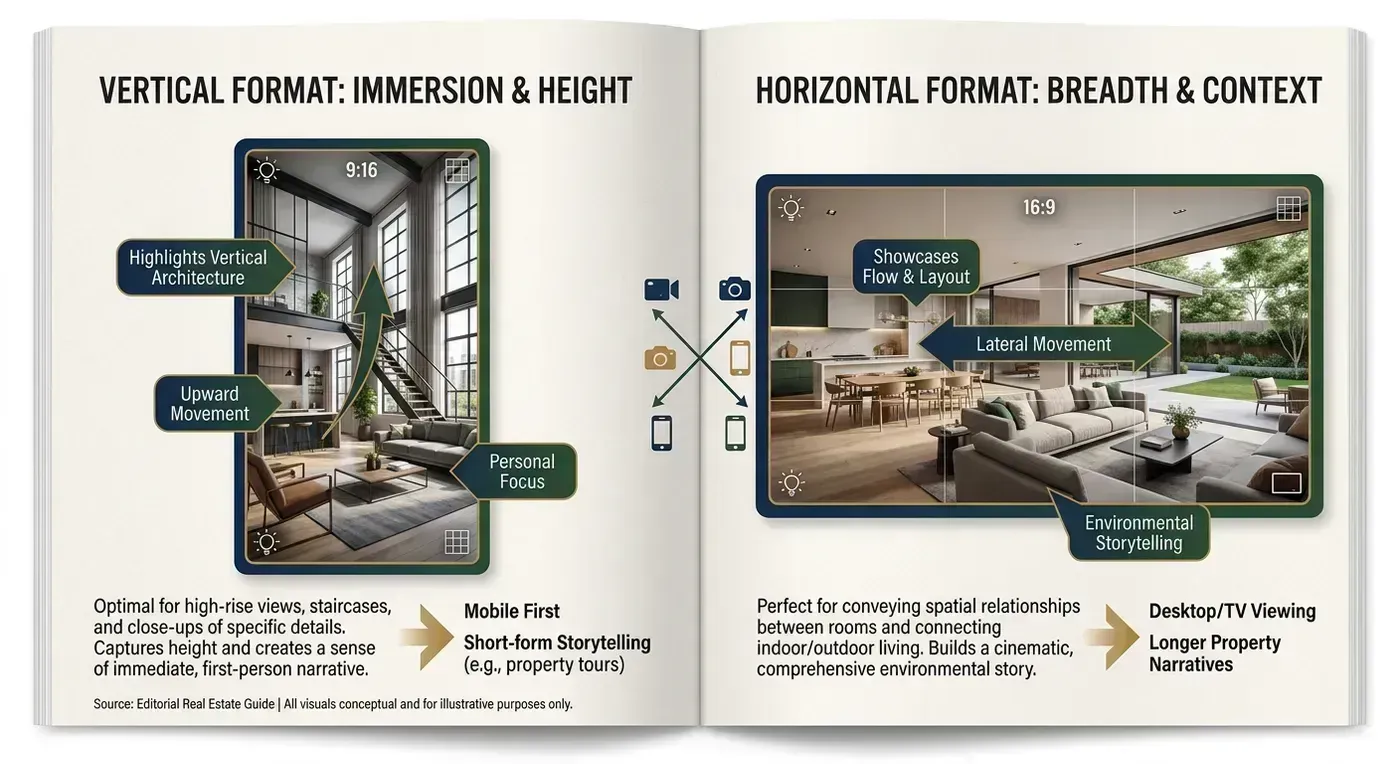
Why it works for real estate: Wide-angle real estate photography is inherently horizontal. A 16mm lens capturing a living room from corner to corner produces a landscape image. Horizontal video preserves the full width of these compositions, showing both walls, the full furniture arrangement, and the spatial depth of the room. It is how real estate photographers compose shots, and it is how property portals display them.
Where it fails: Social media. Uploading a 16:9 horizontal video to Instagram Reels produces a small rectangle floating in the center of a vertical screen, surrounded by black bars (or blurred borders if Instagram auto-fills). The video takes up about 40% of the available screen space. A viewer scrolling through their Reels feed sees your tiny horizontal video sandwiched between full-screen vertical content from other creators. Your video looks out of place, small, and unintentional. The engagement data reflects this.
Vertical (9:16): The Social Media Power Format
Where it dominates:
- Instagram Reels: Native format. Fills the entire phone screen.
- TikTok: Native format. Full-screen experience.
- YouTube Shorts: Native format for the Shorts feed.
- Facebook Reels: Full-screen vertical player.
- Snapchat: Vertical-first platform.
- Pinterest Idea Pins: Vertical format preferred.
Why it works for real estate on social media: Phones are held vertically 94% of the time (MOVR Mobile Overview Report). A vertical video fills 100% of the screen without the viewer rotating their phone. That full-screen experience is immersive. The viewer is not looking at a video on a screen. They are looking through a window into a room. That subtle psychological shift keeps people watching longer, which is exactly what the algorithm rewards.
Where it fails: Property portals, MLS, and professional contexts. A vertical video on Zillow has massive black bars on both sides, reducing the actual content to a narrow strip. On an MLS listing, it looks like you accidentally filmed while holding the camera wrong. In an email or on your website, it creates an awkwardly tall, narrow block that disrupts the page layout. Vertical video screams "social media content," which is fine on social media and out of place everywhere else.
The Engagement Data: Format Impact by Platform
I love opinions, but I love data more. Here is what the numbers say about how format choice affects engagement on each major platform.
Instagram Reels: Vertical Wins by a Landslide
Sprout Social's 2025 social media benchmark report found that vertical (9:16) Reels receive 40% higher completion rates and 35% more reach than horizontal videos posted as Reels on the same accounts. Later's Instagram Engagement Report showed similar numbers, with 9:16 Reels getting 2x the average views of non-native aspect ratios.
The reason is simple math. A vertical Reel fills 100% of the phone screen. A horizontal Reel fills about 40%. Viewers are 2.5x more likely to watch content that dominates their visual field versus content that is a small rectangle surrounded by empty space. This is not an algorithm conspiracy. It is human attention working exactly as you would expect.
TikTok: Vertical Is the Only Real Option
TikTok was built for vertical video. The entire interface, content feed, and discovery algorithm are designed around 9:16 content. Horizontal video on TikTok is displayed with black bars and gets significantly less distribution. TikTok's own creator guidelines recommend 9:16 as the preferred format. Using anything else is like bringing a knife to a gunfight, except the knife is also a spoon.
YouTube: It Depends on the Content Type
YouTube is the only major platform where both formats have distinct, legitimate homes:
- Regular videos (long-form): 16:9 horizontal. YouTube's player is widescreen. A full property tour at 2 to 4 minutes in 16:9 looks professional and provides the best viewing experience on both desktop and mobile (phones rotate to landscape for YouTube videos).
- YouTube Shorts: 9:16 vertical. Shorts are displayed in a vertical feed identical to Reels and TikTok. The same rules apply: vertical fills the screen, horizontal looks tiny.
Smart agents upload both: a full 16:9 listing tour as a regular video (for search and SEO) and a short 9:16 highlight clip as a Short (for discovery and reach). One listing, two YouTube content pieces, two different audiences.
Zillow and MLS: Horizontal, No Contest
Zillow's internal data shows that listings with properly formatted 16:9 horizontal video get 2x the page views of listings without video. There is no public data comparing horizontal vs. vertical video on Zillow, because virtually nobody uploads vertical video to Zillow (and the ones who do probably wish they had not).
The video player on every property portal is horizontal. End of discussion. Do not upload vertical video to Zillow, MLS, Realtor.com, or Redfin. It will look bad and it will not help your listing.
The Format Engagement Summary
| Platform | Best Format | Engagement Impact of Wrong Format |
|---|---|---|
| Instagram Reels | 9:16 vertical | -35% to -50% reach/views if horizontal |
| TikTok | 9:16 vertical | -40% to -60% reach if horizontal |
| YouTube Shorts | 9:16 vertical | -30% to -50% reach if horizontal |
| YouTube (long-form) | 16:9 horizontal | Vertical works but looks amateur |
| MLS | 16:9 horizontal | Vertical displays with black bars, looks broken |
| Zillow | 16:9 horizontal | Vertical displays pillarboxed, wastes screen |
| Realtor.com | 16:9 horizontal | Same as Zillow |
| Facebook Reels | 9:16 vertical | -25% to -40% reach if horizontal |
| Facebook Feed | 16:9 or 1:1 | Vertical crops awkwardly in some views |
| 16:9 horizontal | Vertical creates tall, narrow layout issue |
The pattern is clear. Property portals and professional channels need horizontal. Social media needs vertical. There is no single format that works everywhere. Trying to use one format for all platforms means underperforming on at least half of them.
Here is an example of a listing video with proper AI camera motion that demonstrates the quality achievable in both formats:
Why "Just Crop It" Does Not Work for Real Estate
The most common shortcut agents try is creating a horizontal video and then cropping it to vertical (or vice versa). In theory, this sounds efficient. In practice, it ruins real estate content specifically because of how real estate photography works.
The Cropping Problem
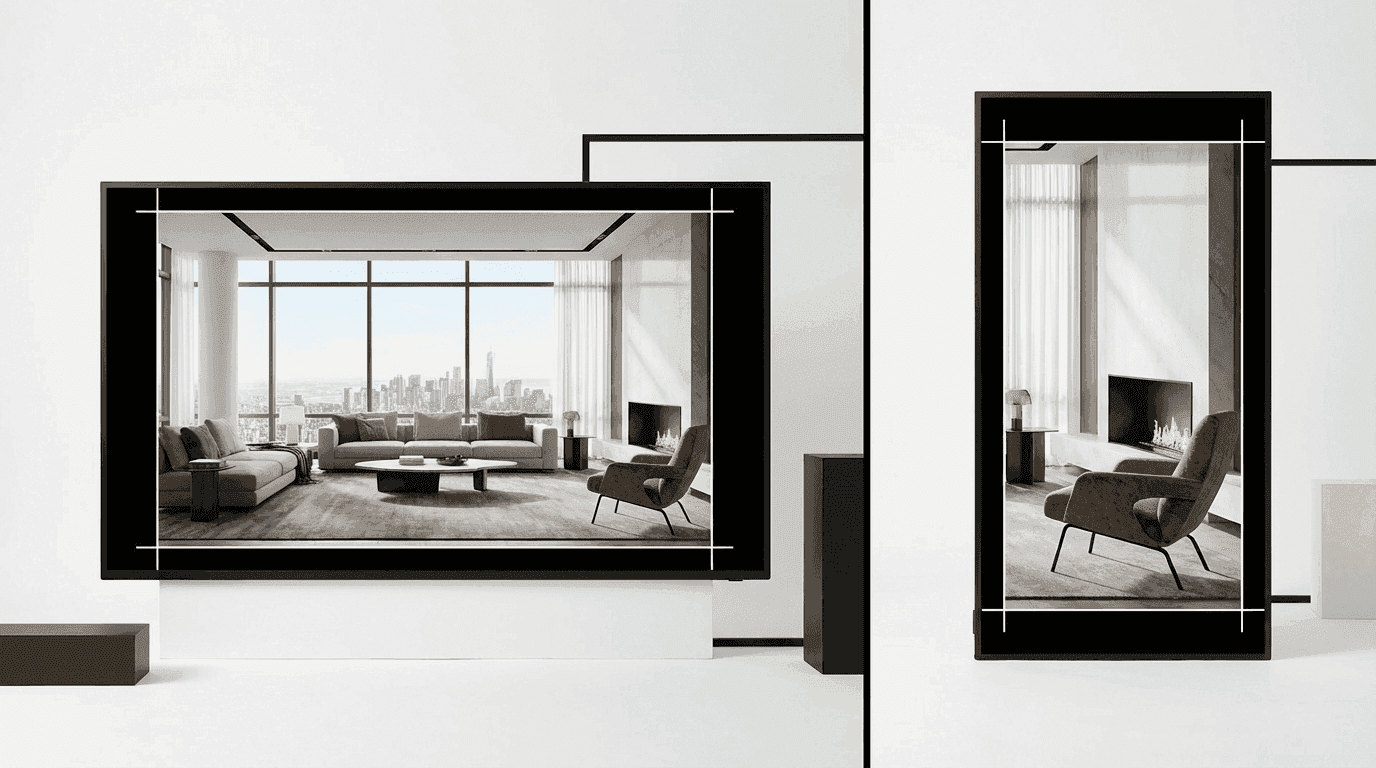
Wide-angle real estate photography captures rooms from wall to wall. The composition is intentionally wide to show the full scope of a space. When you crop a 16:9 image to 9:16, you remove the left and right 72% of the frame. Let that sink in for a moment. You are throwing away almost three-quarters of the image.
For a kitchen shot composed to show the island, the range, and the breakfast nook, a center crop shows only the island. The viewer has no sense of the room's size or layout. For a living room shot showing the fireplace on one side and the windows on the other, a center crop shows just the couch in the middle. Congratulations, you have created a video that features furniture instead of architecture.
The reverse (cropping vertical to horizontal) is equally bad. You lose the top and bottom of the frame, which in a vertical room shot means cutting off the ceiling details and the floor, making the room feel compressed and claustrophobic.
What Works Instead
The correct approach is to create each format independently with optimized composition for that aspect ratio. This means:
- For horizontal (16:9): Use the full-width composition from your listing photos. Show the room from wall to wall. Emphasize the spatial width and layout.
- For vertical (9:16): Frame the composition to emphasize height and depth. Show the room from floor to ceiling. Emphasize features that benefit from vertical space: vaulted ceilings, tall windows, two-story entries, staircase views.
Both compositions start from the same source photo, but the framing is different. This is exactly what AI video tools do when they generate multi-format output. Each variant is framed independently, not cropped from the other.
The Real Estate Video Format Matrix: What Goes Where
Here is the practical reference table for every distribution channel you should be using. Print this out and stick it next to your monitor. Or tattoo it somewhere. (I keep suggesting tattoos in these guides and so far nobody has taken me up on it. Probably for the best.)
Complete Distribution Format Guide
| Channel | Format | Branded? | Ideal Length | Purpose |
|---|---|---|---|---|
| MLS | 16:9 horizontal | Unbranded | 60 to 90 sec | Listing syndication |
| Zillow | 16:9 horizontal | Branded | 60 to 90 sec | Buyer discovery |
| Realtor.com | 16:9 horizontal | Branded | 60 to 90 sec | Buyer discovery |
| YouTube (tour) | 16:9 horizontal | Branded | 2 to 4 min | SEO + search |
| YouTube Shorts | 9:16 vertical | Branded | 15 to 30 sec | Discovery + reach |
| Instagram Reels | 9:16 vertical | Branded | 15 to 30 sec | Brand + leads |
| TikTok | 9:16 vertical | Branded | 15 to 30 sec | Discovery + reach |
| Facebook Reels | 9:16 vertical | Branded | 15 to 30 sec | Brand + leads |
| Email campaign | 16:9 horizontal | Branded | 30 to 60 sec | Direct engagement |
| Agent website | 16:9 horizontal | Branded | 60 to 90 sec | Listing page enhancement |
| Seller share | 16:9 horizontal | Unbranded | 30 to 60 sec | Seller's personal network |
Count the channels: 11 distribution points from each listing video set. Six require horizontal. Five require vertical. If you only create one format, you are effectively invisible on nearly half of these channels.
For complete technical specs (resolution, bitrate, file size, codec) for every platform in this table, see our social media video specs guide.
The Cost of Getting It Wrong
Let me quantify the damage of using the wrong format, because abstract advice like "use the right aspect ratio" does not hit as hard as actual numbers.
Scenario: Agent Uploads Only Horizontal Video to All Platforms
This is the most common approach I see. The agent creates one horizontal video and uploads it everywhere. Here is what happens:
| Platform | Correct Format? | Estimated Engagement Impact |
|---|---|---|
| MLS | Yes | Full engagement (baseline) |
| Zillow | Yes | Full engagement |
| Realtor.com | Yes | Full engagement |
| YouTube | Yes | Full engagement |
| Instagram Reels | NO | -35% to -50% views |
| TikTok | NO | -40% to -60% views |
| YouTube Shorts | NO | -30% to -50% views |
| Facebook Reels | NO | -25% to -40% views |
The agent is getting full value from property portals but hemorrhaging engagement on social media. Depending on their audience mix, this agent is leaving 30% to 50% of their total potential video engagement on the floor. Every month. For every listing.
Scenario: Agent Uploads Only Vertical Video to All Platforms
This is less common but I see it from agents who are very active on social media and forget about the professional channels:
| Platform | Correct Format? | Estimated Engagement Impact |
|---|---|---|
| MLS | NO | Looks broken. Black bars. Unprofessional. |
| Zillow | NO | Pillarboxed. Tiny video content area. |
| Realtor.com | NO | Same as Zillow. Poor presentation. |
| YouTube | NO | Works but looks amateur for long-form. |
| Instagram Reels | Yes | Full engagement |
| TikTok | Yes | Full engagement |
| YouTube Shorts | Yes | Full engagement |
| Facebook Reels | Yes | Full engagement |
This agent crushes social media but their MLS listing looks like it was filmed by someone who does not know how cameras work. Given that MLS is where the highest-intent buyers are, this is arguably worse than the horizontal-only approach.
Scenario: Agent Creates Both Formats
Full engagement everywhere. No wasted screen real estate. No black bars. No lost views. Every platform gets content optimized for its native experience. The agent maxes out their potential reach on every channel.
The math is straightforward. If creating both formats costs you 10 extra minutes (or zero extra minutes with tools that generate both automatically), and that prevents you from losing 30% to 50% of your social engagement, the ROI of multi-format content is essentially infinite.
How to Create Both Formats Without Losing Your Mind
The reason most agents only create one format is not stubbornness. It is time. Filming or editing two versions of every video sounds like doubling your production workload. Here are the three realistic approaches, ranked by effort.
Approach 1: AI Video Generation (Lowest Effort)
Upload your listing photos once. The AI generates horizontal and vertical video variants simultaneously. Both formats get independent framing optimized for their aspect ratio. No cropping. No manual editing. No doubling your timeline.
Reel-E, for example, generates four variants from one upload: horizontal branded, horizontal unbranded, vertical branded, vertical unbranded. Processing takes 90 seconds to 3 minutes for all four. You download each variant and distribute to the appropriate platforms. Total extra effort beyond creating one video: zero. The tool does it all in one pass.
This is my recommended approach for 90% of agents. Not because I built Reel-E (though I did), but because it is objectively the most time-efficient way to solve the multi-format problem.
Approach 2: Film Once, Edit Twice (Medium Effort)
Film your property walkthrough in 16:9 horizontal (the wider format gives you more flexibility). Then use an editing app like CapCut, InShot, or Adobe Premiere to create a separate 9:16 vertical edit. This is not a simple crop. You need to choose which part of each horizontal frame to show in the vertical version. For a room shot, you might center on the kitchen island rather than showing the full left-to-right composition.
This approach takes 15 to 30 minutes of additional editing per listing. The results can be good if you are skilled with the editing tool, but the vertical version will always be a reinterpretation of the horizontal footage rather than content created natively for vertical. You are working against the source material instead of with it.
Approach 3: Film Both (Highest Effort, Best Quality)
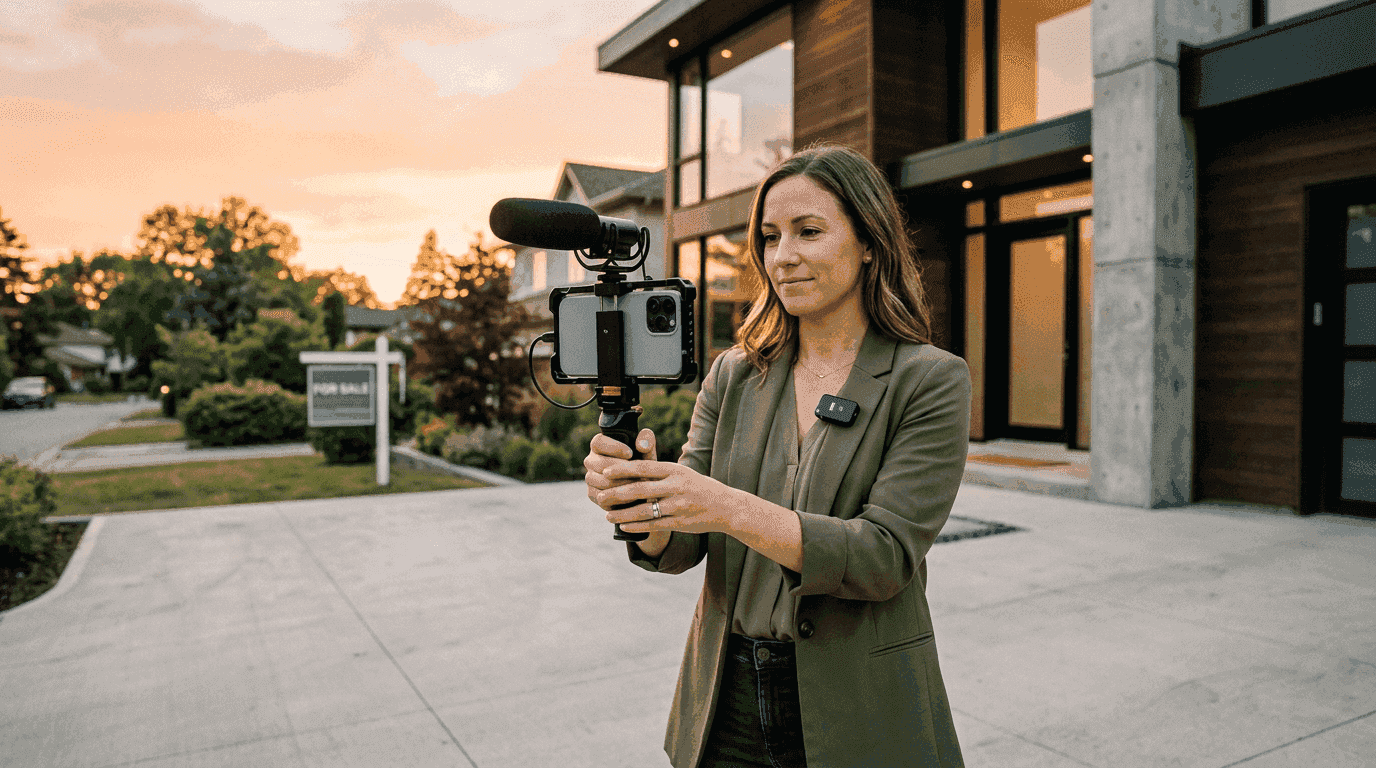
Walk through the property twice: once with the camera in landscape mode for horizontal, once in portrait mode for vertical. This gives you native compositions for both formats, with each walkthrough framed intentionally for its aspect ratio.
This approach takes double the filming time, plus additional editing time for both versions. For agents who film their own walkthrough videos (rather than using photos or hiring a videographer), this produces the best quality because both formats are filmed intentionally. The trade-off is time. At 20 to 30 minutes of filming per walkthrough, doubling that to 40 to 60 minutes per listing is a significant time investment.
The 4-Variant Strategy: Why Branded and Unbranded Matter Too
Format is only half the equation. The other half is branding. You need both branded (with your logo, name, and contact info) and unbranded (clean, no agent info) versions because different distribution channels have different rules.
The full set of variants every agent should have for each listing:
- Horizontal Branded (16:9 + your logo/contact): Zillow, Realtor.com, YouTube, email, website.
- Horizontal Unbranded (16:9, clean): MLS (most boards require unbranded), seller sharing.
- Vertical Branded (9:16 + your logo/contact): Instagram Reels, TikTok, YouTube Shorts, Facebook Reels.
- Vertical Unbranded (9:16, clean): Seller's personal social media, collaborative marketing.
Four variants per listing. That sounds like a lot of production until you realize that AI tools generate all four from one set of photos in under 3 minutes, or that the branding difference is just a logo and contact card appended to the end. The incremental effort of having all four is tiny compared to the distribution flexibility it gives you.
For more on building a complete multi-platform video marketing strategy, see our guide on social media videos for real estate.
Platform-Specific Tips for Each Format
Making Horizontal Video Work Best on MLS and Zillow
- Lead with the hero room. The first frame is often used as the video thumbnail on property portals. Make it the kitchen, the exterior at golden hour, or whatever room is the most visually striking.
- Keep the pace moderate. Buyers on MLS and Zillow have high intent. They want to see the property thoroughly. 3 to 5 seconds per room is ideal. Do not rush.
- Include all major rooms. Unlike social media (where you show highlights), MLS viewers expect a comprehensive tour. Kitchen, living room, primary suite, bathrooms, exterior, and any standout features.
- Add background music at a moderate level. Loud music feels aggressive on a listing page. Subtle, elegant music sets the right tone.
Making Vertical Video Work Best on Instagram and TikTok
- Hook in the first frame. Use your most jaw-dropping room or a text overlay that stops the scroll. "Wait until you see this kitchen" or "$2.1M and THIS is why."
- Keep it under 30 seconds. Social media viewers are browsing, not house hunting. Show the highlights, create desire, and include a call to action. Save the comprehensive tour for MLS.
- Use text overlays. 85% of social media users watch with the sound off. If your Reel only makes sense with audio, you are reaching 15% of your potential audience.
- Include trending audio when possible. Instagram and TikTok algorithms boost content that uses trending sounds. Swap your standard background track for a trending audio clip if it fits the vibe of the property.
- End with a CTA. "DM me TOUR" or "Follow for more homes in [city]." Social media viewers need to be told what to do next. Give them a clear action.
The Answer to the Question You Actually Came Here For
Horizontal or vertical? Both. Always both. Not because I want to sell you a tool that creates both (though I do have one of those, and it is pretty great). But because the platforms are not going to converge on a single format anytime soon. MLS will stay horizontal. Instagram will stay vertical. YouTube uses both. And your listings deserve to look their best everywhere.
The agents who are winning the attention game in 2026 are not the ones with the biggest marketing budgets or the fanciest cameras. They are the ones who create content in the right format for each platform, consistently, for every listing. That is a systems problem, not a talent problem. And systems problems have straightforward solutions.
If you are currently only creating one format, you are leaving 30% to 50% of your potential reach on the table. That is showings, leads, and ultimately commissions that go to the agent who bothered to create the vertical version you did not. The good news: fixing this takes minutes, not hours. Whether you use AI tools, manual editing, or double-filming, the extra effort is minimal compared to the distribution reach you gain.
Ready to stop choosing between horizontal and vertical and just create both? Start a free trial and see how AI generates all four variants from your listing photos in under three minutes. Your next listing deserves to look good on every screen.