A $400,000 listing can get away with photos and a slideshow. A $2,000,000 listing cannot. The seller knows it. The buyer knows it. And if you are the listing agent, you had better know it too.
I have watched hundreds of luxury listing presentations over the past two years, and the gap between agents who win the listing and agents who lose it almost always comes down to one thing: the marketing plan. Specifically, the video component of the marketing plan. When a seller is choosing between two agents with similar comps and commission rates, the one who pulls out a portfolio of cinematic listing videos is the one who walks out with the signed agreement.
This guide covers how top-producing luxury agents use video at the $2M+ level. We will get into production quality expectations, drone strategy, cinematic techniques, distribution to the right audience, ROI math, and where AI video tools fit into a luxury marketing budget. If you sell homes under $1M and want general video marketing advice, our video marketing for real estate guide is a better starting point. This one is specifically about high-end.
Why Video Is Non-Negotiable at the Luxury Level
Let me be blunt: if you are marketing a $2M+ listing without professional video in 2026, you are committing malpractice. Maybe not legally, but professionally. Luxury sellers expect it. Luxury buyers need it. And your competition is absolutely doing it.
Here is why video matters more at the high end than at any other price point.
Luxury Buyers Are Often Remote
At $2M+, a significant percentage of buyers are relocating from another city, state, or country. They are not driving past your open house sign on a Saturday afternoon. They are sitting in a penthouse in Singapore or a corner office in Manhattan, scrolling through listings on their phone during a meeting they are only pretending to pay attention to. Video is how they shortlist properties before booking a flight.
NAR data shows that 95% of international and cross-market buyers use video as a primary screening tool for luxury properties. Without video, your listing does not make their shortlist. Period. The property does not even get a chance to impress in person.
The Commission Justifies the Investment
On a $3M listing at 2.5% commission, the listing agent earns $75,000. Spending $3,000 on professional video production is 4% of that commission. On a $5M listing, the same $3,000 video is 2.4% of the commission. Compare that to a $400K listing where a $500 video is 5% of a $10,000 commission. The math simply works better at the high end.
I have talked to luxury agents who spend $8,000 to $15,000 on a single listing's marketing package (video, photography, brochure, dedicated property website). They consider it a cost of doing business, the same way a surgeon considers a $2,000 scalpel a cost of doing business. You would not want either of them cutting corners.
Sellers at This Level Evaluate Your Marketing
Luxury sellers interview multiple agents. They compare marketing plans side by side. The agent who shows up with a portfolio of cinematic videos from past listings signals competence, professionalism, and a willingness to invest in the outcome. The agent who shows up with "we will put it on MLS and do an open house" signals the opposite.
One luxury agent in Los Angeles told me she lost a $4.5M listing specifically because her competitor showed the seller a 3-minute cinematic video from a comparable property. The seller looked at her and said, "Can you do this?" She could not. She hired a videographer the next week. As she put it: "That listing cost me $112,000. The videographer cost me $4,000. I will never walk into a luxury listing presentation without a video portfolio again."
Research backs this up. According to a 2025 real estate video statistics compilation, listings with video receive 403% more inquiries than photo-only listings. At the luxury level, where one additional serious buyer can mean the difference between selling at ask and sitting on market for months, that multiplier is even more significant.
Production Quality: What $2M+ Buyers Expect
Luxury buyers have seen a lot of marketing. They are not impressed by a shaky iPhone walkthrough set to a royalty-free track that sounds like it belongs in an elevator. They have seen Super Bowl commercials, Netflix documentaries, and Apple product launches. Their baseline for "professional" is high, and your listing video needs to clear that bar.
Here is what constitutes professional quality at the luxury level.
Camera and Stabilization
Full-frame mirrorless cameras (Sony A7S III, Canon R5 C) paired with motorized gimbals (DJI RS 3 Pro) are the current standard. The full-frame sensor captures better low-light performance and shallower depth of field than crop sensors or action cameras. The gimbal eliminates the micro-jitters that make footage look amateurish.
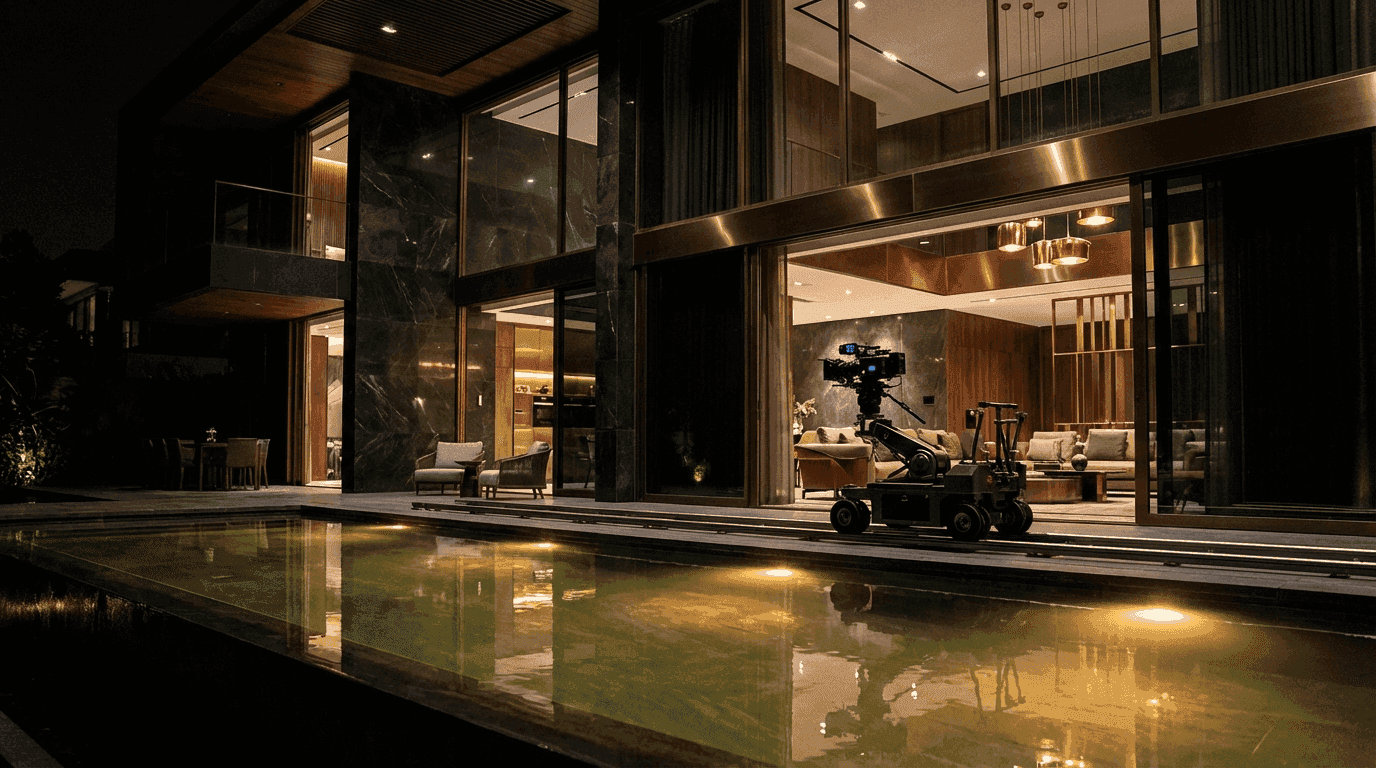
Some productions use slider rails for controlled lateral movements that feel more deliberate than handheld gimbal shots. For ultra-luxury properties ($10M+), cinema cameras like the RED Komodo or Blackmagic URSA Mini Pro deliver the absolute highest image quality, but the difference is marginal for most viewers.
The point is not to obsess over gear specs. The point is that buyers can feel the difference between professional and amateur footage, even if they cannot articulate what is different. Professional footage feels smooth, intentional, and cinematic. Amateur footage feels jerky, random, and rushed.
Lighting
Natural light is the foundation of good real estate video, but luxury properties often have spaces that need supplemental lighting: wine cellars, home theaters, interior bathrooms, walk-in closets, and hallways. A professional videographer brings portable LED panels and knows how to balance artificial fill light with natural window light so the footage looks warm and inviting without harsh shadows or blown-out highlights.
The biggest mistake amateur videographers make in luxury homes is not controlling the contrast between bright windows and dark interiors. This creates silhouette effects where the room looks dark and the windows are white rectangles. HDR video or careful exposure management fixes this.
Color Grading
Raw footage from a professional camera looks flat and desaturated by design. Color grading is the post-production process of adjusting colors, contrast, and tone to create a polished, cohesive look across the entire video. For luxury real estate, the grade should feel warm, inviting, and slightly elevated. Not the orange-and-teal look of a Marvel movie. More like the warm, rich tones of an Architectural Digest feature.
Color grading is one of those invisible elements that buyers cannot identify but absolutely respond to. Well-graded footage makes a home look aspirational. Poorly graded (or ungraded) footage makes the same home look ordinary.
Drone Footage: Strategy, Not Just Spectacle
Every luxury listing agent knows they need drone footage. Very few of them use it strategically. Most drone shots in luxury listing videos follow the same formula: start high, descend slowly toward the house. That is fine. It is also what every other agent does. Here is how to make drone footage actually work for the sale.
The Establishing Shot
The drone's primary job is context. Where does this property sit in the world? What is around it? A ground-level photo of a $4M home on a half-acre lot looks like any nice house. A drone shot of that same house reveals the private canyon behind it, the 100-year-old oak trees framing the lot, and the fact that the nearest neighbor is 200 yards away. Context sells luxury.
Start wide enough to establish the setting, then slowly push in toward the property. This gives the viewer a geographic story: "You are in the hills above the city, surrounded by mature trees, and this is your private estate." By the time the drone reaches the house, the viewer has already imagined the lifestyle.
The Feature Reveal
Use the drone to reveal outdoor features that ground-level shots cannot capture effectively. Pool complexes, outdoor kitchens, tennis courts, guest houses, vineyard rows, private docks. These features are selling points that deserve their own aerial moment. A slow orbit around an infinity pool overlooking the ocean is worth 10 ground-level photos of that same pool.
The Departure Shot
End the video with the drone pulling away from the property, ascending, and revealing the broader setting. This bookends the establishing shot and leaves the viewer with a sense of scale and grandeur. It is the video equivalent of the closing line in a great novel. You want the viewer to sit with that final image for a moment.
What Not to Do with a Drone
Do not fly directly over the roof. Nobody cares what the shingles look like from 200 feet. Do not do rapid fly-throughs between trees at high speed. This is a luxury listing, not a Star Wars chase scene. Do not linger on neighboring properties. The buyer does not want to see a neighbor's above-ground pool while touring a $3M estate. And please, for the love of everything, do not use dramatic swooping movements that make viewers motion-sick. Slow, smooth, deliberate. That is the luxury drone playbook.
Also, a quick regulatory note: commercial drone operation in the United States requires an FAA Part 107 Remote Pilot Certificate. Verify that your drone operator is licensed and insured. Flying without certification over a $5M property is a liability nightmare that no agent should accept.
Cinematic Techniques That Sell Luxury Homes
Good luxury video is not just about expensive equipment. It is about visual storytelling techniques that guide the viewer through the home with intention. Here are the techniques that top luxury videographers use consistently.
The Approach Sequence
Start outside. Show the driveway, the entry gate, the walkway to the front door. This mirrors the experience a buyer would have arriving at the property for the first time. It builds anticipation. The viewer is not just seeing rooms. They are arriving somewhere special.
Some of the best luxury listing videos I have seen start with a car pulling into the driveway. You see the gates open. You hear gravel under tires. The front door opens. You are not watching a video anymore. You are visiting a home. That is the emotional response you want.
Room-to-Room Flow
Do not jump randomly between rooms. Move through the house the way a person would actually walk through it. Entry to living room. Living room to kitchen. Kitchen to family room. Then upstairs to bedrooms. Then back down to the outdoor space. The spatial continuity helps the viewer build a mental map of the home, which is critical for remote buyers who may need to make an offer without visiting in person.
Transitions between rooms should feel natural: passing through a doorway, moving around a corner, following a hallway. Hard cuts between disconnected rooms break the sense of physical space. Some productions use long, unbroken tracking shots through multiple rooms. These are technically challenging but incredibly effective at conveying the home's flow.
Detail Shots
Luxury homes have details worth showcasing. Custom millwork. Imported stone countertops. Hand-forged hardware. Heated floors. Built-in cabinetry. These details justify the price point, and a 3-second close-up of the kitchen's La Cornue range or the bathroom's Calacatta Gold marble tells the buyer: "This home was built with intention." Without detail shots, a $5M home looks like a nice $800K home. The details are the difference.
Lifestyle Moments
The most effective luxury videos show the home in use. Not with actors hamming it up in staged scenes (nobody is fooled by that), but with subtle environmental storytelling. A fire in the outdoor fireplace. Wine glasses on the terrace at sunset. Steam rising from the heated pool on a cool morning. A book open on the reading nook. These small touches activate the buyer's imagination. They stop thinking "what a nice house" and start thinking "what would my life feel like here?"
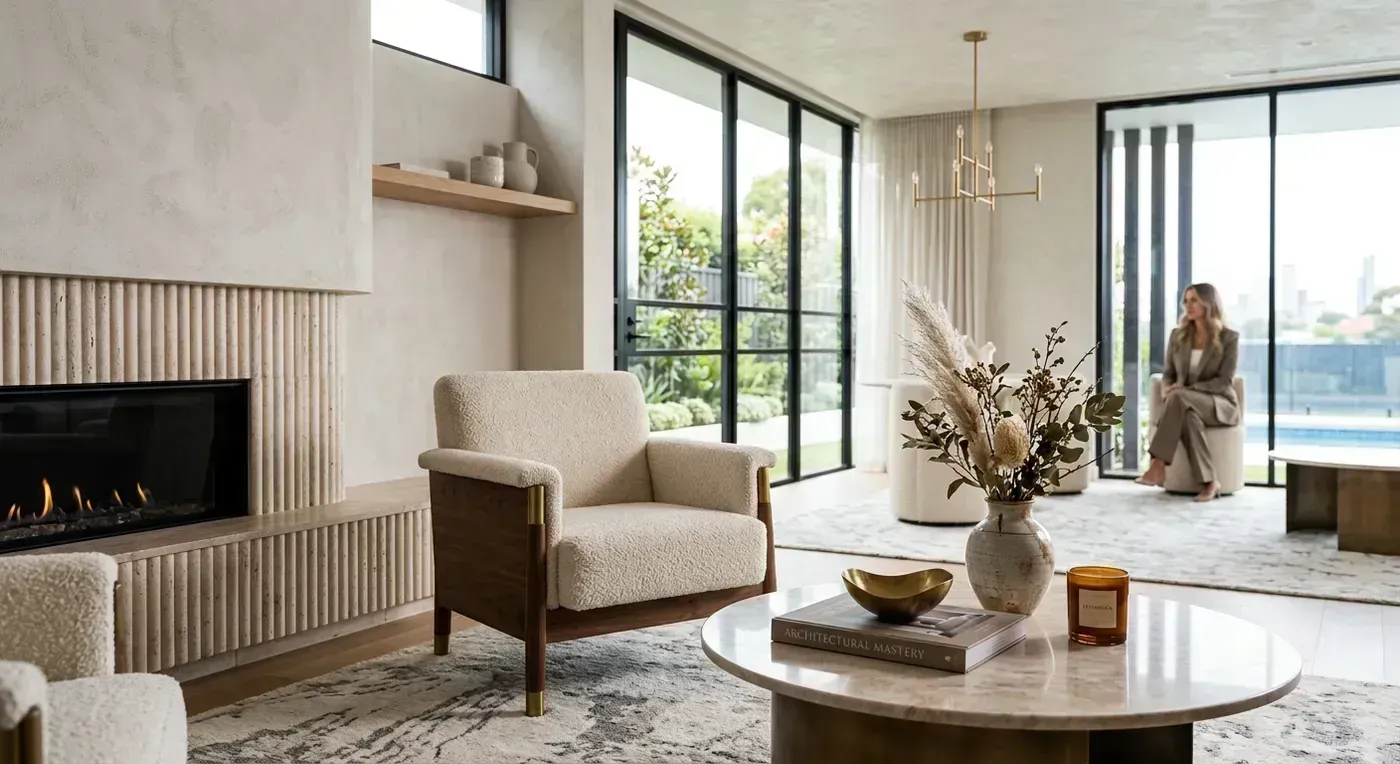
Here is an example of cinematic property video that brings these techniques together:
The Luxury Video Production Process: Step by Step
If you have never produced a luxury listing video before, here is the standard workflow that top agents and their production teams follow.
Pre-Production (1 to 3 Days Before Shoot)
- Scout the property: Visit the home before the shoot day to identify the best angles, natural light timing, and any logistical challenges (tight hallways, mirror walls, dark rooms that need supplemental lighting).
- Plan the shot list: Write down every shot you want, in the order you will capture them. Include drone shots, interior walkthrough path, detail close-ups, and any lifestyle moments. A 2-to-3-minute video typically requires 25 to 40 individual shots.
- Schedule the shoot time: Golden hour (the hour before sunset) provides the warmest, most flattering natural light. Twilight (30 minutes after sunset) is ideal for exterior shots with interior lights on. Morning light works well for east-facing rooms. Avoid midday shoots when overhead sun creates harsh shadows.
- Prepare the home: Work with the seller (or their stager) to ensure the home is show-ready. Remove personal items, clutter, and anything that distracts from the home's features. Turn on all interior lights. Open blinds and curtains on the camera-facing side of rooms.
Shoot Day (3 to 5 Hours)
- Drone footage first (30 to 60 minutes): Capture aerials while conditions are ideal (calm wind, good light). Include establishing wide shots, feature reveals, and the departure shot.
- Interior walkthrough (1.5 to 2.5 hours): Shoot the planned shot list in sequence. Multiple takes of key rooms. Detail shots of premium features. The videographer should capture 3x to 5x more footage than the final video will use.
- Twilight exteriors (30 minutes): If the budget allows, stay until twilight for dramatic exterior shots with warm interior lighting visible through windows.
Post-Production (3 to 7 Business Days)
- Selects and assembly (Day 1 to 2): The editor reviews all footage, selects the best takes, and assembles a rough cut in sequence.
- Color grading (Day 2 to 3): Apply a consistent color grade across all footage. Correct exposure, white balance, and contrast.
- Music and sound design (Day 3 to 4): Select and license appropriate music. Sync transitions to musical beats. Add subtle ambient sound if appropriate.
- Text and graphics (Day 4 to 5): Add property details, agent branding, contact information, and any text overlays. Keep graphics minimal and elegant.
- Review and revisions (Day 5 to 7): Send the draft to the listing agent for feedback. Expect 1 to 2 rounds of revisions on pacing, music, and shot selection.
Distribution: Getting Luxury Video in Front of the Right Buyers
A beautiful luxury listing video sitting on YouTube with 47 views is a waste of $4,000. Distribution is half the battle, and luxury distribution is fundamentally different from standard residential. You are not trying to reach everyone. You are trying to reach the 200 people on the planet who can actually buy this home.
YouTube: The Long-Term Asset
Upload the full-length video (2 to 4 minutes) to YouTube with an SEO-optimized title. Include the address, neighborhood, city, price, and key features in the title and description. "123 Oceanview Drive | $4.2M | 5 Bed 6 Bath | Pacific Palisades Modern Estate." YouTube is a search engine, and luxury buyers actively search for homes on it. A well-optimized listing video can generate qualified views for months.
Dedicated Property Website
Every $2M+ listing should have its own website. Not a listing page on your brokerage site. A standalone URL (like 123OceanviewDrive.com) with the video as the hero, professional photos, floor plans, neighborhood information, and a contact form. The video auto-plays (muted) when the page loads. This is the URL you include in all marketing materials, email campaigns, and paid ads.
Social Media (Platform-Specific Cuts)
Do not post the same video on every platform. Create platform-specific cuts:
- Instagram Reels / TikTok: 30 to 60 seconds, vertical 9:16, the most visually striking moments with text overlays showing key details. This is your discovery content designed to reach new audiences.
- Instagram Feed / Facebook: 60 to 90 seconds, square or horizontal, with a more polished, editorial feel. This targets your existing network and their connections.
- LinkedIn: 60 to 90 seconds, horizontal. Yes, LinkedIn. High-net-worth individuals use LinkedIn, and luxury listing posts perform surprisingly well there because most agents never think to post on the platform. Less competition, high-quality audience.
Targeted Email Campaigns
Send the video (embedded or linked) to your network of qualified buyers, relocation agents, wealth managers, and international buyer agents. Segment your list. A $3M waterfront home in Miami should go to buyers who have expressed interest in waterfront properties, Florida relocations, or similar price points. A spray-and-pray approach to your entire database is lazy and ineffective. And your $400K buyer leads definitely do not need to see a $3M listing in their inbox.
Luxury Portals and Syndication
Syndicate the listing (with video) to luxury-specific platforms: Mansion Global, LuxuryRealEstate.com, James Edition, Sotheby's International Realty network (if applicable), and Christie's Real Estate network. These platforms attract high-net-worth buyers who are specifically searching for luxury properties. Most of these portals support video embedding, and listings with video get significantly more engagement than photo-only listings.
Paid Advertising
For ultra-luxury properties ($5M+), consider running the video as a paid ad on YouTube and Instagram. Target by income level, interests (luxury travel, fine dining, high-end automobiles), and geography (feeder markets where your buyers typically come from). A $500 to $2,000 ad budget can put the video in front of thousands of qualified viewers. The CPM (cost per thousand views) for luxury-targeted ads is higher than general audiences, but the audience quality more than compensates.
ROI Math: Does Luxury Video Pay for Itself?
Let me run the numbers three different ways, because abstract claims about "increased inquiries" do not pay for a $4,000 video production.
Scenario 1: Faster Sale
A $3M property that sits on market for 90 days instead of 60 days carries real costs. Mortgage payments ($12,000 to $15,000/month at current rates), insurance, utilities, maintenance, and the psychological toll on the seller. Every month on market costs the seller roughly $15,000 to $20,000 in carrying costs. If professional video reduces days on market by even 15 days (and the data from our video listings sell faster analysis suggests the reduction is often larger), that is $7,500 to $10,000 in savings for the seller. Your $4,000 video just paid for itself and then some.
Scenario 2: More Competitive Offers
More exposure means more buyers. More buyers mean more competition. More competition means higher offers. If professional video attracts just one additional serious buyer who pushes the final sale price up by 1%, that is $30,000 on a $3M property. Your $4,000 video just generated a 7.5x return. And the seller remembers that you are the agent who got them $30,000 more than they expected.
Scenario 3: Listing Acquisition
This is the ROI that most agents overlook. Professional video is not just about selling the current listing. It is about winning the next one. When you show a $4M seller a cinematic video you produced for your last luxury listing, you are demonstrating capability that most agents cannot match. If that portfolio helps you win one additional luxury listing per year, the ROI is not 7.5x. It is infinite. You spent $4,000 on a video. You won a listing that earned you $100,000+ in commission. Good luck finding a better return on investment than that.
Where AI Video Fits in the Luxury Toolkit
I am going to be honest about something that might seem counterintuitive coming from the founder of an AI video platform: AI video from photos should not be the primary video asset for a $2M+ listing. Not in 2026, anyway.
Professional videography with drone footage, gimbal walkthroughs, and expert color grading still delivers a level of quality that AI-generated motion from photos cannot fully replicate. The parallax effects are good. They are not "fly a drone over a $5M estate and orbit the infinity pool at sunset" good. Not yet.
But here is where AI video becomes incredibly valuable for luxury agents.
Supplemental Social Content
Your videographer delivered a 3-minute hero video. Beautiful. Now you need 6 Instagram Reels, 4 TikToks, 3 Facebook posts, and 2 LinkedIn videos over the next 30 days while the listing is active. Are you going to hire the videographer back every week for new content? Of course not. But you have 40 professional photos from the photographer.
Upload those photos to Reel-E, and you have fresh video content in minutes. Different photo selections, different music, different pacing. Each version feels like a new piece of content even though it is the same property. This is how luxury agents maintain a steady stream of listing promotion without paying for repeated production days.
Speed to Market
The videographer needs 5 to 7 days for post-production. But you want to announce the listing immediately. Upload the professional photos to an AI video tool and have social media content ready the same day the photos are delivered. Use the AI-generated content to build anticipation while the full production video is being edited. When the hero video is ready, release it as the main event.
Coming Soon Teasers
Many luxury agents market properties as "coming soon" before they officially hit MLS. AI video from a handful of preview photos creates compelling teaser content that generates early interest without the expense of a full production shoot for a property that is not yet on market.
Volume Listings Under $2M
Most luxury agents do not exclusively sell luxury. They have $800K listings, $1.2M listings, $600K listings. These properties do not justify a $4,000 video production, but they absolutely benefit from professional-looking video content. AI video is perfect for this tier: Reel-E's Pro plan handles up to 50 listings per month at $599, making it economical to provide video for every listing regardless of price point. Save the big production budget for the properties that need it. Use AI for everything else.
Building a Luxury Video Portfolio
The most successful luxury agents treat video as a cumulative asset, not a one-time expense. Every listing video you produce becomes part of a portfolio that you use to win future listings. Here is how to build that portfolio strategically.
Start with Your Best Listing
If you have never produced a luxury listing video before, invest in a full production for your most impressive current or upcoming listing. This becomes your proof-of-concept piece, the video you show in every listing presentation for the next year. Even if this first video costs $5,000, the return comes from every listing it helps you win.
Create a Highlight Reel
After you have 3 to 5 luxury listing videos, edit together a 60-to-90-second highlight reel showing your best moments across multiple properties. This becomes the opening of every listing presentation: "Here is what your marketing will look like when you work with me." It is far more persuasive than a slide deck showing sold prices and days on market.
Archive and Organize
Keep every listing video organized by property type, price point, and architectural style. When you meet with a seller who has a modern waterfront home, you can pull up the video from the last modern waterfront home you sold. Relevance is persuasive. A seller wants to see that you have marketed a similar property successfully, not just any property.
Common Mistakes in Luxury Listing Video
I have watched enough luxury listing videos to fill several lifetimes (occupational hazard), and these mistakes show up with depressing regularity.
- Using stock music that sounds cheap. Nothing undermines a $4M listing faster than a music track that sounds like it was composed in GarageBand during a lunch break. Invest in quality licensed music that matches the property's personality. A contemporary home needs contemporary music. A historic estate needs something more classical. A beachfront property needs something relaxed and organic. This is not the time for "Motivational Corporate Background Music #47."
- Over-editing. Rapid-fire transitions, lens flares, dramatic color shifts, and text animations belong in a music video, not a luxury listing video. The best luxury video editing is invisible. The viewer should feel like they are walking through a beautiful home, not watching a reel of visual effects. If the viewer notices the editing, the editing is too aggressive.
- Ignoring the outdoor space. I have seen $5M listing videos that spend 2.5 minutes on the interior and 10 seconds on a half-acre backyard with an outdoor kitchen, pool, and mountain views. If the outdoor space is a significant selling point (and at this price, it usually is), give it proportional screen time.
- No branding or contact information. Your $4,000 video should include your name, brokerage, phone number, and website. But tastefully. A small, elegant lower-third graphic that appears briefly, not a flashing banner ad that covers a third of the screen.
- Wrong aspect ratio for the platform. A horizontal 16:9 video uploaded to Instagram Reels with black bars above and below is a wasted opportunity. Always create platform-specific cuts. Or use a tool that generates multiple formats automatically.
Hiring a Luxury Real Estate Videographer
Finding the right videographer is not like finding a wedding videographer who happens to own a drone. Luxury real estate video requires specific skills, equipment, and experience. Here is what to look for.
Portfolio Quality
Ask to see their real estate-specific portfolio. Watch at least 5 videos. Look for smooth camera movement, clean color grading, appropriate pacing, and good music selection. If their portfolio is all weddings and corporate events with one real estate video, keep looking.
Equipment
They should own (not rent) a full-frame camera body, a motorized gimbal, professional LED lighting, and a commercial-grade drone. Renting equipment for each shoot adds cost and increases the chance of unfamiliar gear causing issues on shoot day.
FAA Part 107 Certification
Non-negotiable for any commercial drone work. Ask to see their certificate. If they do not have one, they are operating illegally, and you do not want your luxury listing associated with an FAA violation.
Pricing Structure
Expect $1,500 to $5,000 for a standard luxury production (drone, interior walkthrough, color grading, editing, licensed music). Prices vary significantly by market. Los Angeles, New York, and Miami are at the top of the range. Smaller luxury markets may be lower. Some videographers offer per-listing pricing, while others offer monthly retainer packages for agents with consistent volume.
Turnaround Time
Standard turnaround is 5 to 7 business days. Some videographers offer rush delivery (2 to 3 days) for an additional fee. Avoid videographers who promise same-day delivery for a full production. Quality editing takes time. If they are delivering a finished product in 24 hours, corners are being cut.
Luxury Video in 2026 and Beyond
Luxury video production is evolving quickly. Here is where I see it heading.
Virtual staging in video: AI will soon be able to virtually furnish empty rooms in video, not just photos. An empty luxury home will be shown fully furnished in the listing video without a single piece of real furniture. This is already possible in static images and will reach video quality within a year.
Interactive video tours: Imagine a video where the viewer can click to explore a room in more detail, check material specifications, or see the view from a specific window. This "choose your own adventure" format for luxury listings is in early development and will change how remote buyers evaluate properties.
AI-enhanced production: Even traditional videographers will use AI in post-production. Automatic color grading, AI-generated camera stabilization, and intelligent clip selection will reduce editing time and cost while maintaining or improving quality.
The constant through all of this: video is not going away. It is becoming more essential, more sophisticated, and more expected at the luxury level. The agents who invest in video now are building a competitive advantage that compounds over time.
Getting Started
If you are a luxury agent who has been relying on photos and open houses, here is your action plan:
- This week: Research and interview 2 to 3 real estate videographers in your market. Review their portfolios and get pricing.
- This month: Invest in a full video production for your best current or upcoming listing. Use this as your portfolio anchor.
- Ongoing: Use AI video tools for supplemental social content, non-luxury listings, and speed-to-market teasers. Reel-E's free trial lets you test the output with real listing photos before committing.
- Every listing presentation: Open with your video portfolio. Show sellers what their marketing will look like. Let the video do the selling before you do.
The luxury market rewards agents who market with the same quality their sellers expect in their homes. A $3M home with $300 marketing looks like an agent who does not care. A $3M home with $3,000 to $5,000 in professional video looks like an agent who takes the outcome seriously.
Your sellers are watching. Your competitors are investing. The buyers are searching. Make sure they find your listing first, and make sure what they find is worth watching.
For the data behind video's impact on listing performance, explore our real estate video statistics analysis. And for agents who want to start generating video content immediately while building their professional video portfolio, our video marketing for real estate guide covers the full strategy from first video to consistent content engine.