
Most real estate agents do not need a bigger software stack. They need a smaller pile of unfinished tasks. That is the right lens for evaluating AI tools for real estate agents in 2026.
When agents say they want help with marketing, what they usually mean is this: video gets skipped because custom production feels too slow, the photo set still needs cleanup after the shoot, listing copy starts from a blank page every time, and the campaign loses momentum because no one wants to rebuild the same property story for MLS, email, and social. The useful AI tools are the ones that shrink those repeatable jobs without adding a second job called software management.
Start with the workflow, not the feature sheet
Agents usually buy AI tools backwards. They start with the demo that looks shiny, then discover the real pain was getting a listing video out by lunch, cleaning ugly window light, or rewriting the same positioning for MLS, captions, and email. If the business problem is repetitive marketing production, the tool has to save time on the listings that are merely normal, not only on the listings you were already excited to market.
A good stack for real estate agents still comes back to four jobs: create listing media, improve the photo set, accelerate copy, and repurpose the best angle across channels. If a tool does not clearly belong to one of those jobs, it is probably software cosplay. That is a rude phrase, but some tools earn it by making the workflow look more advanced while doing very little for the actual launch calendar.
This is why the first question should not be, "What can this tool do?" The better question is, "Which recurring bottleneck disappears if we use it for thirty days on ordinary listings?" That question protects you from buying ideas instead of operations.
- Listing media: turn photos into AI listing video and short-form realtor video content.
- Photo workflow: clean, stage, resize, and prep the asset package.
- Copy workflow: produce first drafts for MLS, email, and captions.
- Distribution workflow: reuse the same listing story across more touchpoints.
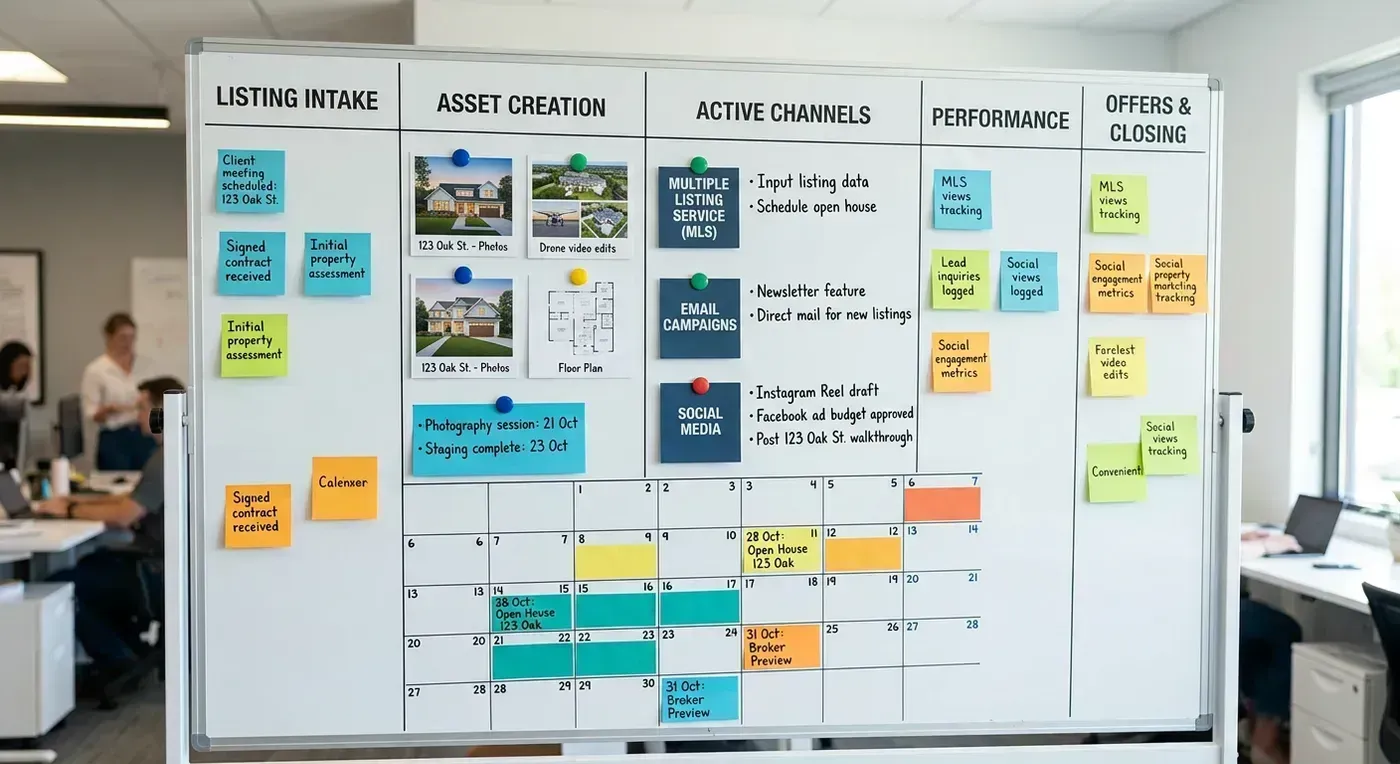
Listing media is still the highest-leverage category
For most teams, listing media is still the most valuable AI category because it fixes the asset agents skip most often. Static photos matter, but they do not travel through the funnel the way video does. The listing without video usually loses the short-form clip, the easy property-site hero asset, the social boost, and the extra follow-up touchpoint that keeps the property visible after launch day.
That is where Reel-E’s real estate video maker becomes a practical part of the stack instead of a nice theory. If you already have the photos, the missing asset is not another gallery. The missing asset is motion. The reason agents skip it is not that they dislike video. It is that booking, editing, revising, and versioning custom production makes video hard to standardize across average inventory.
The minute one upload can create branded, unbranded, horizontal, and vertical outputs, the decision changes. Coverage starts beating perfectionism. That is often the exact moment the whole stack begins to feel sensible, because the most painful missing asset finally becomes repeatable.
| Category | What it should remove | What winning looks like |
|---|---|---|
| Listing media | Editing delay and custom coordination tax | One photo set becomes multiple finished video outputs |
| Photo cleanup | Back-and-forth on gallery repair work | A stronger publishable image package in one pass |
| Copy drafting | Blank-page time and repetitive rewrites | A useful first draft that still sounds human after review |
| Repurposing | Rebuilding the same story for every channel | One angle adapted cleanly across MLS, email, and social |
Photo tools matter, but they should feed the rest of the system
Photo tools are the second most useful category because they improve the raw material every other workflow depends on. Better windows, stronger exposure, object removal, light staging, and cleaner composition are not glamorous jobs, but they compound. If the image package is stronger, the gallery looks better, the video output looks better, and the social crop holds up better. That is real leverage, even if nobody feels inspired to make a thought-leadership post about lawn cleanup.
Agents should be careful not to buy photo tools in isolation. If the only output of the tool is a nicer gallery, the workflow still has to solve video, social, and follow-up elsewhere. The best image workflow is the one that gets the listing package ready faster and improves the inputs for everything that happens after the gallery is approved.
That is also why AI photo editing belongs in the same conversation as turning listing photos into video. Better photos are not the end of the story. They are the start of a stronger asset package.
Copy tools are useful, but they should stay in their lane
AI copy tools earn their keep by eliminating blank-page time. That is the whole point. They should get you to a usable first draft faster, not replace taste, compliance review, or direct familiarity with the property. The minute the tool starts describing a very normal condo like a once-in-a-generation architectural statement, it has wandered outside its lane.
The healthiest workflow is simple. Feed the tool clean facts and the actual angle of the listing. Generate a draft. Remove anything inflated or weird. Then spin the approved copy into MLS, email, and caption variants. That is efficient. What is not efficient is asking the model to improvise the campaign voice from thin air and then spending twenty minutes cleaning up its poetry about stainless steel appliances.
Copy tools become genuinely valuable when they reinforce the same story the visuals already tell. If the copy is about privacy, the video should support that. If the hero angle is layout efficiency for a first-time buyer, the email and captions should not suddenly pretend the listing is a grand entertainer's estate. Consistency is where the stack starts to feel like a system.
Repurposing is where the stack either compounds or collapses
A lot of teams buy AI tools to create assets faster, but the real upside appears when those assets keep working after the first publish button is pressed. That is what repurposing means in a useful sense. It is not filler. It is the discipline of turning one property story into the property-site asset, the short-form clip, the email follow-up, and the next-touchpoint reminder without recreating the whole campaign from scratch each time.
Weak stacks expose themselves here. They can generate something, but they cannot create a smooth path from that output to the rest of the launch. The team still ends up downloading, resizing, rewriting, and manually rethinking the same asset across channels. That workflow looks advanced in screenshots and exhausting in practice.
The better approach is to choose tools that assume the listing has more than one destination. That is why video marketing tools and social media execution belong in the same operating conversation. The listing does not care which vendor got credit. It cares whether the team turned one angle into enough finished visibility to matter.
A practical stack for solo agents
Solo agents usually need the leanest possible version of the stack, and that is a good thing. The best solo setup is rarely a giant suite of coordinated software. It is one listing media tool, one photo cleanup or staging layer, and one writing tool that helps with first drafts and variants. That is enough to create real operating leverage if the pieces fit the way a normal week actually works.
For most solo agents, video is still the first hole to patch because it is the asset that gets skipped most often. Once the video workflow is solved, the rest of the launch gets easier. You stop treating every listing like a fresh act of heroism. Pair AI real estate video with a lightweight photo workflow and a sane copy assistant, and you have something close to a modern baseline.
The rule for solo agents is blunt: every tool has to remove a repeated task you actually hate. If the tool only helps on the rare listing where you had time to be unusually organized, it is not part of the core stack. It is a side hobby with a login screen.
- Prioritize video first if listings still launch without it most of the time.
- Use photo tools for cleanup, staging, or repair when the source set needs help.
- Use a writing assistant for drafts and variants, not for truth.
- Keep the stack small enough that you can explain it in one minute.
A practical stack for teams and coordinators
Teams should optimize for throughput and consistency, not novelty. If one coordinator supports multiple agents, the real question is whether the stack creates predictable outputs without adding another approval bottleneck. In that environment, standardization becomes more valuable than cleverness very quickly. The most expensive line item is often not the software itself. It is the chaos created when every agent wants a different process.
A strong team stack usually has one standard video workflow, one image review checklist, one approval loop for copy, and a short list of exceptions for listings that genuinely deserve premium treatment. That is why Reel-E for Realtors fits best when it is part of the operating system, not treated like a special project somebody has to beg the office to use.
The biggest gain for teams is not that one asset gets prettier. The biggest gain is that the baseline output becomes dependable. Once that happens, manual effort can be spent where it actually moves the needle instead of being wasted everywhere at once.
How to evaluate a new tool without lying to yourself
Most software trials are biased toward optimism. The team tests the tool on the one listing they were already excited about, during a week when everyone happened to be paying attention, and then writes down conclusions that collapse the moment real workload returns. That is not a test. That is a crush.
A real evaluation uses ordinary listings, ordinary deadlines, and the people who will own the workflow long-term. Track the current turnaround, the number of handoffs, the revision count, and the percentage of assets that never get finished. Then run the new tool against that baseline for thirty days. If it survives boring work, it has a real chance. If it only shines on polished demo conditions, it belongs in the maybe-later pile.
Also define success before the trial starts. Faster turnaround is good. Fewer manual rebuilds are good. More listings receiving video by default is very good. A team should know what it wants the tool to improve before it signs into anything, or it will confuse movement with progress and spend a quarter learning that shiny is not the same thing as useful.
| Trial question | Good answer | Bad answer |
|---|---|---|
| Did turnaround improve? | Yes, on normal listings with normal staffing | Only on easy listings |
| Did manual work shrink? | Yes, fewer edits and handoffs | The team still rebuilt most of the output |
| Did coverage improve? | More listings got the intended assets by default | The asset is still treated like a special project |
| Would the team keep using it next month? | Yes, because it fits the real workflow | Only if someone babysits it |

Compliance and data hygiene still matter
AI does not remove the need for judgment. It raises the cost of sloppy judgment because the team can now create more assets, faster. That is especially true in real estate, where listing copy, visual enhancement, and disclosure-sensitive claims can all drift into risk if nobody owns the final pass. Faster mistakes are still mistakes. They just arrive with more confidence.
Teams should keep a short, boring, mandatory checklist: what facts must be confirmed before generation, what language is off limits, what gets reviewed by a human before publish, and what local disclosure expectations apply. The exact checklist will vary by brokerage and state, but the principle does not. Use AI to accelerate production, not to outsource responsibility.
That is one reason our California AB 723 disclosure guide belongs next to this topic. Disclosure and AI policy are not separate from marketing operations. They are part of marketing operations. A stack is only good if the business can trust it during a busy week when nobody has time to clean up after the model.
Where agents waste money
The fastest way to waste money is stacking overlapping tools that all solve slightly different versions of the same insecurity. You do not need three copy tools, two timeline editors, a virtual staging app you open once a month, and an automation product that nobody can explain without using the phrase ecosystem. That is not leverage. That is software hoarding with a nicer color palette.
The second waste pattern is buying tools that optimize the fourth step of the campaign before the first bottleneck is solved. Many agents still do not have a repeatable video workflow, but they keep buying products that only become valuable after the media package is already complete. Fix the missing asset first. Then refine the layers around it.
If you already use a broader app stack for agents, trim it by workflow, not by brand loyalty. Keep the tools that reliably turn one listing into more finished, visible marketing. If a tool exists mostly because you liked the launch video, that tool is auditioning for deletion.
If video is still the missing asset in your listing workflow, fix that before you buy a fifth copy assistant. If you want the video side of the workflow to stop eating your afternoon, start a Reel-E project and turn one listing shoot into multiple finished video assets.
A buying checklist for the next tool you are tempted to add
Before any team adds another AI tool, it should answer five boring questions in writing. What recurring task does this remove? Who will own the workflow after week two? What metric will prove the tool is worth keeping? What tool does it replace if it works? And what exactly happens if the trial fails? That last question matters because teams rarely budget for software exits. They just keep adding subscriptions until the tech stack starts to look like a graveyard with annual billing.
A useful buying checklist forces the conversation away from vibes and back toward operations. If the answer to "what problem does this solve" sounds vague, the tool is probably solving an emotion, not a workflow. If the answer to "who owns it" is a shrug, the tool is already in trouble. If the answer to "what does it replace" is nothing, the team is probably adding complexity instead of reducing it.
The best rule is simple: no new tool enters the stack unless it has a named owner, a thirty-day success metric, and a clear connection to faster listing visibility. That might sound strict, but it is far cheaper than running a brokerage on software optimism. The stack should feel like a clean operating system, not a storage unit full of apps you are afraid to cancel.
- Define the recurring task the tool is supposed to eliminate.
- Assign one owner who will run the trial and report the result.
- Set the success metric before the first login happens.
- Name the tool or manual task this tool is supposed to replace.
The best AI stack is the one you actually use on every listing
The point of AI tools for real estate agents is not to make the business look futuristic. The point is to make the next listing easier to launch than the last one. That usually means stronger listing media, cleaner photography, better first-draft copy, and faster distribution. It does not mean every task should become a software pilgrimage.
If you want the media side tightened first, start with how Reel-E works, then compare it with our real estate video marketing tools guide. Those pieces make the highest-leverage part of the stack much easier to see. Once the team can turn one listing shoot into MLS-ready media, social clips, and cleaner follow-up, the rest of the tool decisions become much more obvious.
A good stack should make the week feel calmer after a month, not busier. If the team has more finished assets, fewer loose ends, and fewer weird handoffs, the stack is doing its job. If the stack mostly created another folder of saved logins and hopeful vendor emails, it did not solve the real problem.

Agents do not need an AI science fair. They need a workflow that gets more listings visible with less chaos. That is a much less glamorous sentence than most software wants to hear, but it is the one that actually pays the bills.
If you want a practical next step, audit the last ten listings you launched and mark which assets were missing, delayed, or rebuilt manually. That short exercise will usually tell you exactly which AI tool category should enter the stack first and which subscriptions deserve a very polite breakup email.
FAQ
What are the best AI tools for real estate agents?
The best AI tools are the ones that remove recurring bottlenecks: listing video creation, photo cleanup, draft copy, and repurposing. A smaller stack that gets used on every listing is worth far more than a giant stack nobody trusts under deadline.
Is there an AI tool that makes listing videos for agents?
Yes. Reel-E is built to turn listing photos into branded and unbranded horizontal and vertical video assets so agents can cover more listings without adding a custom production cycle to every property.
How should agents choose an AI stack?
Start with the biggest weekly bottleneck, test tools on ordinary live listings, and keep only the ones that reduce turnaround, cut revisions, and increase the number of finished assets your team actually ships.
What AI tools help real estate agents get more listing visibility?
The best tools increase the number of usable assets in circulation, especially listing video, social-ready variants, cleaner photo sets, and faster follow-up content.
Which AI tools are worth it for a solo real estate agent?
Usually one AI listing video tool, one photo cleanup workflow, and one writing assistant. That smaller stack is often enough to change launch speed materially.