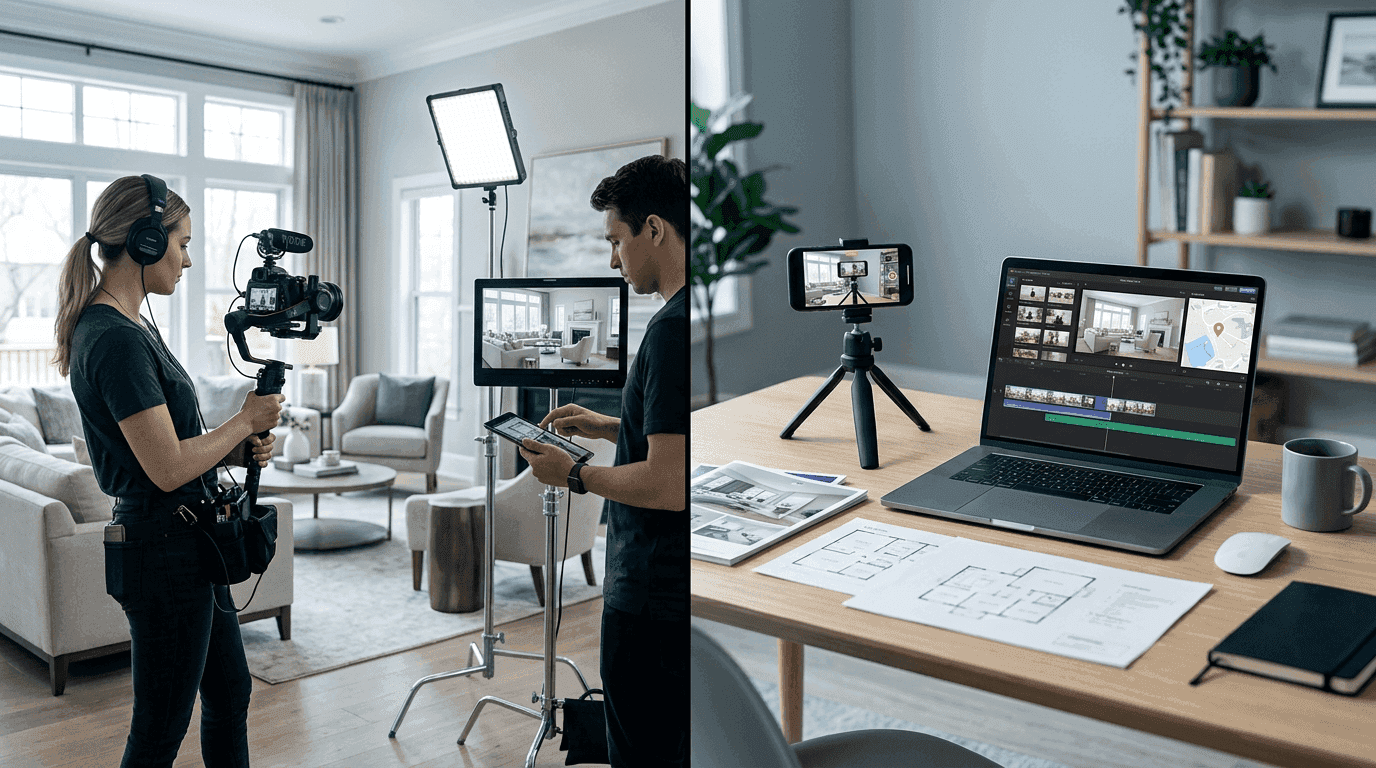
Real estate video services sound premium because they are premium. The question is whether premium is the right default for your workflow or just the most familiar answer.
Video maker software solves a different problem. It is not trying to replace every custom production use case. It is trying to make sure the average listing actually gets marketed with video instead of being left in a static-photo purgatory because nobody had time or budget for a service engagement.
Services and software are built for different jobs
A real estate video service is best for custom execution: a dedicated shoot, custom editing, and more creative control. Video maker software is best for repeatability: turning the inputs you already have into a finished asset without needing another production cycle.
Both are useful. The problem happens when agents apply the premium service model to ordinary inventory and then wonder why video only appears on a fraction of their listings. The answer is usually cost, delay, or both.
| Question | Video service | Video maker software |
|---|---|---|
| Best for | Custom campaign or standout listing | Consistent coverage across many listings |
| Speed | Slower | Faster |
| Cost model | Per project | Subscription or low marginal cost |
| Scalability | Limited | High |
| Control | High with custom creative | High within a repeatable system |

Where services still win
Video services win when the listing needs something custom that software should not fake. Think luxury inventory, architectural storytelling, lifestyle-heavy launches, or neighborhood-driven campaign work. That kind of production can create a true brand moment.
But even then, most teams still benefit from a repeatable baseline. The premium service should be the exception, not the entire playbook. Otherwise the team spends too much time waiting for assets that should already exist by default.
Where video maker software wins
Software wins when the goal is broad listing coverage, faster turnaround, and more variations from the same asset set. That is why AI cost comparisons keep pointing in the same direction. The more listings you handle, the stronger the software case becomes.
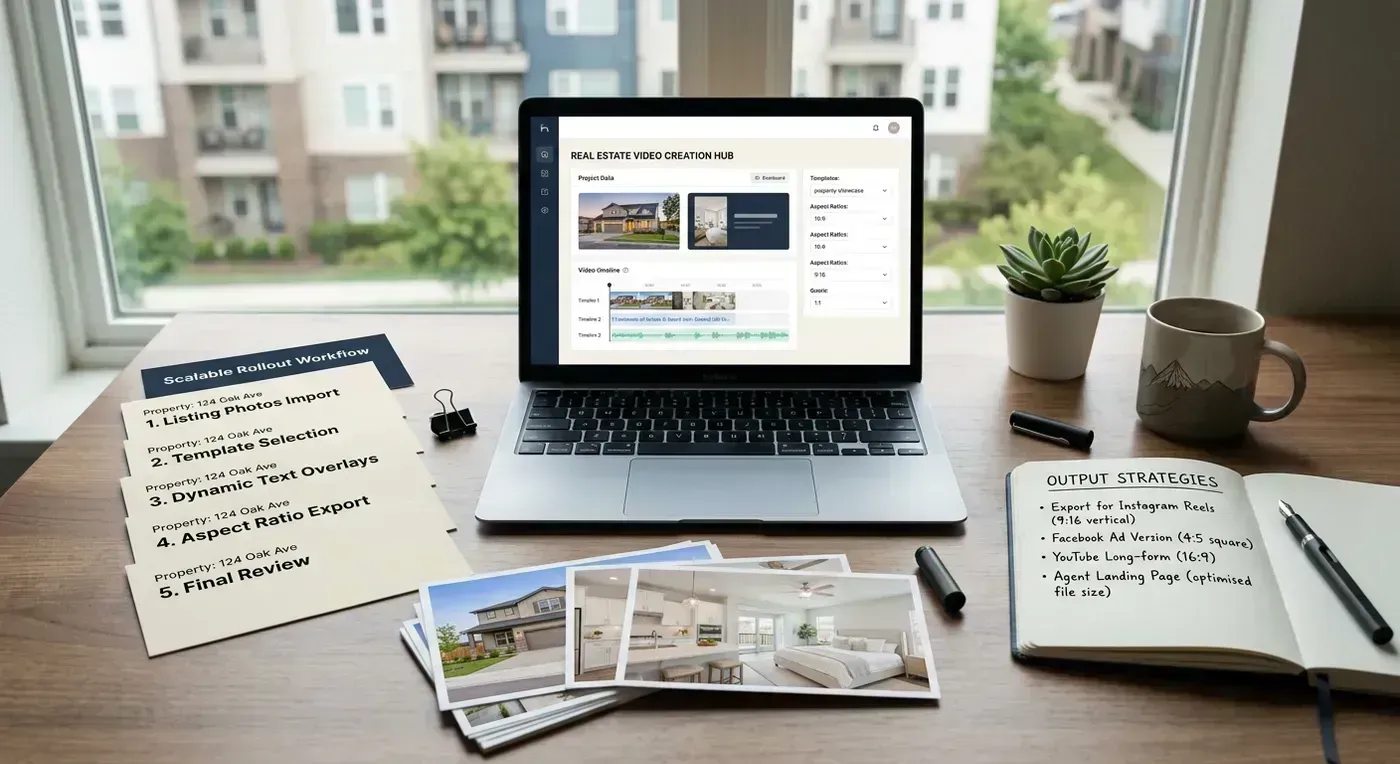
A good listing video maker also helps with distribution. With Reel-E, the same project can create branded and unbranded versions plus vertical and horizontal outputs. That means the asset fits more channels immediately. A custom service often still leaves the team doing extra work for those variants after the main delivery.
The real decision is control versus coverage
Most agents do not need maximum control on every property. They need enough control to keep quality high while getting coverage across the whole pipeline. That is why services versus software is really a control-versus-coverage decision.
If the custom route means only one-third of your listings get video, that is not a premium strategy. That is a bottleneck with nicer branding. Coverage matters because buyers and sellers notice whether video is standard or occasional.
What to choose in practice
Choose software when you want video on every listing. Choose services when the listing clearly deserves custom production. Choose a hybrid model if your business spans both ordinary inventory and the occasional hero property. That is the practical answer, not the sexy one.
For agents who want the scalable path first, start with listing video maker software and compare that against the current cost of outsourced production. Then read our video cost guide if you want the budget math spelled out more directly.
If you want video to become the default instead of a special occasion, software should probably be the foundation. If you want the video side of the workflow to stop eating your afternoon, start a Reel-E project and turn one listing shoot into multiple finished video assets.
The budget math on a normal month
Take a simple example. An agent or small team carries eight listings in a month. If a custom video service costs $350 to $900 per property depending on market and scope, the monthly outlay gets large quickly. At the lower end, you are already at $2,800. At the upper end, you are staring at a number that could fund a serious software stack, stronger photography, and still leave room for paid distribution. That is before you count rush fees, reshoots, or the cost of launching late.
This is why software keeps winning the broad workflow argument. It lowers the marginal cost of saying yes to video on the next listing. Once the inputs exist, the system can create more outputs without requiring the team to reopen a budget debate every single time. That matters because the real failure mode is not overpaying for one custom video. It is underusing video across the whole pipeline because every listing feels like a fresh production expense.
The conversation gets even clearer when you separate hero listings from ordinary inventory. If only one or two listings a month truly deserve custom treatment, great. Give them custom treatment. But do not let those exceptions set the default for the other six. Premium work should live in the exception budget, not quietly hijack the baseline.
| Scenario | Service-heavy approach | Software-first approach |
|---|---|---|
| 8 ordinary listings in a month | Recurring per-listing spend plus scheduling overhead | Lower marginal cost once the workflow is in place |
| 1 hero property plus 7 standard listings | Temptation to over-service the whole month | Reserve service for the one property that needs it |
| Small team covering multiple agents | Constant budget negotiation | Repeatable baseline with clear exceptions |
Turnaround time changes the math more than people admit
Budget is easy to see. Time is easier to ignore, even though it shapes the result more often. A slower service workflow does not just cost money. It pushes the asset further away from the moment when the listing is most interesting. If the video goes live after the first blast of attention has already passed, the team may still technically have a video asset, but it has already missed the best distribution window.
Software-first workflows win a lot of arguments simply by being faster. That speed lets the campaign feel coordinated. Photos, copy, property page, email, and video can move together instead of arriving in a sequence of apologetic updates. Nobody loves sending the sentence, 'Video coming soon.' It sounds organized in your head and slightly chaotic to everyone else.
If speed is the main bottleneck in your business, this topic connects directly to whether video listings sell faster and how distribution windows work across portals. The timing of the asset is part of the asset.
The hidden labor inside service-heavy workflows
When people compare services to software, they often compare invoices and forget labor. Services create coordination work: booking, confirming access, negotiating timelines, reviewing drafts, chasing revisions, and explaining to sellers why the unbranded version is somehow on a different schedule. None of that shows up cleanly in the line item, but the team feels it in the week.
Software shifts the labor profile. You still have to choose the angle, prepare the inputs, and review the outputs. But the work becomes more repeatable. It is closer to a system than a project. That difference matters because project-mode marketing burns people out. System-mode marketing is how a team keeps standards high without acting like every listing is an awards submission.
This is one reason founders and coordinators often become more pro-software over time. Not because they stopped appreciating craft. Because they got tired of managing invisible labor that never shows up in the first pricing comparison. The bill is not just the bill. It is the whole circus attached to it.
What sellers think they are paying for versus what they actually need
Sellers often say they want premium video because that language sounds reassuring. What many of them actually want is confidence that the home will be marketed seriously. Those are not the same request. Serious marketing can absolutely include custom production on the right property, but it can also mean that the listing gets strong, timely, multi-channel coverage without needless delay.
Agents should get comfortable translating the request. If the seller mainly wants to know the home will look polished and reach the market with energy, software may cover that perfectly well. If the seller wants an architectural showcase film with neighborhood storytelling and a more cinematic campaign, that is a different brief. The problem happens when every concern gets answered with the most expensive available tactic, regardless of whether it fits the listing.
A smarter answer is usually confidence plus criteria. Tell the seller what the baseline system includes, why that system works, and what would justify stepping up to a premium service. Clear criteria feel more professional than vague promises. They also protect the team from improvising expensive decisions just to sound accommodating.
Where software loses and services still deserve the assignment
Software should not pretend to win every situation. Truly distinctive architecture, heavy lifestyle storytelling, high-end brand campaigns, and launches where on-camera personality matters a lot can justify a service. That is not a weakness in the software case. It is a sign you understand what each option is built for.
The wrong move is to turn those edge cases into the operating model for the whole business. Most inventory does not need the full production tax. It needs competent, fast, consistent media that can support MLS, property-site, email, and social promotion. That is a different job. Once you accept that, the workflow gets simpler and the budget gets saner.
If you want the sharper cost argument, pair this with our videographer cost vs AI guide. The question is not whether services are ever good. Of course they are. The question is whether they are the right default.
What a hybrid model looks like when it is run well
The healthiest approach for many teams is hybrid. Software handles the baseline so every listing gets video coverage. Services are reserved for a defined tier of homes: high-end inventory, properties with a larger marketing budget, or launches where custom filming will clearly change the outcome. That structure gives you both coverage and premium upside without forcing the business to choose one ideology.
The key is writing the rules down. Decide what counts as a premium listing. Decide who approves exceptions. Decide what the baseline media package includes. If you leave those decisions vague, hybrid quickly turns into emotional chaos. Somebody falls in love with one listing, somebody else panics about another, and before long the whole team is operating on vibes. Vibes are not a finance system.
A written hybrid policy also makes seller conversations easier. You can explain what every listing receives by default and what additional investment unlocks. That sounds more credible than making up the answer on a call because the property happens to have a nice staircase.
How to pitch software-first without sounding cheap
Do not frame software as the budget option. Frame it as the standard operating system. Sellers are usually receptive when the explanation is built around consistency, speed, and channel coverage. Tell them the goal is to make sure the property launches with strong media immediately and across all the places buyers actually engage with it.
Then, if the listing merits more, explain the upgrade path clearly. This is a better conversation than apologizing for not sending a videographer by default. Confidence matters. If you sound like you are downgrading the seller, they will hear it that way. If you sound like you are applying a smart proven system and reserving custom production for special cases, the decision feels intentional.
This is one of those areas where founder tone matters more than script tone. Say the real thing. You want video on every listing. You want it fast. You want it consistent. You want premium resources used where they actually move the needle. That is not cheap. That is disciplined.
The quarterly review that keeps the decision honest
Every quarter, review the mix. How many listings got baseline software treatment? How many got custom services? Which ones actually benefited from premium production? Which ones would have performed just fine on the baseline? If you never run that review, service usage tends to drift upward because premium feels emotionally safer, even when the numbers disagree.
Also review timing. Did the service-based listings actually launch later? Did the extra spend produce stronger engagement or a better seller experience? Did the team feel calmer or more overextended? The answers matter because marketing quality is not only about visual polish. It is also about whether the process is stable enough to execute repeatedly.
The goal is not to prove software wins every time. The goal is to build a video policy that survives contact with a real pipeline. The teams that do this well are not ideological. They are observant. They keep the baseline strong, keep the exceptions clear, and do not confuse expensive with strategic.
A simple scorecard to choose the right option before each listing
If the team keeps revisiting the same argument, build a scorecard. Ask whether the listing is visually distinctive enough to justify custom production. Ask whether seller expectations are unusually high. Ask whether timing is tight. Ask whether the campaign needs neighborhood storytelling or on-camera presence. Ask whether the asset will be reused beyond the listing itself. Those answers will tell you whether the property belongs in the baseline software lane or the premium service lane.
The real value of a scorecard is not mathematical precision. It is organizational clarity. People stop debating from instinct and start deciding from criteria. That makes the business easier to run and easier to explain to sellers. It also reduces the silent resentment that appears when one listing gets special treatment and everyone else has to pretend there was a secret strategy behind it.
A good scorecard also keeps the team honest about what is normal inventory. Not every nice home is a custom campaign. Some properties are simply well-presented homes that deserve strong, fast, repeatable marketing. That is exactly the kind of listing software should dominate.

What brokerages should standardize before they spend another dollar
Brokerages and teams should standardize three things before they have another meeting about vendors. First, define the default media package for every listing. Second, define who can approve premium production. Third, define the turnaround expectation for all core assets. Without those rules, the services-versus-software debate never ends because every listing turns into a custom political negotiation.
This standardization is not bureaucracy for the sake of it. It protects margin and quality at the same time. When the baseline is clear, software has a clean job. When the exceptions are clear, services have a clean job. The whole system stops stepping on itself.
That is the biggest operational difference between teams that talk about video a lot and teams that actually ship it consistently. The good teams do not just buy tools. They define the workflow around the tools. Everything gets easier after that.
Why copying luxury marketing onto ordinary inventory is a strategic mistake
A lot of service-heavy thinking comes from watching luxury campaigns and assuming the same playbook should apply to the average listing. It usually should not. Luxury marketing is often about differentiation, brand theater, and storytelling depth. Ordinary inventory usually needs clarity, speed, and wide distribution. They are not the same assignment.
When teams confuse those jobs, they overspend on the average property and under-systematize the rest of the pipeline. That is how you end up with a few beautiful campaigns and a lot of under-marketed homes. Great for mood boards. Bad for actual operations.
A software-first baseline corrects that imbalance. It gives ordinary inventory a strong, dependable marketing package and leaves room for custom production where it actually belongs. That is not lowering the standard. It is applying the right standard to the right job.
Separate filmmaking from marketing and the answer gets easier
One reason this debate stays confusing is that people mix up filmmaking and marketing. Filmmaking is about craft, expression, camera decisions, and custom storytelling. Marketing is about getting the right asset in front of the right buyer quickly and consistently. Real estate businesses need some filmmaking sometimes. They need marketing every single week.
Once you separate those jobs, the workflow becomes easier to design. Use services when the assignment truly is filmmaking. Use software when the assignment is scalable marketing coverage. Most listings are the second job. That does not make them unimportant. It just means the operational answer should match the actual need instead of the most cinematic possible idea.
Teams that get stuck often do so because they are trying to make every listing carry the emotional weight of a flagship campaign. It sounds aspirational. It usually performs like operational sabotage. A calm software-first baseline is often the more serious move.
The smartest teams are not choosing one ideology. They are matching the tool to the listing. Services for the few. Software for the many. That is usually where the ROI gets much less dramatic and much more real.
If the workflow can cover the whole pipeline without a daily budget debate, you are probably closer to the right answer than the team still treating every listing like a miniature film festival.
The goal is not to win an argument about taste. The goal is to build a video system that survives a busy month.
And in real estate, a system that survives a busy month is worth more than a premium process that collapses under ordinary volume.
That is the better business.
FAQ
Are real estate video services better than video maker software?
Services are better for highly custom campaign work. Software is better for scalable, repeatable listing coverage across a larger pipeline.
What is the downside of hiring a video service for every listing?
The downside is cost, slower turnaround, and a workflow that does not scale well when you need video assets on every property instead of only on selected listings.
When is video maker software better than a real estate video service?
Usually when you need broad coverage, faster timing, and consistent output across many ordinary listings instead of one-off premium campaigns.
Can video maker software create MLS-safe unbranded listing videos?
Yes. The right workflow can create unbranded outputs and the right formats so the same project works across MLS, property sites, and social use.
What listings still justify a full real estate video service?
The best candidates are luxury homes, unusual architecture, and launches where custom storytelling or on-location personality changes the whole campaign.