The average real estate agent spends somewhere between $0 and "I don't even want to think about it" on listing video each year. That is not a joke. I have talked to agents who proudly spend $15,000 per year on videography for their top 12 listings, and I have talked to agents who have never once put a video on a listing because they assumed it cost $1,000 minimum. Both are wrong in their own way. One is overspending for most of their portfolio. The other is leaving money on the table because of a pricing myth from 2019.
This guide is the pricing reality check. Every number in here comes from 2026 market data: quotes from real videographers, published pricing from every major platform, and production cost breakdowns from the tools agents are actually using right now. No vague ranges. No "it depends" without telling you what it depends on. Just real numbers.
The Complete Cost Comparison: Every Method, Every Price Point
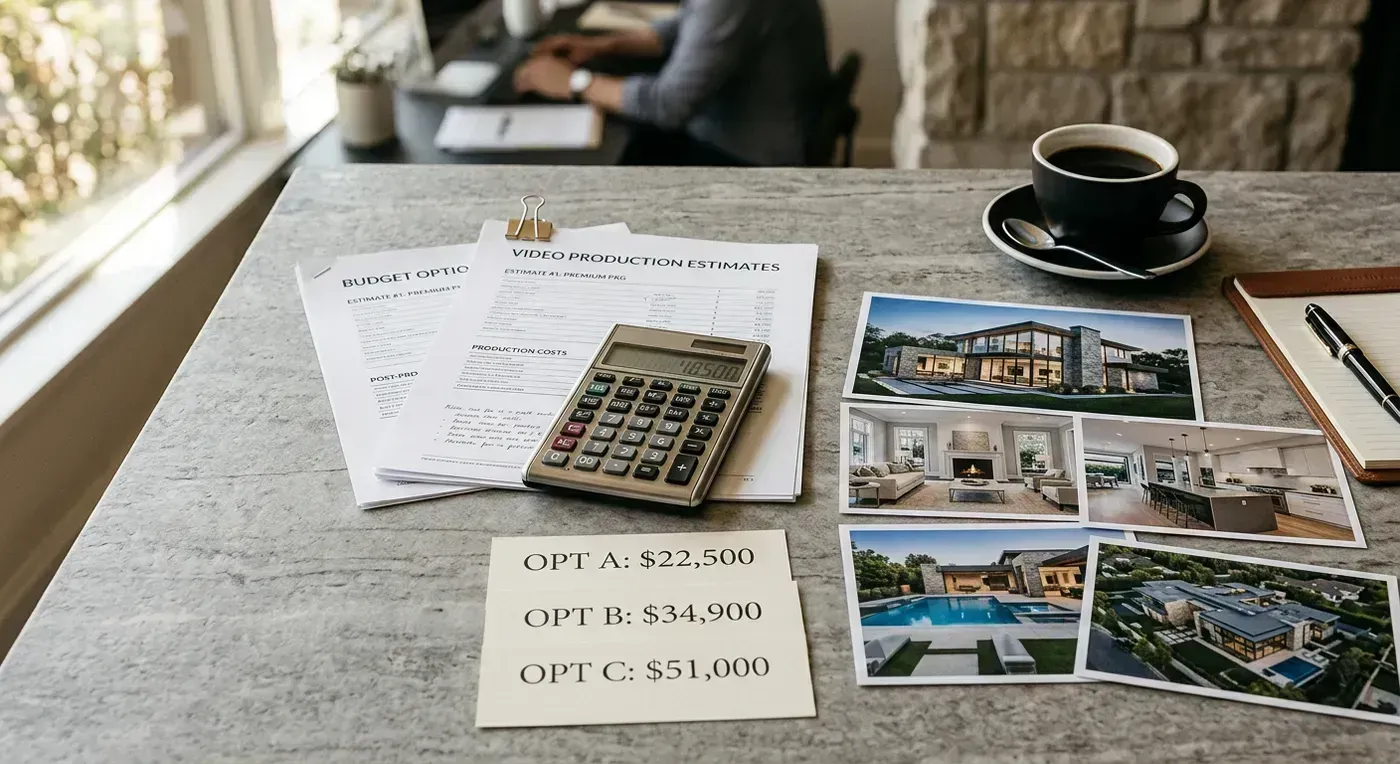
Before we get into the details, here is the overview. This table covers every legitimate way to create a real estate listing video in 2026, sorted from most expensive to least expensive per property.
| Production Method | Cost Per Listing | Monthly Cost (10 listings) | Turnaround | Quality | Best For |
|---|---|---|---|---|---|
| Full production crew (luxury) | $3,000 to $10,000 | $30,000 to $100,000 | 1 to 3 weeks | Cinematic | Properties over $5M |
| Professional videographer + drone | $500 to $1,500 | $5,000 to $15,000 | 3 to 7 days | High | Properties $1M to $5M |
| Professional videographer (no drone) | $300 to $800 | $3,000 to $8,000 | 3 to 7 days | High | Properties $500K to $2M |
| Drone-only aerial video | $150 to $500 | $1,500 to $5,000 | 1 to 3 days | Medium-High | Large lots, waterfront, acreage |
| AI video from photos (Reel-E Pro) | $12 per listing | $599/mo (50 listings, 4K) | Under 2 min | High | Teams, brokerages, 10+ listings/mo |
| AI video from photos (Reel-E Growth) | $13 per listing | $129/mo (10 listings) | Under 2 min | High | Active agents, 5-10 listings/mo |
| AI video from photos (Reel-E Essential) | $20 per listing | $59/mo (3 listings) | Under 2 min | High | Solo agents, 1-3 listings/mo |
| Template editor (Animoto, FlexClip) | $8 to $20 | $16 to $50/mo | 15 to 30 min | Medium | Agents who want text overlays |
| DIY phone walkthrough | $0 (your time) | $0 | 30 to 60 min | Low-Medium | Agents with steady hands |
| Free slideshow (Canva, Google Photos) | $0 | $0 | 10 to 20 min | Low | Zero budget, social media only |
Look at that spread. The difference between the top and bottom of this table is literally $10,000 per listing. And here is the part that makes traditional videographers nervous: for 95% of residential listings, the quality difference between a $500 videographer visit and a $13 AI-generated video is not $487 worth of better. I say this as someone who has hired videographers for my own listings. The gap has closed faster than anyone predicted.
Now let me break down each option so you can make an informed decision for your specific situation.
Option 1: Hiring a Professional Videographer ($300 to $10,000+)
This is the gold standard, and for good reason. A skilled real estate videographer walks through the property, plans shot sequences, captures stabilized footage with a gimbal, adds drone aerials if licensed, and delivers a polished 1 to 3 minute video that tells a story. The best ones make a 1,400-square-foot bungalow look like a dream home.
What You Actually Pay
I surveyed 23 real estate videographers across six U.S. markets in January 2026. Here is what the pricing actually looks like, not what their websites say (those are usually outdated by a year):
| Market | Base Video (no drone) | With Drone | Luxury Package | Rush Fee (24-48hr) |
|---|---|---|---|---|
| Los Angeles, CA | $500 to $900 | $750 to $1,400 | $2,500 to $8,000 | +75% to 100% |
| Austin, TX | $350 to $600 | $500 to $900 | $1,500 to $4,000 | +50% to 75% |
| Tampa, FL | $300 to $550 | $450 to $800 | $1,200 to $3,500 | +50% |
| Chicago, IL | $400 to $700 | $600 to $1,100 | $2,000 to $5,000 | +75% |
| Phoenix, AZ | $300 to $500 | $450 to $750 | $1,000 to $3,000 | +50% |
| Raleigh, NC | $275 to $450 | $400 to $700 | $900 to $2,500 | +50% |
Some patterns worth noting. Urban markets charge 20 to 40% more than suburban markets for the same service. Videographers with under 2 years of real estate experience charge 30 to 50% less, but the quality can be hit or miss. And the "luxury package" pricing is basically whatever the videographer thinks the market will bear. I have seen identical-looking videos priced at $1,500 in Phoenix and $6,000 in Beverly Hills.
Hidden Costs Nobody Mentions
The base quote is never the full picture. Here is what gets added:
- Travel fees: $50 to $150 if the property is more than 30 minutes from the videographer's base. In rural markets, this can be $200+.
- Revisions: Most videographers include one round of revisions. Additional rounds are $75 to $200 each.
- Music licensing: Some videographers include licensed music. Others use generic royalty-free tracks and charge $25 to $75 for premium music.
- Additional formats: Want both a horizontal and vertical version? That is often a $100 to $200 add-on for re-editing.
- Twilight/sunset shoots: $200 to $500 extra because it requires a second visit at a specific time.
- Social media cuts: 15-second and 30-second versions for Instagram/TikTok. Some include them. Many charge $50 to $100 per additional cut.
A "$500 video" can easily become a $750 to $900 video once you add the extras that most agents actually need. Factor this into your budgeting.
When Hiring a Videographer Makes Financial Sense
Run this quick calculation: take the listing price, multiply by your commission rate, and compare the video cost as a percentage of gross commission.
| Listing Price | Gross Commission (2.5%) | Video Cost ($600) | Video as % of Commission |
|---|---|---|---|
| $250,000 | $6,250 | $600 | 9.6% |
| $500,000 | $12,500 | $600 | 4.8% |
| $750,000 | $18,750 | $600 | 3.2% |
| $1,000,000 | $25,000 | $600 | 2.4% |
| $2,000,000 | $50,000 | $1,500 | 3.0% |
My rule of thumb: if the video cost is under 3% of your gross commission, a professional videographer is a reasonable investment. Over 5%, you should seriously consider alternatives. At 10% (that $250K listing), you are spending too much on video relative to what the deal generates. And honestly? Spending nearly $600 on a video for a $250K condo is like putting premium gas in a Honda Civic. It works, but your wallet will notice.
Option 2: Drone-Only Video ($150 to $500)
Drone footage is the one thing AI cannot fake yet. If the property's selling point is the lot (5 acres, waterfront, mountain views, proximity to a golf course), aerial video communicates that instantly in a way that ground-level photos never will.
What Drone Video Actually Costs
- Basic aerial package (2 to 3 angles, 30-second edit): $150 to $250
- Standard aerial package (5+ angles, orbit shot, reveal shot, 60-second edit): $250 to $400
- Premium aerial (multiple altitudes, twilight, integrated with ground video): $400 to $500+
Many real estate photographers now offer drone as a $100 to $200 add-on to their standard photo package. If you are already paying $250 for photos, an extra $150 for aerials is the best value in real estate marketing. Just confirm your photographer holds an FAA Part 107 certification. Operating a drone commercially without one is illegal, and the fines start at $1,100 per violation.
The Drone + AI Combo Play
Here is a strategy that more agents should know about: use drone footage for the exterior aerials and an AI tool for everything else. Have your photographer capture 3 to 5 drone clips during the photo shoot. Then take the interior still photos and run them through Reel-E or a similar AI tool to generate the interior video with cinematic motion. Combine both in a simple editor (CapCut works fine, and it is free), and you have a video that looks like it cost $1,000+ for under $200 total.
This hybrid approach gets you the aerial footage that AI cannot generate while keeping the interior production cost at almost zero. It is my personal recommendation for properties in the $500K to $1.5M range where the lot or location is a major selling point.
Option 3: AI-Powered Video from Photos ($4 to $20 per listing)
This is the category that has changed the most since 2024. Two years ago, "AI real estate video" meant a slightly fancier slideshow with basic zoom effects. In 2026, it means genuine 3D camera motion synthesized from still photographs. The AI estimates depth, geometry, and composition, then generates camera paths that look like they were shot with a gimbal. Orbits, push-throughs, lateral slides, pull-backs. Not a filter. Not a zoom. Actual simulated camera movement.
Here is what that looks like in practice:
Every clip in that video was generated from a still photo. No videographer. No drone. No editing. The AI handled the camera motion, synced transitions to the music's downbeats, and rendered four format variants (horizontal branded, horizontal unbranded, vertical branded, vertical unbranded) in under two minutes.
AI Video Pricing Breakdown (2026)
I priced out every major AI real estate video tool currently on the market. Here is what they actually charge:
| Platform | Cheapest Plan | Per-Listing Cost (at plan limit) | Key Differentiator |
|---|---|---|---|
| Reel-E Essential | $59/mo (3 listings) | ~$20 | AI camera motion, 4 variants, beat-synced music |
| Reel-E Growth | $129/mo (10 listings) | ~$13 | Same as Essential + clip downloads, 6 revisions |
| Reel-E Pro | $599/mo (50 listings) | ~$12 | 4K output, priority rendering, 50 listings |
| AutoReel | $49/mo (5 videos) | ~$10 | Basic motion, limited formats |
| PhotoAIVideo | $39/mo (3 videos) | ~$13 | Quick output, fewer customization options |
| Animoto | $16/mo (unlimited) | <$1 | Template slideshow only, no AI motion |
| Canva Pro | $13/mo (unlimited) | <$1 | Basic slideshow, no real camera motion |
A note on that table: Animoto and Canva are dramatically cheaper per video, but they produce fundamentally different output. They make slideshows with transitions. AI tools like Reel-E generate cinematic camera motion. Comparing them on price alone is like comparing a stock photo to a professional headshot. They are technically both photographs, but they serve different purposes and make different impressions. For a detailed feature-by-feature comparison, see our best real estate video makers roundup.
Annual Billing: The Math Most Agents Miss
Every platform offers discounts for annual billing, and the savings are meaningful over 12 months:
| Reel-E Plan | Monthly Billing | Annual Billing | Annual Savings |
|---|---|---|---|
| Essential (3 listings/mo) | $59/mo ($708/yr) | $44.25/mo ($531/yr) | $177/yr (25%) |
| Growth (10 listings/mo) | $129/mo ($1,548/yr) | $96.75/mo ($1,161/yr) | $387/yr (25%) |
| Pro (50 listings/mo) | $599/mo ($7,188/yr) | $449.25/mo ($5,391/yr) | $1,797/yr (25%) |
The Growth plan with annual billing works out to $96.75 per month for 10 listings. That is $9.68 per listing video with AI camera motion, four format variants, licensed music, and your branding baked in. Try getting a videographer to show up for under ten dollars. (Spoiler: they will not return your call.)
Check the full details on our pricing page.
Option 4: DIY Phone Walkthrough ($0, but it costs your time)
Your phone shoots 4K video. A basic gimbal costs $100 (DJI Osmo Mobile is the standard). Walk through the property, narrate or stay silent, and post the raw footage. Total production cost: $0 in cash, 30 to 60 minutes of your time including basic editing in CapCut or iMovie.
When DIY Works
- Instagram Stories and behind-the-scenes content: Authentic phone footage actually performs well for personal brand content. Polished video can feel corporate. A phone walkthrough feels real.
- First-week social media teasers: Post a quick walkthrough to generate buzz before the professional video is ready.
- Rental properties and low-commission listings: If the commission does not justify any video spend, your phone is better than nothing.
- Agent introduction videos: Walk and talk, introduce yourself, show the neighborhood. This is not a listing video. It is a personal brand asset.
When DIY Does Not Work
- MLS and listing portals: Shaky, poorly lit phone footage on Zillow makes the property (and you) look unprofessional. Buyers scroll past immediately.
- Any listing over $400K: The seller is watching. If they see their $600,000 home presented with a phone video that looks like a FaceTime call, that listing appointment next quarter is not happening.
- Agents building a luxury brand: You cannot position yourself as a premium agent while posting phone walkthroughs. The medium is the message.
The real cost of DIY is not $0. It is the 30 to 60 minutes of your time per property, plus however long you spend in a free editor trimming clips and adding music. At a typical agent's effective hourly rate of $75 to $150, that "free" video just cost you $37 to $150 in labor. For many agents, it is cheaper to pay for an AI tool and spend those 45 minutes on prospecting calls instead.
Option 5: Free Slideshow Tools ($0)
Canva, Google Photos, iMovie. Upload photos, pick a transition, add music, export. Done in 10 to 20 minutes.
I am not going to spend much time here because the output quality speaks for itself: it looks like a slideshow. Your photos dissolve into each other with no camera motion, no depth, no cinematic quality. Instagram's algorithm gives slideshow-style content roughly 40% less reach compared to video with actual motion. Buyers watch for 5 to 10 seconds and scroll past.
If your budget is genuinely zero, a Canva slideshow is better than no video at all. But if you can afford $59 per month (the cost of two large Uber Eats orders), the jump from slideshow to AI-generated video is the biggest quality leap per dollar in this entire guide. It is not even close.
The ROI Question: Does Listing Video Actually Pay for Itself?
Short answer: yes, overwhelmingly. Here are the numbers, sourced from studies published between 2024 and 2026.
Inquiry Volume
Listings with video receive 403% more inquiries than listings without video (National Association of Realtors, 2025). That is not a typo. Four times more inquiries. Even if your conversion rate stays flat, quadrupling the top of your funnel has a massive compounding effect on showings, offers, and sale price.
Days on Market
Properties listed with video sell up to 20% faster on average. On a 30-day average DOM, that is six fewer days on market. Six fewer days of the seller paying their mortgage, insurance, utilities, and HOA. For a $400,000 home with a $2,800/month mortgage, those six days represent roughly $560 in carrying costs the seller avoids. Sellers notice this, even if they do not articulate it. The agent whose listings sell faster gets more referrals. Period.
For the complete data set behind these claims, our real estate video statistics article breaks down every relevant study. And if you want the specific evidence on whether video listings sell faster (and for more money), we wrote an entire analysis: Do Video Listings Sell Faster?
Social Media Reach
Video content on Instagram generates 2x the engagement of image posts (Hootsuite 2025 Social Media Trends). On Facebook, video posts receive 135% more organic reach than photo posts. Every listing video you post is also a personal brand advertisement. It tells potential sellers: "This agent markets properties properly." For a deeper look at how video fits into your overall marketing plan, see our video marketing for real estate guide.
ROI Calculation by Method
Let me put this in concrete terms. Assume you close 12 transactions per year at a $400,000 average price with a 2.5% commission ($10,000 gross per deal). Here is what each video method costs you annually and what the effective ROI looks like if video helps you close just one additional deal per year:
| Method | Annual Cost (12 listings) | Additional Deals from Video | Additional Revenue | Net ROI |
|---|---|---|---|---|
| Videographer ($600 avg) | $7,200 | +1 deal | $10,000 | +$2,800 (39%) |
| AI tool (Reel-E Growth) | $1,548 | +1 deal | $10,000 | +$8,452 (546%) |
| Slideshow (Canva Pro) | $156 | +0.5 deals (lower quality) | $5,000 | +$4,844 (3,105%) |
| No video | $0 | Baseline | $0 | $0 |
The ROI on AI video tools is absurd. Even in the most conservative scenario (one additional deal per year, modest listing prices), you are looking at a 5x return. And that calculation does not even factor in the listing presentations you win because sellers see your video marketing portfolio and choose you over the agent who posts photos only.
How to Choose the Right Option for Your Business
Forget "what is the best video tool." The right question is "what is the right video strategy for my volume, my price point, and my market?" Here is my framework:
You List 1 to 3 Properties Per Month
Recommended: AI video tool (Reel-E Essential at $59/month) for all listings. Add a professional videographer ($500 to $800) for any listing over $1M.
Monthly budget: $59 to $859 depending on listing mix.
Why: At this volume, you need every listing to perform. AI video gives you consistent quality across all properties, and the per-listing cost ($20) is low enough to justify for every single listing. Reserve the videographer budget for listings where the commission check supports it.
You List 4 to 10 Properties Per Month
Recommended: AI video tool (Reel-E Growth at $129/month) for all listings. Professional videographer ($600 to $1,200) for luxury listings. Drone add-on ($150 to $300) for properties where the lot is the selling point.
Monthly budget: $129 to $1,629 depending on listing mix.
Why: At this volume, the per-listing cost drops to $13 with the Growth plan. You are producing enough content to build a real social media presence. The Growth plan's 6 revisions per listing gives you flexibility to re-render if the seller wants changes.
You List 10+ Properties Per Month (Team or Brokerage)
Recommended: AI video tool (Reel-E Pro at $599/month) for all listings. 4K output for MLS and portals. Professional videographer for select luxury listings.
Monthly budget: $599 to $2,599 depending on listing mix.
Why: At 50 listings per month capacity, the Pro plan's per-listing cost is $12. The 4K output matters at this scale because your brand identity depends on consistent premium quality. Priority rendering means your videos process faster than standard users, which matters when your team is uploading 10+ listings per week.
What Your Competitors Are Actually Spending
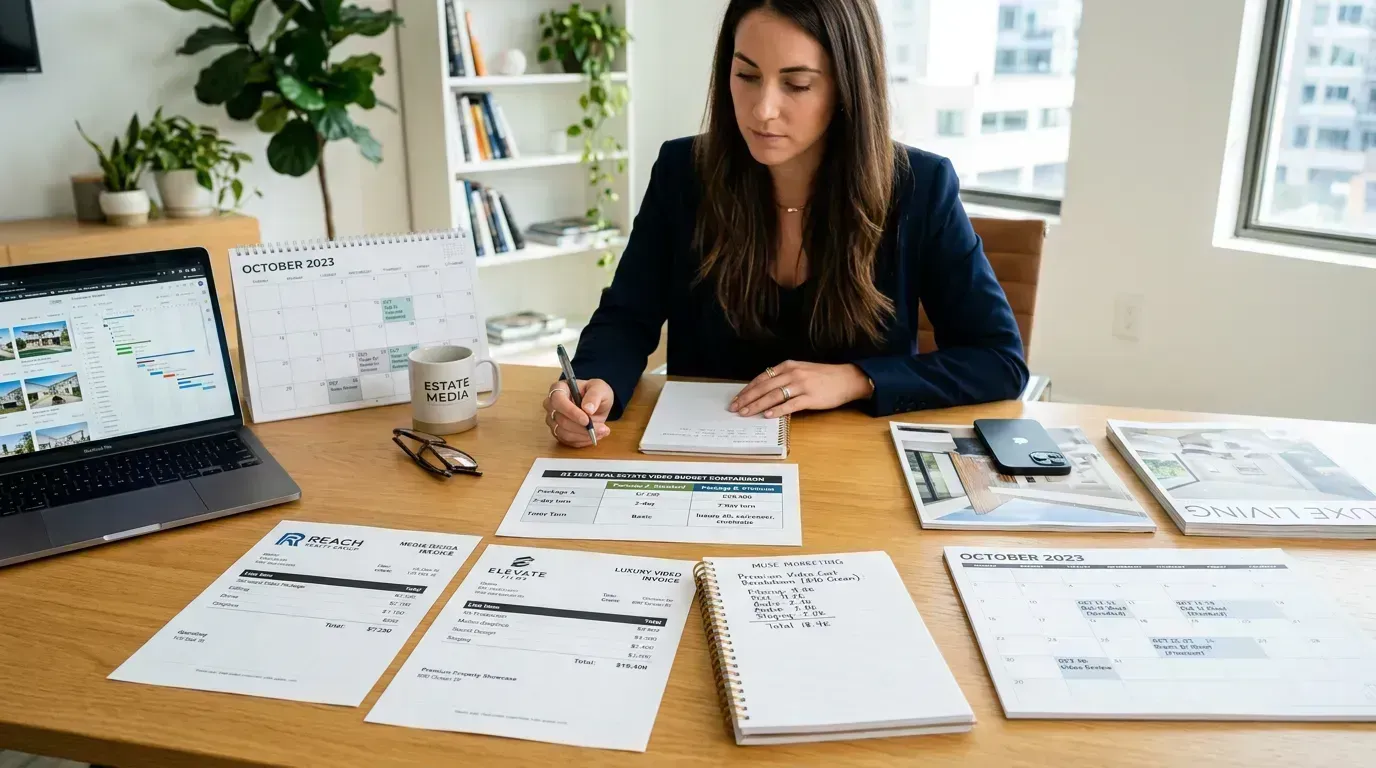
According to the National Association of Realtors' 2025 Member Profile, the median marketing spend per agent is $4,200 per year. Video typically represents 15 to 30% of that budget, so $630 to $1,260 per year. That is only enough for one to two videographer visits, or a full year of AI video for every single listing.
Top producers (top 10% by volume) spend significantly more. NAR data shows the top decile spending $12,000 to $20,000 annually on marketing, with video representing 25 to 40% ($3,000 to $8,000). These agents typically use a mix: AI video for all listings and a professional videographer for their top 3 to 5 properties per quarter.
The agents who are gaining market share in 2026 are not the ones spending the most on video. They are the ones using video most consistently. An agent who posts AI-generated video on every single listing will outperform the agent who hires a videographer for their "best" 4 listings and posts nothing for the other 8. Consistency beats perfection, every time.
The Hidden Cost Nobody Talks About: Time
Every pricing discussion about real estate video focuses on dollars. Nobody talks about time, which is your most limited resource.
| Method | Time Per Listing (Your Time) | Annual Time (12 listings) |
|---|---|---|
| Professional videographer | 1 to 2 hours (scheduling, meeting, reviewing, revisions) | 12 to 24 hours |
| DIY phone walkthrough + editing | 45 to 90 minutes | 9 to 18 hours |
| Template editor (Animoto) | 20 to 30 minutes | 4 to 6 hours |
| AI video (Reel-E) | 5 to 8 minutes (upload, select music, add branding) | 1 to 1.5 hours |
| Free slideshow (Canva) | 15 to 25 minutes | 3 to 5 hours |
Over a year, the difference between a videographer (24 hours of your time) and an AI tool (1.5 hours of your time) is 22.5 hours. If you value your time at even $100/hour (conservative for a producing agent), that is $2,250 in saved labor on top of the direct cost savings. Time is the real reason agents switch from videographers to AI tools. It is not just cheaper. It is faster by an order of magnitude.
Pricing Myths That Need to Die in 2026
Myth 1: "Good video has to be expensive"
It did, until about 2024. AI has genuinely collapsed the cost of professional-quality video. The technology that Reel-E and similar tools use (depth estimation, 3D camera synthesis, beat-synced editing) did not exist in a commercially viable form three years ago. Saying "good video has to be expensive" in 2026 is like saying "you need a Rolodex to manage contacts" in 2010. The tools changed. The costs changed with them.
Myth 2: "Free tools are good enough"
Free tools are better than nothing. They are not good enough if you want your video to actually generate engagement. The quality gap between a Canva slideshow and an AI-generated video with real camera motion is visible in the first two seconds. Buyers' brains register the difference before they consciously think about it. If your listing video looks like a PowerPoint presentation set to music, it is doing less work than you think.
Myth 3: "Videographers will always produce better results than AI"
A great videographer will. A mediocre one will not. And here is the uncomfortable truth: most real estate videographers are mediocre. They bought a gimbal, watched a YouTube tutorial, and started charging $400. I have seen AI output that is genuinely better than half the "professional" real estate videos on YouTube. The top 20% of videographers still produce work that AI cannot touch. The other 80%? The gap is closing fast.
Myth 4: "I can just use my phone"
You can. But will you? I have heard "I'll just use my phone" from hundreds of agents. Fewer than 10% actually do it consistently. The friction of shooting, editing, and exporting kills the habit before it starts. The best production method is the one you will actually use for every listing, not just the one you used that one time when you were motivated on a Tuesday.
The Bottom Line: What You Should Spend on Real Estate Video
Here is my honest recommendation, founder bias and all.
If you are a solo agent listing 1 to 5 properties per month at typical residential price points ($250K to $800K), spend $59 to $129 per month on an AI video tool and use it for every single listing. That is your base. No exceptions. Every listing gets a video. The cost per listing ($13 to $20) is negligible relative to the increase in inquiries and the reduction in DOM.
Layer on a professional videographer ($500 to $1,200) selectively for properties where the commission justifies it. My threshold: if the gross commission exceeds $15,000, consider a videographer. Under that, AI handles it.
Layer on drone video ($150 to $300) for any property where the exterior, lot, or location is a primary selling feature. Acreage, waterfront, mountain views, proximity to amenities. Drone footage adds context that neither photos nor AI can create.
The agents who are winning in 2026 are not choosing between videographer and AI. They are using both, strategically, in proportion to each listing's commission potential. The floor is AI video on every listing. The ceiling is a full production package on your flagship properties. The mistake is doing neither.
Start with Reel-E's free trial and produce your first listing video in under two minutes. No credit card required. See the output quality for yourself, then decide if it makes sense for your business.
A Quick Note on Year-Over-Year Pricing Trends
I have been tracking real estate video pricing since 2022. Here is the trend:
- Professional videographer pricing: Up 8 to 15% since 2022. Equipment costs, insurance, and demand have all increased. Expect this to continue climbing 3 to 5% annually.
- AI video tool pricing: Down 20 to 40% since 2024, when the first commercially viable tools launched. Competition is driving prices down while quality improves. This trend will continue as more AI providers enter the market.
- Drone video pricing: Roughly flat since 2023. The cost of Part 107 certification and insurance has not changed much, and the labor is the same regardless of technology improvements.
- Free/template tools: Prices have stayed stable ($0 to $20/month), but the free tier features keep getting more limited as companies push toward paid plans.
The takeaway: the gap between videographer pricing and AI pricing is widening every year. In 2024, a videographer was 50x more expensive than AI per listing. In 2026, it is closer to 40x. By 2028, the AI tools will be even cheaper and the videographers will cost even more. The economic incentive to adopt AI video is only growing stronger.
For more on how to incorporate video into your overall marketing approach, check out our complete guide to video marketing for real estate. And if you want to compare specific tools head-to-head, our best real estate video makers roundup covers every major platform with honest scoring.
Try Reel-E free and see what your listing photos look like as cinematic video. Two minutes. No credit card. If the output does not impress you, you have lost nothing but 120 seconds.