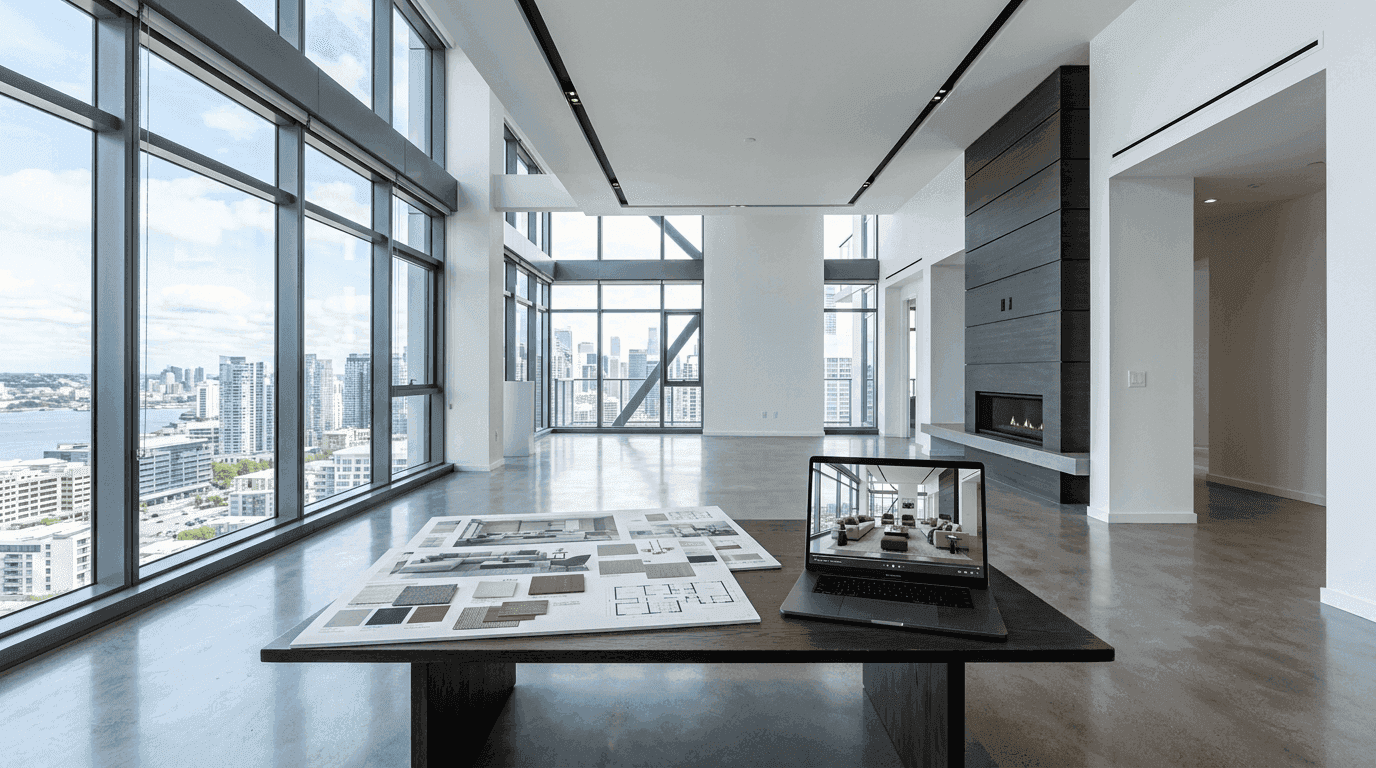
Here is a scenario every listing agent knows: you walk into a vacant property for the first time. The rooms echo. The walls are scuffed. The carpet has furniture indentations where a couch used to be. You know this home could sell for $450K with the right presentation, but the photos are going to look like a crime scene cleanup minus the yellow tape. Empty homes photograph terribly, and that is just physics. Light bounces off bare walls and hardwood floors with nothing to absorb it, creating harsh shadows and an uninviting sterility that screams "nobody lives here, and maybe nobody should."
For years, the solution was physical staging: rent $5,000 worth of furniture, hire movers, arrange everything, take photos, then reverse the entire process when the home sells. It works. It also costs a fortune, takes a week to coordinate, and ties you to a staging company's schedule. Then virtual staging arrived and changed the economics completely. For $25 to $50 per photo, you could digitally furnish those empty rooms and produce listing photos that looked warm, inviting, and livable.
But there was a problem. Virtual staging was photos only. When the rest of the real estate world moved to video marketing, virtually staged listings were stuck in a still-image world. You could not take a virtually staged photo and make a video from it. At least, you could not until AI video generation showed up and made the combination possible.
This article covers the intersection of these two technologies: virtual staging and AI video. Why the combination works, how the workflow fits together, what it costs, and why this pairing is quickly becoming the standard for marketing vacant listings in 2026. For the technical foundations, our AI listing video guide covers how photo-to-video AI works under the hood.
The Vacant Listing Problem (By the Numbers)
Empty homes are not just a presentation challenge. They are a measurable business problem. The data is clear and, frankly, a little depressing if you are currently trying to sell one without staging.
- Empty homes sit on market 73% longer than staged homes (National Association of Realtors, 2025 Profile of Home Staging)
- Buyers spend 60% less time looking at photos of empty rooms compared to furnished rooms (Zillow Research, 2024)
- 85% of buyers say they cannot visualize furniture placement in an empty room (Real Estate Staging Association, 2025)
- Staged homes sell for 5% to 15% more than empty comparable homes (same NAR report)
- The average vacant listing requires a 3.5% price reduction within the first 30 days, compared to 1.2% for staged listings
That last stat is the one that should get your attention. On a $450,000 listing, a 3.5% price reduction is $15,750. The cost of virtual staging for the entire home? Maybe $200 to $400. The cost of adding AI video on top of that? Starting at $20 per listing with tools like Reel-E. The math here is not close. It is embarrassing for anyone who is still listing vacant homes with empty-room photos.
And yet, according to NAR data, only 41% of listing agents use any form of staging (physical or virtual) for vacant properties. The other 59% are uploading photos of empty rooms and hoping buyers have vivid imaginations. They do not. Nobody does. The human brain is remarkably bad at spatial visualization, which is why furniture stores have showrooms and IKEA has those little fake apartments. People need to see it furnished to want it.
How Virtual Staging Works in 2026
Virtual staging has evolved significantly in the past two years. Understanding the current state of the technology helps explain why combining it with AI video now produces results that were not possible even a year ago.
Traditional Virtual Staging (Human-Designed)
The original approach: you send empty room photos to a staging company, a human designer selects furniture from a 3D asset library, places it in the scene using rendering software, adjusts lighting and shadows to match the original photo, and sends back the finished image. Turnaround is typically 24 to 48 hours. Quality is excellent because a trained designer makes every placement decision.
Cost: $25 to $75 per photo, depending on the service and quality tier.
The best services in this category (BoxBrownie, VirtualStagingSolutions, Stuccco) produce images that are genuinely indistinguishable from photos of real furniture. Shadows fall correctly. Reflections match the room's light sources. Proportions are accurate. Even other agents cannot tell the difference.
AI Virtual Staging (Automated)
The newer approach: you upload an empty room photo, the AI detects the room type (living room, bedroom, kitchen), identifies the walls, floor, and ceiling planes, and automatically generates a furnished version of the room. No human designer involved. Turnaround is instant to 30 seconds.
Cost: $5 to $25 per photo, with some tools offering subscription plans.
AI staging quality has improved dramatically. In 2024, AI-staged rooms often had furniture floating slightly above the floor, shadows going the wrong direction, and scale that was off (a couch that was clearly 40% too large for the room). In 2026, the top AI staging tools produce results that are 85% to 90% as good as human-designed staging for standard residential rooms. The remaining gap is in edge cases: oddly shaped rooms, dramatic lighting, and specific design style requests.
The Quality Spectrum
| Staging Method | Cost per Photo | Turnaround | Quality | Best For |
|---|---|---|---|---|
| Physical staging | $150 to $400 (amortized) | 3 to 7 days setup | Highest (real furniture) | Luxury, in-person showings |
| Human virtual staging | $25 to $75 | 24 to 48 hours | Excellent | High-value listings, MLS hero shots |
| AI virtual staging | $5 to $25 | Instant to 30 seconds | Very good | Standard residential, high volume |
| No staging | $0 | None | Poor (for vacant) | Budget zero or already furnished |
The sweet spot for most agents in 2026: AI staging for the majority of photos, human staging for the hero shot (living room or the first image in the listing). This gives you the best visual impact where it matters most while keeping costs low across the full photo set.

Virtual Staging Meets AI Video: The Combined Workflow
Here is where it gets interesting. Virtual staging solves the "empty rooms look terrible in photos" problem. AI video solves the "listings need video, not just photos" problem. Combining them solves both problems simultaneously, and the workflow is surprisingly simple.
The Step-by-Step Process
- Photograph the empty property. Use a professional real estate photographer. Shoot at full resolution (minimum 3000x2000 pixels) with HDR bracketing. Clear, well-lit, properly exposed photos are the foundation for everything that follows. For best practices on real estate photography that works for both staging and video, see our real estate photography guide.
- Virtually stage the photos. Send the empty room photos to your chosen staging service (or run them through an AI staging tool). For the full listing, stage the living room, primary bedroom, kitchen (if it looks bare without accessories), dining room, and any other key rooms. This typically costs $50 to $200 for a full home.
- Upload staged photos to an AI video tool. Take the virtually staged photos and upload them to a video generation tool like Reel-E. The AI does not know or care that the furniture is virtual. It processes the staged images exactly like it processes any other real estate photo: depth estimation, 3D scene reconstruction, camera path generation, and frame synthesis.
- Select music and branding. Choose a track from the music library, add your logo and contact card, and let the system generate the video. Processing time: 90 seconds to 3 minutes.
- Download and distribute. You get four variants: horizontal branded, horizontal unbranded, vertical branded, vertical unbranded. Upload the horizontal branded to MLS and Zillow. Post the vertical branded to Instagram and TikTok. Send the unbranded versions to the seller.
Total time from empty property to finished video: 1 to 3 days if using human staging, under 1 hour if using AI staging plus AI video. Total cost: $70 to $260 (staging + video subscription), compared to $5,000+ for physical staging alone.
Here is what the final output looks like when AI video is generated from high-quality listing photos:
Why This Combination Works So Well
The magic of combining staging and video comes down to buyer psychology. Consider the three levels of listing presentation and how each affects a buyer's emotional response:
Level 1: Empty room photos. The buyer sees blank walls and bare floors. Their brain processes it as "uninhabited space." There is no emotional connection. They might intellectually understand the room is 15x20 feet, but they cannot feel what it would be like to live there. Engagement: minimal. Time spent looking: 2 to 3 seconds per photo.
Level 2: Virtually staged photos. The buyer sees a furnished room with a couch, rug, art, and accessories. Their brain shifts from "empty space" to "someone could live here." They start imagining themselves in the room. Engagement: moderate. Time spent looking: 5 to 8 seconds per photo.
Level 3: Virtually staged video with motion. The buyer sees the camera slowly moving through a furnished room, revealing depth and spatial relationships. The music creates emotional atmosphere. The motion triggers the brain's spatial navigation system, creating a sensation closer to "being there" than any still photo can achieve. Engagement: high. Average watch time: 15 to 45 seconds per video, with most viewers watching the full video.
Each level represents a significant jump in emotional engagement. The combination of staging plus video does not just add these effects together. It multiplies them. A buyer watching a video of a virtually staged room is simultaneously processing the furniture (habitability cue), the spatial movement (presence cue), and the music (emotional cue). That triple processing creates an experience that is measurably more effective at driving showing requests than either staging or video alone.
Cost Analysis: The Economics of Staging + Video

Let us run the real numbers for a typical vacant 3-bedroom, 2-bathroom home listed at $425,000. I am going to compare four approaches and show you exactly what each one costs.
Approach 1: No Staging, No Video
| Item | Cost |
|---|---|
| Professional photography (25 photos) | $200 |
| Total marketing cost | $200 |
| Typical days on market (vacant, no staging) | 45 to 60 days |
| Probability of price reduction | High (60%+) |
Approach 2: Physical Staging Only
| Item | Cost |
|---|---|
| Professional photography | $200 |
| Physical staging (first month) | $3,500 |
| Staging monthly renewal (if needed) | $1,500/mo |
| Total marketing cost (first month) | $3,700 |
| Typical days on market | 20 to 35 days |
| Probability of price reduction | Low (15%) |
Approach 3: Virtual Staging + Photos Only
| Item | Cost |
|---|---|
| Professional photography | $200 |
| Virtual staging (10 rooms, human-designed) | $350 |
| Total marketing cost | $550 |
| Typical days on market | 25 to 40 days |
| Probability of price reduction | Moderate (30%) |
Approach 4: Virtual Staging + AI Video (The Recommended Approach)
| Item | Cost |
|---|---|
| Professional photography | $200 |
| Virtual staging (10 rooms, AI + human hero shots) | $150 |
| AI video generation (Reel-E subscription, amortized) | $20 to $43 |
| Total marketing cost | $370 to $393 |
| Typical days on market | 18 to 30 days |
| Probability of price reduction | Low (20%) |
The combined approach (Approach 4) costs 90% less than physical staging while achieving comparable results for online presentation. It also produces video content for social media distribution, which physical staging alone does not. The $370 investment generates staged photos for MLS, staged video for social media, branded video for email marketing, and vertical video for Instagram and TikTok. All from a single set of photographs.
I will admit the days-on-market estimates above are generalizations. Your local market, price point, and listing quality all affect these numbers. But the directional truth holds: staging plus video sells faster than staging alone, which sells faster than empty photos. And the digital approach costs a fraction of the physical approach.
Buyer Psychology: Why Motion Matters for Staged Spaces
This is the section where I get a little nerdy about how human brains process visual information. Bear with me, because understanding this explains why the staging-plus-video combination is so much more effective than either technology alone.
The Spatial Presence Effect
When you watch a video with camera motion (push-in, orbit, lateral slide), your brain's vestibular system activates the same neural pathways it uses for actual physical movement through space. This creates what researchers call "spatial presence," the sensation of being in the depicted environment rather than just looking at it.
Still photos do not trigger this response. Your brain processes a photo as a flat image. Even a beautifully staged photo is experienced as "a picture of a room," not as "being in a room." Video with camera motion crosses that threshold. The viewer's brain shifts from "observing" to "experiencing."
For real estate, this distinction matters because buying a home is fundamentally about imagining yourself living in a space. The more effectively a listing presentation triggers that "I could live here" response, the more likely the buyer is to request a showing. Video with camera motion triggers it. Photos do not, or at least not as strongly.
The Furniture Anchoring Effect
There is another psychological mechanism at work specifically with staged spaces. Furniture in a room acts as an anchor for the buyer's imagination. When a buyer sees an empty room, they have to generate the entire mental image of "my furniture in this space" from scratch. That is cognitively expensive, and most people simply do not do it. They glance at the photo and move on.
When a buyer sees a furnished room (even if they know the furniture is virtual), the cognitive load drops dramatically. They are no longer starting from zero. They can modify the existing scene: "I would put my couch there instead" or "I would use a different rug." This is much easier than imagining furniture from nothing. The staging gives their imagination a starting point.
Now combine this with video motion. The buyer is watching a camera glide through a furnished room. Their brain is simultaneously processing the furniture (anchoring), the spatial movement (presence), and the room's dimensions as revealed by the changing perspective (spatial understanding). The result is a multi-sensory mental experience that closely mimics an in-person visit.
This is not theoretical. According to our real estate video statistics analysis, listings with video receive 403% more inquiries than listings without video. Staged listings receive 40% more views than empty listings. The combination of staging and video stacks these advantages.
Quality Considerations: What Makes Staging Work (and Fail) in Video
Not all virtual staging produces good video. The AI video generation process reveals quality issues in staged photos that might not be obvious in still images. When the camera moves through a virtually staged room, inconsistencies become more noticeable because the brain expects the 3D scene to behave consistently as the perspective shifts.
What Works Well
- Consistent shadow direction. If the virtual furniture casts shadows that match the room's existing light sources, the AI video output looks natural. The depth estimation correctly identifies the furniture as real objects and generates convincing camera motion.
- Correct scale and proportion. Furniture that is sized appropriately for the room translates well to video because the depth model can accurately gauge distances. A correctly proportioned couch in a correctly proportioned room produces smooth, believable motion.
- Floor-level placement. Virtual furniture that sits firmly on the floor (with appropriate shadow contact) is processed correctly by the AI. The depth estimation places it at the right depth, and camera motion around it looks natural.
- Realistic material textures. Fabric that looks like fabric, wood that looks like wood, metal that looks like metal. The AI's depth model uses texture cues to estimate depth, so realistic textures improve the overall quality of the video output.
What Causes Problems
- Floating furniture. If the virtual staging has furniture that is slightly above the floor (a common issue with budget staging), the depth estimation gets confused. The camera motion may reveal the gap or create a "hovering" artifact that looks unnatural.
- Wrong shadow angles. Shadows going one direction from real objects and a different direction from virtual furniture create an inconsistency that the AI cannot resolve. The video output will have depth artifacts near the mismatched shadows.
- Excessive accessories. Virtual staging that fills every surface with candles, books, vases, and decorative objects can confuse the depth model because there are too many small objects at different depths. Cleaner staging (fewer, larger pieces) produces better video.
- Mismatched lighting temperature. If the virtual furniture is rendered with warm lighting but the room is shot in cool daylight, the color mismatch is more noticeable in video because the camera motion draws attention to the boundary between real and virtual elements.
The takeaway: invest in quality virtual staging. The $25 premium between budget AI staging and quality human staging pays for itself in video output quality. A beautifully staged photo that produces a beautifully moving video is worth far more than a cheaply staged photo that produces an obviously artificial video.
Disclosure and Ethics: Doing This Right
Virtual staging plus AI video raises legitimate ethical questions that I want to address directly. I think the technology is fantastic, but only when used transparently. Here is the honest framework for ethical implementation.
Always Disclose
Every virtually staged photo and video should be clearly labeled. This is both an ethical obligation and, in most jurisdictions, a legal one. The NAR Code of Ethics requires accurate representation of properties. Most MLS systems require disclosure of digital alterations. California's AB 723 specifically mandates disclosure of AI-generated imagery in listings.
Practical disclosure language for your listings:
"Some photos in this listing have been virtually staged to show potential furniture placement. Video created from virtually staged photos using AI motion technology. The property is currently vacant."
Put this in your MLS remarks, your video descriptions, and your social media captions. Transparency is not a weakness. It is a signal of professionalism.
Include Unstaged Photos
The best practice is to include both staged and unstaged photos in your listing. Lead with the staged photos (they get clicks) but include the empty room photos as well (they set accurate expectations). This way, buyers know exactly what they are getting before they schedule a showing. No surprises, no disappointment, no wasted time for anyone.
Do Not Stage Over Defects
Virtual staging should help buyers visualize furniture in an empty space. It should never be used to hide problems. Do not stage a rug over damaged flooring. Do not stage a bookcase over a water stain. Do not stage curtains over a cracked window. This crosses the line from marketing to deception, and it will damage your reputation when buyers discover the issue at showing.
The Technology Trajectory: Where This Is Heading
The combination of virtual staging and AI video is only going to get more powerful. Here is what I expect to see in the next 12 to 24 months, based on the current trajectory of both technologies.
Unified Staging + Video Platforms
Today, staging and video generation are separate steps with separate tools. Within the next year, expect platforms that do both in a single workflow: upload empty room photos, the AI stages and generates video in one pass. No intermediate step, no separate service, no waiting for staged photos to come back before generating video. This cuts the workflow from hours to minutes.
Interactive Virtual Tours
The next evolution beyond video is interactive. Imagine a buyer clicking on a virtually staged room and choosing between three different furniture styles, then watching the video regenerate with their preferred design. "Show me this room in mid-century modern." "Now show me contemporary." This technology exists in prototype form and will be commercially available within two years.
AI-Suggested Staging Styles
AI will analyze the home's architecture, neighborhood demographics, and buyer profiles to recommend the staging style most likely to appeal to the target buyer. A mid-century home in a hip neighborhood gets staged with Scandinavian furniture. A traditional colonial in the suburbs gets staged with classic American decor. The AI makes the design decision based on data, not guesswork.
Real-Time Staging During Video Calls
Agents conducting video-call property tours will be able to toggle virtual staging on and off in real-time. Walking through an empty property on FaceTime with a buyer? Tap a button and the empty rooms populate with furniture on their screen in real-time. This blends the convenience of virtual touring with the personalization of in-person showings.
Practical Implementation: Getting Started Today
If you have vacant listings (or frequently work with vacant properties), here is how to implement the staging-plus-video workflow starting this week.
For 1 to 3 Vacant Listings Per Month
- Staging: Use BoxBrownie or a similar human staging service ($25 to $40/photo). Stage living room, primary bedroom, kitchen, and one additional room. Budget: $100 to $200 per listing.
- Video: Sign up for Reel-E's Essential plan ($59/month for 3 listings). Upload the staged photos, generate video. Budget: $20 to $59 per listing (amortized).
- Total cost per listing: $120 to $260.
For 4 to 10 Vacant Listings Per Month
- Staging: Use an AI staging tool ($5 to $15/photo) for standard rooms, and human staging ($30 to $40/photo) for the hero shot. Budget: $80 to $150 per listing.
- Video: Use Reel-E's Growth plan ($129/month for 10 listings). Budget: $13 per listing (amortized).
- Total cost per listing: $93 to $163.
For High-Volume Teams (10+ Per Month)
- Staging: AI staging subscription ($99 to $199/month unlimited) plus human staging for premium listings. Budget: $30 to $80 per listing.
- Video: Reel-E Pro plan ($599/month for 50 listings). Budget: $12 per listing (amortized).
- Total cost per listing: $42 to $92.
At every volume level, the staging-plus-video combination costs less than physical staging alone while producing marketing materials for multiple platforms (MLS, social media, email, website). The ROI is not subtle. It is obvious.
Common Objections (Addressed Honestly)
I hear the same pushback from agents every time I discuss this workflow. Let me address the big ones.
"Buyers will be disappointed when they see the home is empty."
They will, if you do not disclose. That is why disclosure is non-negotiable. Include both staged and unstaged photos. State clearly that the home is vacant. Set expectations before the showing. The purpose of virtual staging is not to trick buyers into visiting. It is to help them visualize the space's potential so they want to visit. When expectations are set correctly, buyers arrive knowing the home is empty and already having a mental image of how they would furnish it.
"Virtual staging looks fake."
It did in 2020. It does not in 2026. The top virtual staging services produce images that fool other real estate professionals. The average buyer will not notice. And in video form, with the camera in motion and music setting the mood, the staged furniture blends even more seamlessly because the viewer is processing the overall experience, not scrutinizing individual pixels.
"My sellers expect physical staging."
Show them the cost comparison. $3,500 for physical staging versus $200 for virtual staging plus video. Then show them the output. Play the AI video generated from the staged photos. Most sellers are immediately convinced. The ones who are not are usually listing luxury properties where physical staging is genuinely worth the investment (and you should absolutely physically stage $2M+ listings).
"I do not have time to learn new tools."
The combined workflow takes less time than coordinating physical staging. No scheduling movers. No managing staging inventory. No coordinating pickup dates. Upload photos to a staging service, wait for results, upload results to a video tool, download video. Active time: 15 to 30 minutes per listing. That is probably less time than you spend writing the MLS description.
The Bottom Line
Virtual staging and AI video are not competing technologies. They are complementary tools that, when combined, solve the vacant listing marketing problem more completely and cost-effectively than any single approach. Staging gives buyers the visual anchors they need to imagine living in the space. Video gives them the spatial experience that drives emotional engagement. Together, they produce listing marketing that rivals what a $5,000 staging budget and a $500 videographer would deliver, at roughly 5% of the cost.
If you are listing vacant properties in 2026 without at least virtual staging, you are leaving money on the table. If you are staging without video, you are getting half the benefit. The agents who combine both technologies are producing listing presentations that look like they have a six-figure marketing budget. They do not. They have a $150 staging bill and a $59-per-month video subscription.
The technology exists. The workflow is simple. The cost is minimal. The only question is whether you will adopt it now or wait until every other agent in your market does it first. I would not wait.
Ready to see what your listing photos look like as cinematic video? Start a free trial and upload your first set of photos today. Or, to understand the full technology behind photo-to-video AI, our AI listing video guide covers every detail of how it works.