Listings with video get 403% more inquiries than those without. Agents who use video grow revenue 49% faster. Yet in 2026, the majority of real estate agents still post static photo carousels and wonder why their listings sit for 60+ days. This guide is the playbook for fixing that.
We're going to cover the real numbers behind video marketing for real estate, break down which platforms actually move the needle, show you exactly what it costs (and what it returns), and give you a week-by-week content calendar you can start using today. No vague advice. No "just be consistent." Actual strategy.
Why video marketing for real estate matters more than ever
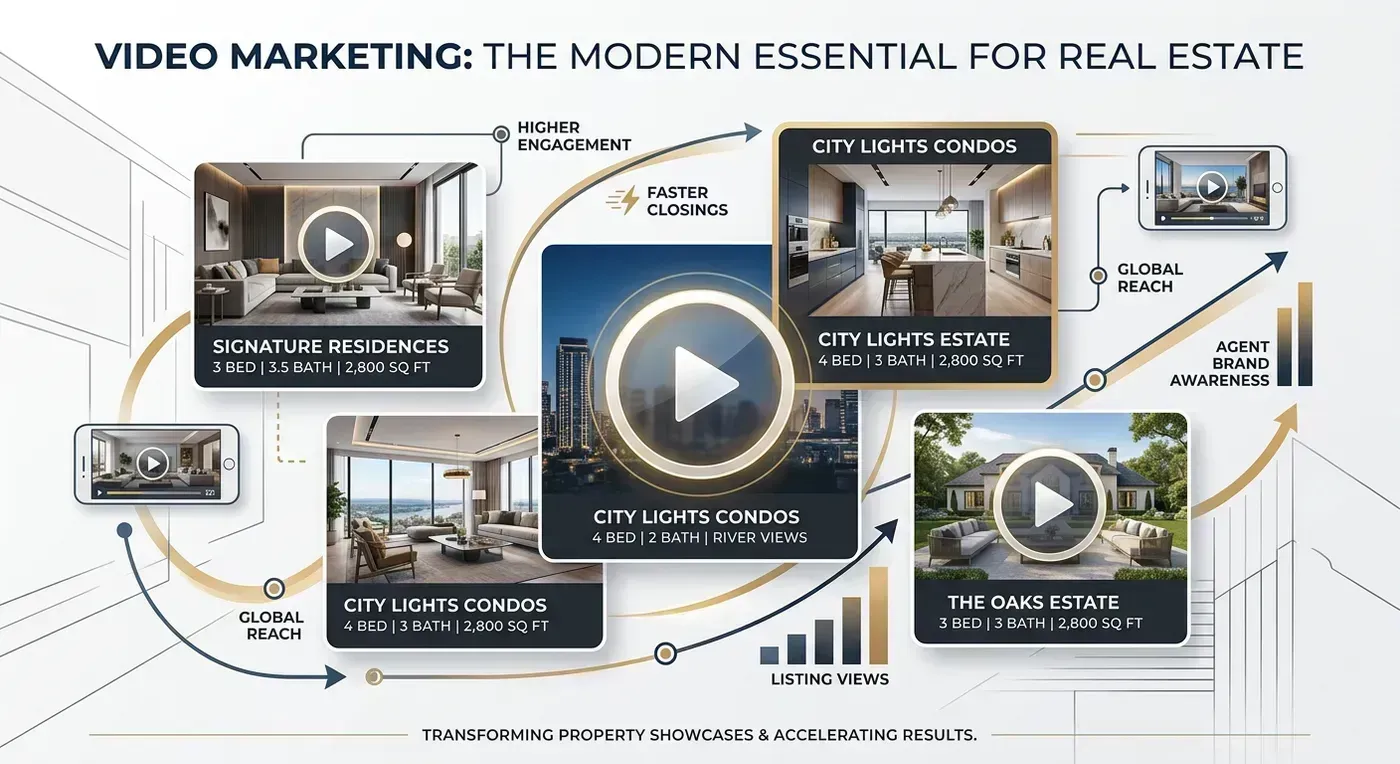
The National Association of Realtors reports that 73% of homeowners prefer to list with an agent who uses video. That stat alone should end the debate. But the behavioral shift is even more telling: buyers scroll past photo galleries. They stop for video. On Instagram, a listing video gets 10x the engagement of a photo carousel. On Zillow, video-enhanced listings appear higher in search results and get clicked first.
Here's what changed. Five years ago, "real estate video" meant hiring a videographer for $800 and waiting a week. Only luxury listings justified that cost. In 2026, AI tools can turn your existing MLS photos into cinematic listing videos in under two minutes, for $9-15 per video. That changes the calculus entirely. Video isn't a premium add-on anymore. It's the baseline expectation.
Agents who understood this early are dominating. A Coldwell Banker team in San Jose reduced their videography spend by 90% while tripling their listing video output. A solo agent in Austin started sending listing videos to sellers before listing appointments and won listings over agents who showed up with just a CMA. This isn't theory. The results are already here for agents willing to adapt.
The video marketing shift: 2023 vs 2026
Three years ago, real estate video marketing meant one of two things: hiring a local videographer or spending an hour in Canva dragging photos onto a timeline. Both had problems. Videographers cost $500-1,200 per property and required scheduling, staging, and days of turnaround. Canva produced slideshows that looked exactly like what they were: photos with a Ken Burns zoom pasted over elevator music.
The 2024-2025 inflection point was AI video generation. Not the gimmicky "AI" label slapped onto template tools, but actual generative models that create realistic camera movement from flat images. Orbit shots around a kitchen island. Push-ins through a hallway. Pull-outs from a bedroom window to reveal the view. The kind of movement that previously required a gimbal, an operator, and $800.
The result: video marketing for realtors went from a luxury expense to a utility cost. And that changed who uses it. In 2023, roughly 15% of agents used video consistently. NAR's 2025 member survey put that number at 38%, with agents under 35 adopting at nearly 60%. By the end of 2026, video will be as standard as professional photography. The window to gain a competitive advantage is closing. The agents who move now still get the edge. The agents who wait six more months will be playing catch-up.
Buyer expectations have shifted too. The median homebuyer is now 36 years old. This cohort grew up on YouTube, lives on Instagram, and discovered their last 3 restaurants via TikTok. When they see a listing with 25 photos and no video, it registers as incomplete. Not outdated, just incomplete, like a restaurant with no website. They'll still look at it, but they'll engage more with the listing that has a 60-second walkthrough video showing the actual flow of the home. The agent providing that experience gets the showing request first.
Types of real estate videos that drive results
Not all real estate video content performs the same. Here are the five formats worth your time, ranked by ROI:
1. Listing tour videos
The core of real estate video marketing. A 60-90 second walkthrough with cinematic camera motion and music. These go on MLS, YouTube, your website, and social media. They're the single highest-ROI video type because they directly drive buyer inquiries. Every listing should have one. No exceptions. Not just the $800K listings. The $285K three-bedroom in Tampa needs video too, because that seller is watching to see if you actually market their home.
2. Social media reels (Instagram + TikTok)
Short-form vertical video, 15-60 seconds, for Instagram Reels, TikTok, and YouTube Shorts. These are discovery engines. Your next client isn't searching for you on Google. They're scrolling TikTok at 11pm and your listing reel stops their thumb. The key is volume and consistency: 3-5 reels per week. Each reel doesn't need to be groundbreaking. It needs to exist.
3. Property highlight clips
Quick 15-30 second clips focusing on a single feature. The kitchen reveal. The backyard at sunset. The walk-in closet. These work as teasers before the full listing video drops, and they're perfect for Instagram Stories. One listing can produce 3-4 highlight clips, giving you content for an entire week from a single property.
4. Neighborhood and market update videos
Educational content that positions you as the local expert. "3 things happening in the Austin housing market this month." "Why this neighborhood is underpriced right now." These don't sell a specific property, but they build trust. The agent who posts consistent market commentary is the agent who gets the call when someone decides to list.
5. Agent introduction and brand videos
A 60-second video pinned to the top of your Instagram profile that answers: who are you, what do you specialize in, and why should someone work with you? This isn't a priority if you're already doing listing videos, but it rounds out your video marketing strategy and gives new profile visitors a reason to follow.
Bonus: Just-sold recap videos
An underrated format. After closing, create a quick video showcasing the sold property with "SOLD" branding. This does double duty: it reinforces your track record to potential sellers watching your feed ("this agent actually sells homes"), and it gives the buyer and seller a shareable piece of content they'll post to their own social media, expanding your reach organically. If the buyer or seller tags you, that's free advertising to their entire network of friends who are statistically in the same life stage and therefore more likely to be future homebuyers or sellers themselves.
Video marketing for realtors: platform-by-platform strategy
Instagram Reels
Instagram is where real estate agents have the most to gain in 2026. Reels get 2x the reach of static posts and 3x the reach of carousel posts. The algorithm actively pushes real estate content to local audiences, which is exactly the distribution you want.
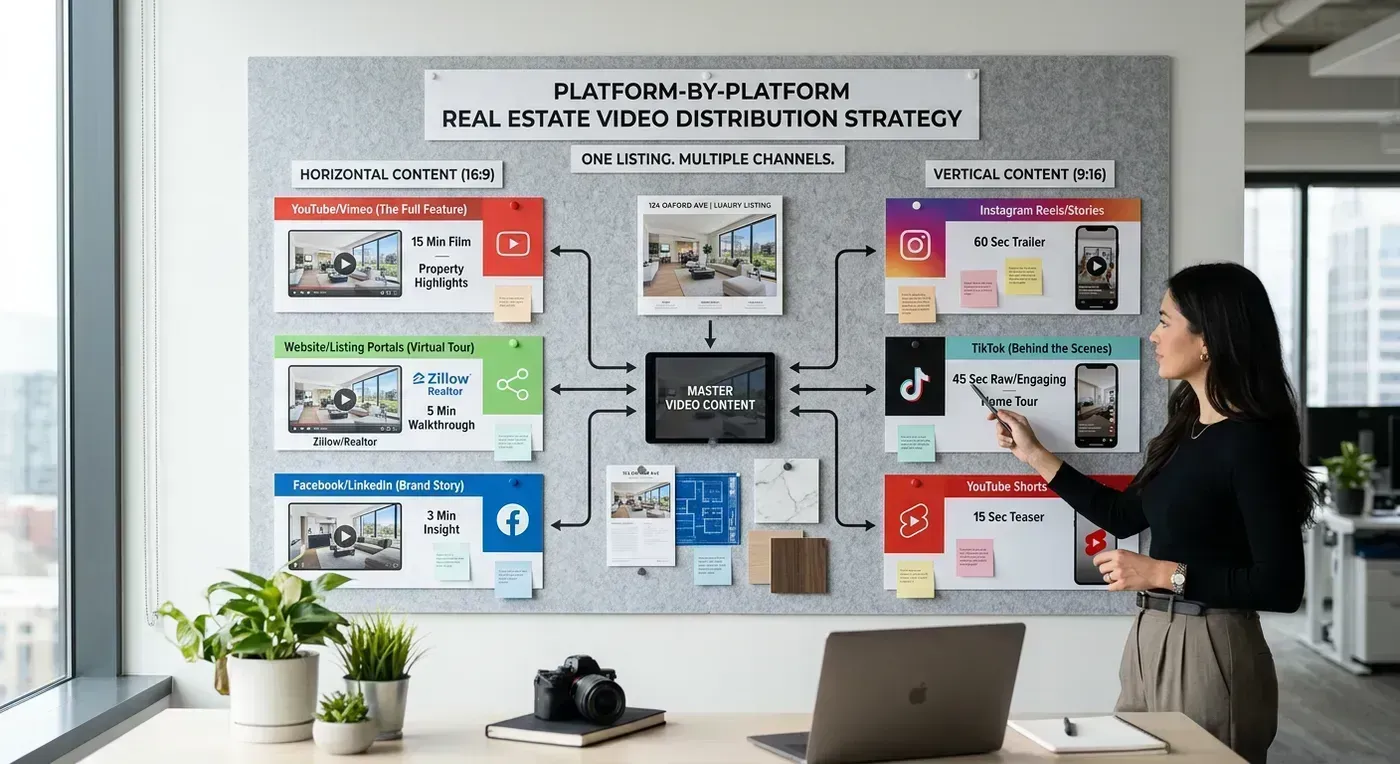
Format: 9:16 vertical, 30-60 seconds. Best posting times: Tuesday-Thursday, 11am-1pm and 7-9pm local time. Caption strategy: Lead with a hook ("This $425K home has something you don't see in this price range"), include the address and price, end with a CTA ("DM me for a showing" or "Link in bio for details"). Use 8-12 hashtags mixing broad (#realestate) with local (#austinrealestate).
What works: Branded listing tours with your logo and contact info. The AI listing video you'd post on MLS, reformatted to vertical. No need to create separate content. Just make sure you have a vertical version of every listing video. Agents who repurpose listing videos across vertical and horizontal formats consistently report 2-3x the engagement of those who create platform-specific content from scratch, because the extra effort rarely translates to better results.
Pro tip: Instagram's algorithm favors accounts that post Reels at consistent times. Pick your 3-4 weekly slots and stick to them for at least 60 days before changing. The algorithm needs time to learn who to show your content to. Switching schedules weekly confuses it and tanks your reach.
TikTok
TikTok's algorithm is the most democratic in social media. A brand-new account with zero followers can get 100,000 views on their first video if the content is good. Real estate is one of TikTok's top-performing categories, and the platform's user base now includes 35-44 year olds, the prime first-time and move-up buyer demographic.
Format: 9:16 vertical, 15-60 seconds. Best posting times: Monday-Wednesday, 7-9pm. Thursday-Saturday, 10am-12pm. Content mix: 60% listing tours, 20% market commentary, 20% personality/behind-the-scenes. TikTok rewards authenticity. The listing video with your honest reaction to a wild kitchen backsplash will outperform the polished corporate post every time.
What to avoid: Don't post the same video to TikTok and Instagram without removing the Instagram watermark (and vice versa). Both platforms detect and suppress cross-posted content with competitor watermarks. Export your vertical listing video once and upload natively to each platform. If your video tool gives you a clean unwatermarked vertical file, this is already handled.
YouTube
YouTube is the second-largest search engine on the planet. Buyers actively search "homes for sale in [city]" on YouTube. A listing tour you post today can generate views for 6-12 months. That's unmatched shelf life compared to social media, where content dies in 48 hours.
Format: 16:9 horizontal, 60-180 seconds. SEO matters here: Title should include the address, city, and price. Description should have neighborhood keywords. Tags should include "homes for sale in [city]" and "real estate [city]." Thumbnail: Use the best exterior photo with text overlay showing price and key feature ("$525K | 4BR Pool Home").
Underused tactic: Create a YouTube playlist for each neighborhood you work. "Homes for Sale in Westlake Hills." "Downtown Austin Condos." As you add listing videos over time, the playlist becomes a searchable catalog that builds domain authority for those neighborhood keywords. Three months of consistent posting and you'll start ranking for "[neighborhood] homes for sale" searches on YouTube. That's free, recurring lead generation.
Facebook organic reach is roughly 2-5% of your followers. That's terrible. But Facebook video ads remain the lowest cost-per-click channel in real estate marketing. Post listing videos to your business page for your existing audience, then boost the best-performing posts with $20-50 in ad spend targeting your farm area. The 35-55 demographic that dominates Facebook is also the demographic most likely to be selling a home.
Ad targeting tip: Create a custom audience of people who watched 50%+ of your previous listing videos, then create a lookalike audience from that group. This targets people who behave like your engaged viewers but haven't found you yet. The cost per lead from this approach is typically 40-60% lower than interest-based targeting.
MLS and listing portals
This is the one most agents skip, and it's arguably the most important. Most MLS systems now support video uploads, and listings with video on MLS stand out in search results. Zillow, Realtor.com, and Redfin all surface video-enhanced listings more prominently. Use horizontal 16:9 format, unbranded (most MLS systems prohibit agent branding in media). A tool that gives you both branded and unbranded versions saves you the headache of creating separate exports.
Here's the thing about MLS video that agents miss: it doesn't just help the listing. It helps you win future listings. When a potential seller searches their neighborhood on MLS and sees that your listings have video while other agents' don't, that's a powerful differentiator. You're demonstrating a higher level of marketing before you've even met the seller.
Filming real estate: the old way vs the new way

The traditional approach to filming real estate: hire a videographer ($500-1,200 per property), coordinate schedules with the homeowner, make sure the home is staged and clean, wait for the crew to shoot (2-3 hours on site), then wait 3-7 business days for editing and delivery. For an agent listing 8 properties per month, that's $4,000-9,600/month and a scheduling nightmare. Most agents doing this only video their top 2-3 listings and skip the rest.
The new approach: AI-powered video creation. Upload your existing listing photos (the same ones going on MLS), choose a music track, and get a cinematic listing video in under two minutes. The AI generates actual camera movement from still photos. Orbits. Push-ins. Pull-outs. Smooth reveals. Not a slideshow with zoom effects. Real depth-aware motion paths that make it look like a camera operator walked through the property.
Here's what that looks like in practice. This listing video for "1 Island Vista" was created by Josh Altman's team using Reel-E, from listing photos, in under two minutes:
Does this replace videographers entirely? No. For $3M+ luxury properties where drone footage, twilight shoots, and lifestyle staging add unique value, a professional crew still makes sense. But for the other 90% of your listings, the $340K ranches, the $520K townhomes, the $275K condos, AI video delivers comparable quality at 1/50th the cost. And crucially, it means every listing gets video. Not just the ones you decide are "worth it."
A real-world comparison
Consider a KW team in Nashville doing 10 listings per month. Before switching to AI video, they hired a videographer for their top 3 listings at $750 each ($2,250/month). The other 7 listings got photo-only marketing. After switching to Reel-E at $97/month, all 10 listings get professional video. Their total video spend dropped from $2,250 to $97, and their listings with video went from 3/month to 10/month. The result: social engagement tripled, average days on market dropped from 38 to 26, and two sellers specifically cited the listing video as the reason they chose the team over a competing agent. The math isn't complicated. More video, less spend, better results.
The ROI of real estate video marketing
Agents want numbers, so here are three real-world scenarios:
Scenario 1: Solo agent, 4 listings/month
| Metric | Without video | With AI video |
|---|---|---|
| Monthly cost | $0 | $44/month (Essential plan) |
| Cost per listing video | N/A | $11 |
| Listing inquiries | ~6/month | ~24/month |
| Social media reach | ~500/week | ~5,000/week |
| Avg days on market | 52 days | 35 days |
At $44/month, you need one additional showing that converts to a sale over an entire year to be profitable. One. The actual ROI is closer to 50:1.
Scenario 2: Small team, 10 listings/month
| Metric | Videographer | AI video |
|---|---|---|
| Monthly cost | $5,000-8,000 | $97/month (Growth plan) |
| Cost per listing video | $500-800 | $9.70 |
| Videos per listing covered | Top 3-4 only | All 10 |
| Turnaround time | 3-7 days | 2 minutes |
| Formats delivered | 1 (usually horizontal) | 4 (H+V, branded+unbranded) |
The team saves $59,000-95,000 per year while producing more videos for more listings. That's not a rounding error. That's a new hire's salary.
Scenario 3: High-volume team, 30+ listings/month
| Metric | Videographer | AI video |
|---|---|---|
| Monthly cost | $15,000-30,000 | $449/month (Pro plan) |
| Cost per listing video | $500-1,000 | $9-15 |
| Listings with video | 8-12 (budget-limited) | All 30+ |
| Quality | Professional (1080p) | Professional (4K) |
At scale, the math becomes absurd. $449/month for 30+ 4K listing videos versus $15,000+ for a fraction of that coverage. The high-volume team can reinvest the savings into ad spend, which compounds the video's impact.
5 mistakes agents make with video marketing
Knowing the strategy isn't enough if you sabotage yourself with common errors. Here are the five mistakes that kill real estate video marketing results:
1. Inconsistency
The agent who posts 10 videos in January and zero in February gets worse results than the agent who posts 3 per week every week. Social media algorithms reward consistency. Your audience rewards consistency. Post regularly or don't bother starting. This is why low-effort, high-quality AI video tools matter: they make consistency possible even when you're buried in closings.
2. Wrong format for the platform
Posting a horizontal 16:9 video to Instagram Reels is like showing up to a pool party in a suit. It technically works, but you look out of place and nobody wants to engage. Vertical for Reels/TikTok. Horizontal for YouTube/MLS. Both for every listing. If your tool doesn't export both formats automatically, switch tools.
3. No call to action
Beautiful listing video. Gorgeous property. No CTA. The viewer watches, double-taps, and keeps scrolling. Every video needs a next step: "DM for showing details." "Link in bio for full listing." "Save this for your house hunt." Tell people what to do. They will do it more often than you think. The agents getting 20+ DMs per listing video aren't creating better videos. They're writing better captions with a clear next step.
4. Waiting for the "perfect" video
The listing video you post today is infinitely better than the perfect video you post never. Agents spend weeks researching videographers, comparing editing software, and watching YouTube tutorials on color grading. Meanwhile, their competitor listed a property, posted an AI video in 2 minutes, and got 15 inquiries before the first agent even scheduled a shoot. Done is better than perfect. Especially in real estate, where a listing's first 7 days on market are the most critical for generating interest. A video posted on day 14 misses the window entirely.
5. Only making video for expensive listings
If you only create video for your $700K+ listings, you're telling your $350K sellers that their home isn't worth the effort. Every listing deserves video. When the cost per video is $4-16 with an AI tool, there is zero reason to skip any listing. The seller of that $290K condo will remember that you gave their home the same marketing treatment as the million-dollar estate down the street. That's how you get referrals.
Think about it from the seller's perspective. They're interviewing 2-3 agents. You show up with a sample listing video you created for a similar property in 2 minutes during your listing appointment. The other agents show up with a printout of comparable sales. Who gets the listing? The agent who demonstrated marketing capability in real time wins. And if your tool can create a video from the seller's existing listing photos during the appointment itself, that's a closing move most agents can't match.
Real estate video content calendar
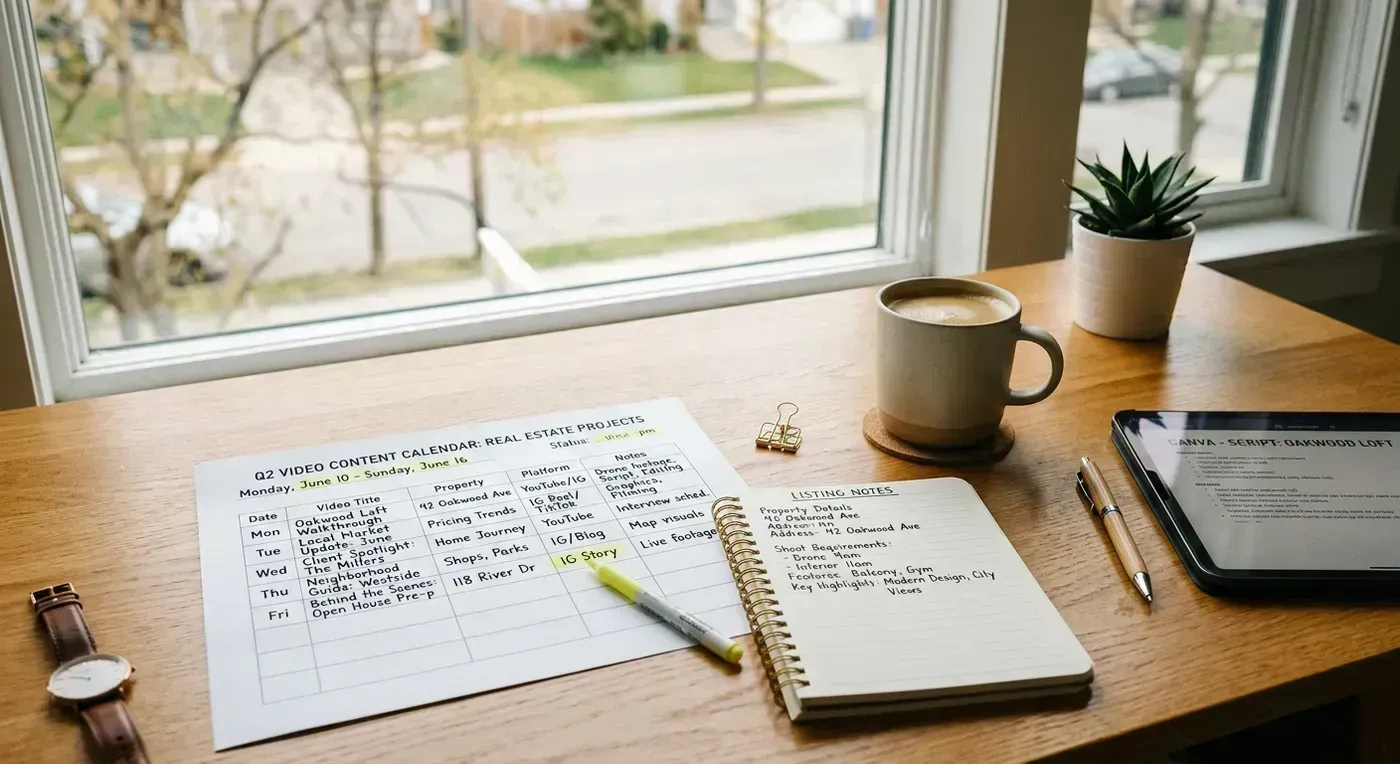
Stop guessing what to post. Here's a week-by-week template you can start using immediately:
| Day | Content type | Platform | Format |
|---|---|---|---|
| Monday | New listing tour video | Instagram Reels + TikTok | 9:16 vertical, 30-60s |
| Tuesday | Same listing, full tour | YouTube + MLS | 16:9 horizontal, 60-90s |
| Wednesday | Property highlight clip (kitchen, view, etc.) | Instagram Stories + TikTok | 9:16 vertical, 15-30s |
| Thursday | Market update or neighborhood spotlight | Instagram Reels + YouTube | Both formats |
| Friday | Second listing tour or just-sold recap | Instagram Reels + TikTok | 9:16 vertical, 30-60s |
| Saturday | Open house teaser or weekend showing preview | Instagram Stories + Facebook | 9:16 vertical, 15s |
| Sunday | Rest or batch-create next week's content | - | - |
Notice the pattern: one listing can fuel 3-4 pieces of content across the week. The full tour goes on MLS and YouTube. A vertical cut goes on Reels and TikTok. A highlight clip goes on Stories. One upload to an AI listing video maker gives you all these formats automatically. The calendar isn't about creating more. It's about distributing what you already have.
Batch creation tip: Spend 30 minutes every Sunday batch-creating the week's content. If you have 2 active listings, that's 2 listing videos (each producing 4 format variants), plus 2-3 highlight clips. Upload everything to a scheduling tool like Later, Planoly, or even Instagram's native scheduler. Then forget about content creation until next Sunday. The total time investment: 30 minutes per week, 2 hours per month. That's less than a single listing appointment.
What if you don't have a new listing this week? Repurpose. Repost a previous listing tour with "JUST SOLD" text overlay. Create a "market update" video using your phone's selfie camera (60 seconds, no editing needed). Feature a local business in your farm area. Share a testimonial from a recent client. The point is maintaining your posting cadence, not creating a Hollywood production every week.
How to get started with real estate video marketing
You don't need a camera. You don't need editing skills. You don't need a $2,000/month videography budget. Here's the step-by-step:
- Pick your next listing. Choose any active listing, even one that's been on the market for weeks. Existing MLS photos work perfectly. You can also paste a Zillow, Redfin, or Realtor.com URL and the tool pulls photos automatically.
- Upload photos and choose music. Select 10-30 photos that show the property's best features. Pick a music track that matches the home's vibe. A $285K starter home gets upbeat, energetic music. A $1.2M estate gets something cinematic and elegant.
- Let the AI create your video. The AI analyzes each photo, generates depth-aware camera motion paths (orbits, push-ins, pull-outs), and syncs transitions to the music's beat. Two minutes later, you have four complete videos: horizontal branded, horizontal unbranded, vertical branded, vertical unbranded.
- Post everywhere. Upload the horizontal unbranded version to MLS. Post the vertical branded version to Instagram Reels and TikTok. Upload the horizontal branded version to YouTube and Facebook. Share the link with your seller. One upload, four videos, every platform covered.
Start with one listing. See the response. Then do it for every listing going forward. Within 30 days, you'll see measurably more inquiries. Within 90 days, you'll wonder how you ever marketed without video.
Your first week: a step-by-step action plan
Day 1: Sign up for a 7-day free trial of an AI real estate video tool. Create your first listing video from your most recent active listing. Post the vertical version to Instagram Reels with a strong caption and CTA. Total time: 15 minutes.
Day 2: Post the horizontal version to YouTube with a keyword-optimized title and description. Upload the unbranded version to your MLS listing. Total time: 10 minutes.
Day 3: Create a second listing video for another active property. Post the vertical version to TikTok. Total time: 10 minutes.
Day 4: Post a highlight clip (pick the best single room from either listing) to Instagram Stories. Total time: 5 minutes.
Day 5: Post the second listing video to Instagram Reels and YouTube. Share both listing videos with your sellers. Total time: 15 minutes.
Days 6-7: Review your analytics. Check Reel views, YouTube impressions, and MLS listing activity. Note what performed best. Plan next week's content.
Total investment for your first week: about 55 minutes. That's less than the time most agents spend agonizing over a single email newsletter. And the results will be visible in days, not months.
Video marketing tools for real estate: a quick overview
The tool you use matters less than whether you use one at all. That said, here's how the main options compare:
| Tool | Type | Cost | Time per video | AI camera motion | RE-specific |
|---|---|---|---|---|---|
| Reel-E | AI video from photos | $44-$449/mo | 2 min | Yes | Yes (100%) |
| Canva | Template editor | Free-$15/mo | 15-30 min | No | No |
| InVideo | Template editor | $25/mo | 10-20 min | No | No |
| CapCut | Manual editor | Free | 20-45 min | No | No |
| Videographer | Professional | $500-1,200/listing | 3-7 days | N/A (real camera) | Depends |
What to look for in a real estate video tool: Four things matter. First, does it produce real camera motion or just slideshow transitions? Buyers can tell the difference instantly. Second, does it export both horizontal and vertical formats from one upload? If you have to re-export for each platform, you'll stop doing it within two weeks. Third, does it include branded and unbranded versions? MLS requires unbranded. Social media performs better with branding. You need both. Fourth, how fast is it? If creating a listing video takes more than 5 minutes, it won't become part of your routine. The data on video listings selling faster (and our complete video statistics roundup) only helps if you actually create the videos.
For a complete platform-by-platform strategy including content calendars and posting schedules, read our social media videos guide for real estate agents. For a deep dive on tools, read our full real estate video marketing tools comparison or the best real estate video makers roundup.
Frequently asked questions
Is video marketing worth it for real estate agents?
Yes. Listings with video get 403% more inquiries. Agents who use video grow revenue 49% faster than those who don't. With AI tools bringing the cost down to $9-15 per listing video, the ROI is immediate for virtually every agent, regardless of market or price point.
What is the best platform for real estate video marketing?
Instagram Reels for discovery and engagement. YouTube for long-term search visibility. MLS for direct buyer inquiries. The best strategy posts to all three. A tool that exports both horizontal and vertical formats from one upload makes this practical rather than painful.
How much does real estate video marketing cost?
Traditional videography: $500-1,200 per property. AI-powered tools like Reel-E: $44-$449/month for 3-50 listings, making each video $9-15. For most agents, the monthly cost is less than a single client lunch. See current pricing.
Do I need professional photos for listing videos?
No. AI video tools work with phone photos, professional photography, MLS photos, and even architectural renderings. Better photos produce better videos, but any clear, well-lit photos will work. You can also paste a listing URL from Zillow or Redfin and the tool pulls photos automatically.
How often should real estate agents post video?
3-5 videos per week across social platforms for maximum algorithmic reach. Every new listing should have a video posted on day one. The content calendar above shows how to get 5+ pieces of video content per week from just 1-2 listings. Consistency matters more than production value.
What's the difference between AI video and a slideshow?
A slideshow applies basic zoom-and-pan effects (Ken Burns) to still photos. It looks like exactly what it is: a slideshow. AI video tools like Reel-E generate actual 3D camera motion paths from flat images, creating orbits, push-ins, and pull-outs that simulate a real camera operator walking through the property. The difference is immediately visible to buyers scrolling through listings. Read more about how the AI technology works.
Can I use listing video on my MLS?
Yes. Most MLS systems now support video uploads. The key requirement is using horizontal 16:9 format without agent branding (most MLS compliance rules prohibit logos and contact info in media uploads). A tool that automatically exports both branded (for social) and unbranded (for MLS) versions from a single upload saves you from dealing with this manually.
What kind of photos work best for listing videos?
Any clear, well-lit photos work. Professional photography produces the best results, but phone photos, MLS photos, and even architectural renderings are all viable. The AI needs enough visual information to generate camera motion, so avoid extremely dark, blurry, or heavily filtered images. For best results, include 15-30 photos covering all major rooms and exterior shots. You can also paste a Zillow, Redfin, or Realtor.com URL and the tool pulls the photos automatically.
Video marketing for real estate is the biggest competitive advantage available to agents in 2026. The window is closing as adoption increases. Start with one listing. See the results. Then never go back to marketing without video.
Try Reel-E free for 7 days and create your first AI listing video in 2 minutes. Or read our step-by-step guide to turning listing photos into video.
Recommended Next Steps for Agents
Turn this strategy into a production workflow with AI real estate video, real estate video maker workflows, and listing video maker templates. For deeper tactical planning, review video marketing for real estate and real estate video statistics before your next campaign sprint.