
I spent last November reviewing our analytics for the year. Across 4,200+ videos created on Reel-E, one pattern screamed louder than everything else: the agents who treated video as a system (not a one-off experiment) generated 3.7x more inquiries per listing than agents who posted sporadically.
That is not a typo. Not 37% more. 370% more.
The difference was not production quality, camera gear, or editing skills. It was consistency, distribution, and strategy. The agents who won had a plan. The agents who stalled were posting whenever they "felt like it," which averaged out to about once every three weeks.
This article is the plan. A complete video marketing strategy for real estate agents in 2026, built from real data, with monthly content calendars you can copy, budget breakdowns that actually make sense, and platform-specific tactics that go beyond "post consistently." If you are already posting videos but not seeing leads, this will show you what is missing. If you have not started yet, this is your blueprint.
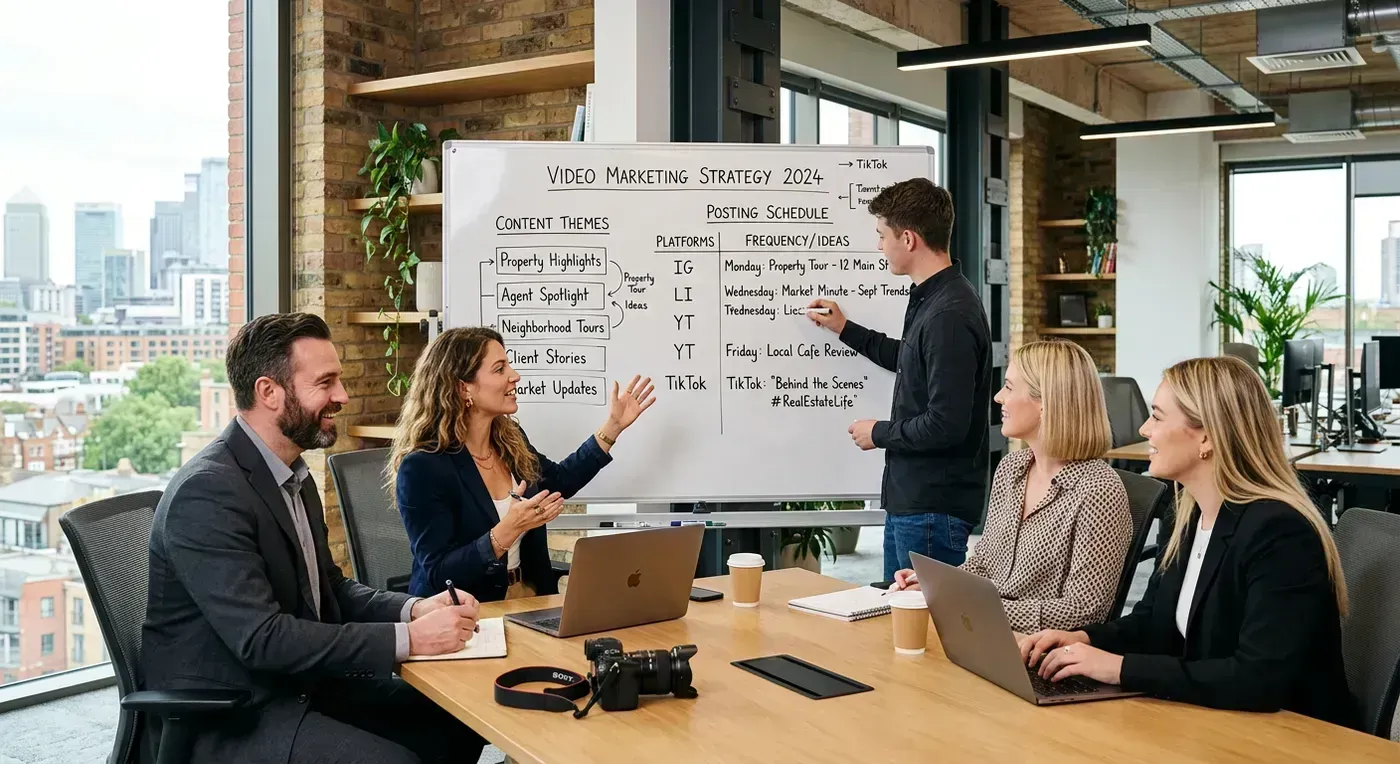
Why Most Agents Fail at Video Marketing (And How to Avoid It)
The National Association of Realtors has been publishing the same stat for three years: listings with video receive 403% more inquiries. And yet, fewer than 10% of agents use video consistently. That gap is not a knowledge gap. Every agent knows video works. It is an execution gap.
Here are the three reasons agents fail at video marketing, ranked by how often I see them:
1. No System, Just Intentions
"I should be doing more video" is not a strategy. Without a content calendar, a batch production workflow, and a distribution checklist, video becomes the thing you do when you have a spare afternoon. Which is never. The agents who succeed at video treat it like they treat their CRM: it runs on a schedule regardless of how busy they feel.
2. All Production, No Distribution
Spending 45 minutes on a listing video and then posting it once to Instagram is like printing 500 flyers and putting them in a single mailbox. The video itself is only 20% of the work. The other 80% is distribution: posting across platforms, sharing to stories, embedding in email drips, texting to past clients in the neighborhood, sending to the seller for their own channels, and boosting the highest-performing posts. We will cover a complete distribution framework later in this article.
3. Measuring the Wrong Things
Views are not leads. Likes are not closings. Agents look at 200 views on a Reel, decide "video does not work for me," and quit. Meanwhile, the agent down the street got 180 views on a similar Reel, but one of those viewers was a homeowner thinking about selling, who DM'd the agent, who converted that conversation into a $14,000 commission check 90 days later. Video marketing ROI is not measured in vanity metrics. It is measured in pipeline and closed transactions over a 90 to 180 day window.
For the hard data on why video outperforms photo-only listings, see our real estate video statistics roundup. And if you are still on the fence about whether video actually moves the needle on sale price and days on market, our analysis of whether video listings sell faster covers the research.
The 2026 Video Marketing Framework: Three Pillars
Every effective real estate video strategy rests on three pillars. Miss one, and the whole thing underperforms.
Pillar 1: Listing Content (Your Bread and Butter)
This is the baseline. Every listing you take should have video within 24 hours of photos being delivered. Not some listings. Not your expensive listings. Every single one. Here is why: video marketing for real estate is no longer a differentiator for luxury properties. It is table stakes across all price points.
The 24-hour window matters because of how listing portals rank content. Zillow's algorithm surfaces new listings with complete media (photos + video + 3D tour) higher than listings that add media days later. The first 48 hours are when a listing gets 73% of its total views on portal sites. If your video is not live by then, you have missed the peak.
What listing content looks like in practice:
- Just-listed video (day 1): Full property showcase, 30 to 60 seconds, posted everywhere
- Highlight reel (day 2 to 3): 15-second clip of the best feature (the kitchen, the view, the pool) for Stories and Reels
- Price update video (if applicable): Quick talking-head over b-roll when you adjust the price
- Open house teaser (3 days before): Short vertical clip with date, time, address overlay
- Just-sold video (after closing): Celebration post that doubles as a subtle flex to potential sellers
That is five video touchpoints from a single listing. Each one takes less than five minutes when you have a system in place. With Reel-E, the listing video itself takes under two minutes. The highlight reel is just a trimmed clip. The rest are quick phone videos with text overlays.
Pillar 2: Authority Content (Your Long Game)
Listing videos attract buyers. Authority content attracts sellers. And sellers are where the money is.
Authority content positions you as the expert in your market. It is the content that makes a homeowner think, "This agent really knows the neighborhood. I should talk to them when I am ready to sell." It includes:
- Monthly market updates: Break down local stats (median price, inventory, days on market, absorption rate) in a 2 to 3 minute video. Use screen recordings of MLS data or simple graphics.
- Neighborhood spotlights: Walk through a neighborhood and highlight what makes it special. Local restaurants, parks, school ratings, commute times. These rank in YouTube search and generate passive views for years.
- Buyer/seller education: "5 things sellers overlook before listing," "What your home inspection really means," "How to read a comparative market analysis." Practical advice that builds trust.
- Community event coverage: Local farmers market, charity 5K, school fundraiser. Shows you are part of the community, not just selling in it.
The key insight: authority content has a much longer shelf life than listing content. A listing video is irrelevant after the property sells. A "Guide to Living in Westlake" video generates views and leads for 2 to 3 years. Invest proportionally.
Pillar 3: Personal Brand Content (Your Differentiator)
People hire people they like. Personal brand content is how they get to know you before the first meeting. This is the category most agents skip because it feels "narcissistic" or "not professional." In reality, it is the most powerful lead generation content you can create.
- Day-in-the-life snippets: Quick 15-second clips of your actual day. Driving to a showing, staging a home, writing an offer, celebrating a closing.
- Client stories (with permission): Short testimonials or closing-day celebrations. Social proof is the most persuasive content type.
- Behind the scenes: Show the work that goes into a listing: the staging process, the photo shoot, the marketing prep. Sellers do not understand how much you do. Show them.
- Hot takes and opinions: "I think open houses are overrated for selling homes. Here is why." Polarizing content drives engagement. Just be genuine, not contrarian for clicks.
The split should be roughly 40% listing content, 30% authority content, 30% personal brand. Adjust based on where you are in your career. New agents with few listings should lean heavier on authority and personal brand (60/40 split). Top producers with 30+ listings per year can lean heavier on listing content because they have a constant stream of properties to showcase.
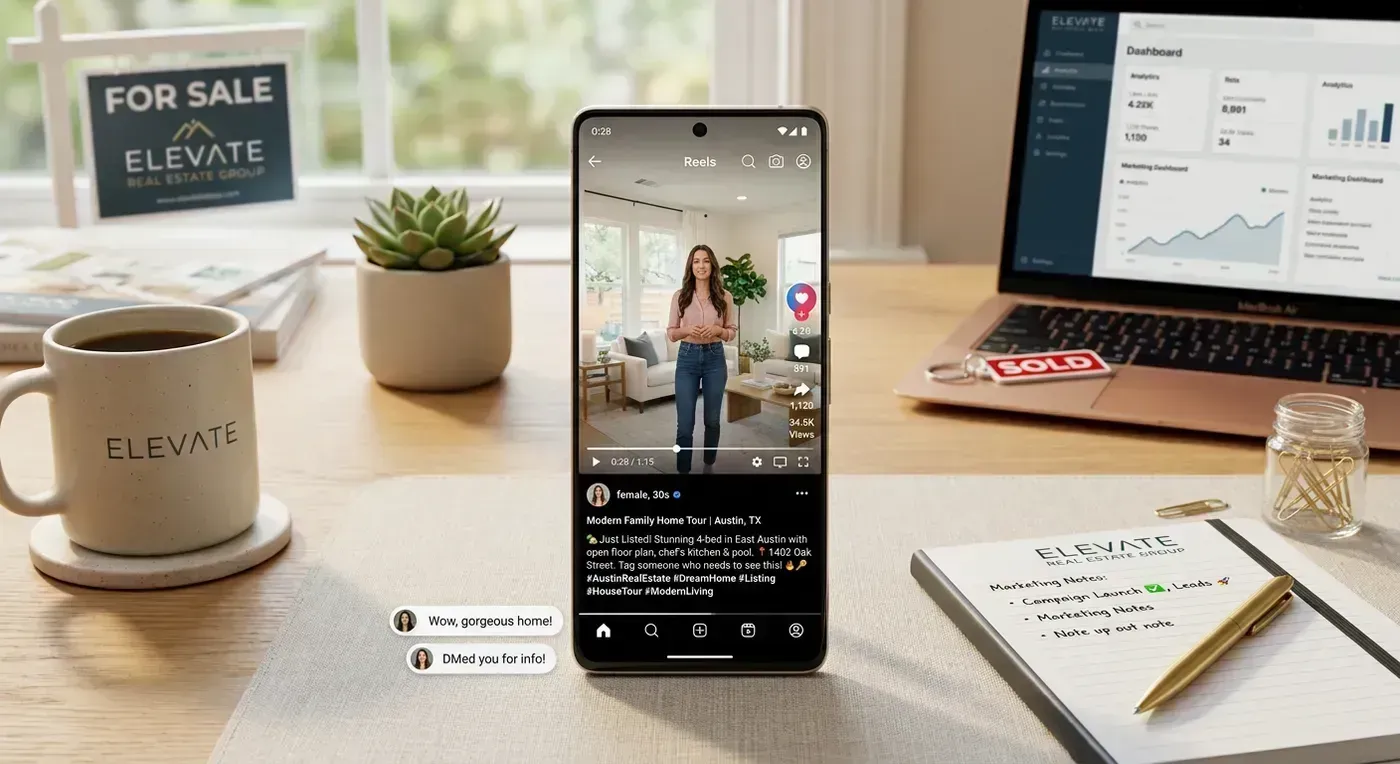
Your Monthly Content Calendar (Copy This)
Theory is nice. A calendar you can actually follow is better. Here is a month-long content calendar designed for a solo agent or small team producing 2 to 3 videos per week. Adjust the specific topics to your market.
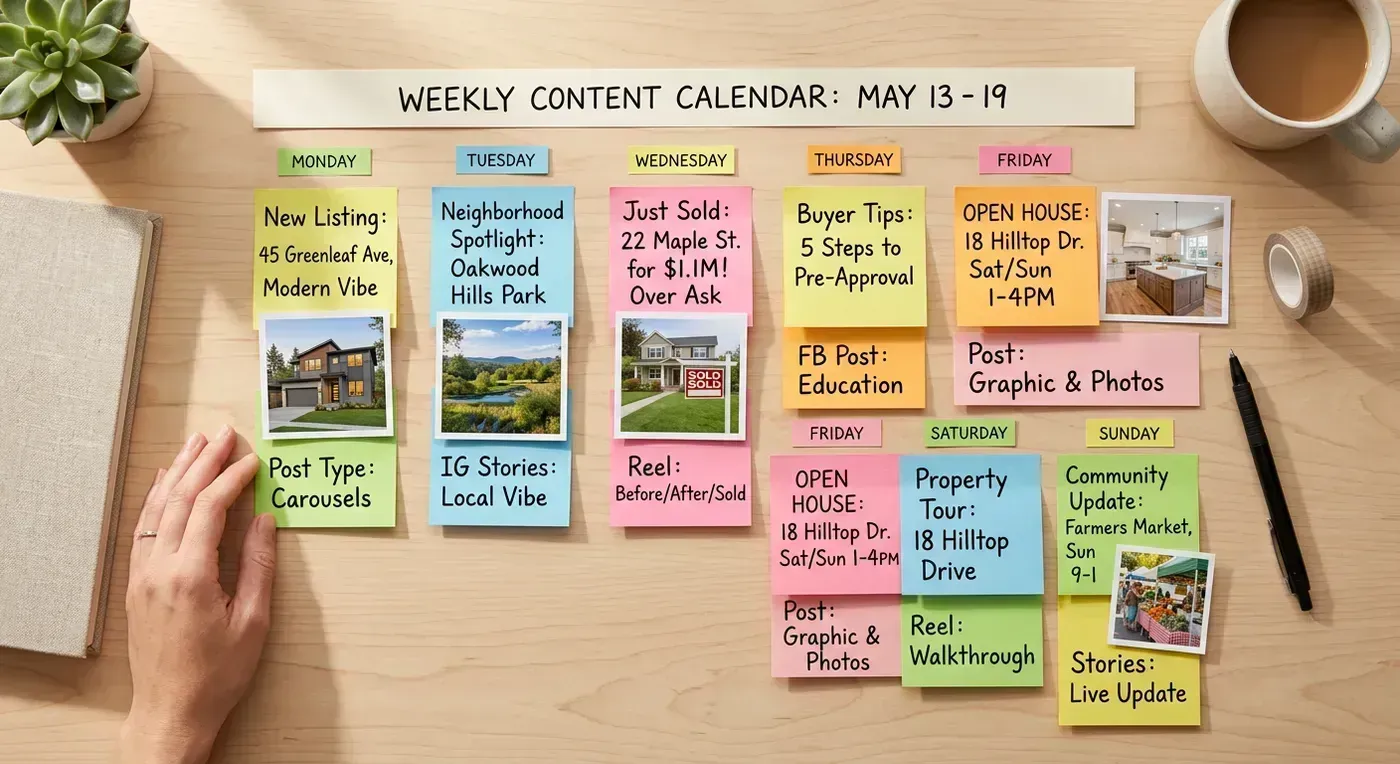
Week 1
| Day | Content Type | Video Description | Platform | Format |
|---|---|---|---|---|
| Monday | Listing | New listing showcase (full video) | Instagram Reel, TikTok, YouTube, MLS | 9:16 + 16:9 |
| Wednesday | Authority | Monthly market update (local stats) | YouTube, Instagram Reel, LinkedIn | 16:9 + 9:16 |
| Friday | Personal Brand | Behind the scenes: staging this week's listing | Instagram Story, TikTok | 9:16 |
Week 2
| Day | Content Type | Video Description | Platform | Format |
|---|---|---|---|---|
| Monday | Listing | Highlight reel: best feature of active listing | Instagram Reel, TikTok | 9:16 |
| Wednesday | Authority | Neighborhood spotlight (walk + talk) | YouTube, Instagram Reel | 16:9 + 9:16 |
| Friday | Personal Brand | Client closing day celebration | Instagram Reel, Story, Facebook | 9:16 |
Week 3
| Day | Content Type | Video Description | Platform | Format |
|---|---|---|---|---|
| Monday | Listing | Open house teaser for weekend showing | Instagram Reel, TikTok, Facebook | 9:16 |
| Wednesday | Authority | Buyer education: "3 things to check before making an offer" | YouTube, Instagram Reel, TikTok | 16:9 + 9:16 |
| Friday | Personal Brand | Day in the life: showing day montage | Instagram Reel, TikTok | 9:16 |
Week 4
| Day | Content Type | Video Description | Platform | Format |
|---|---|---|---|---|
| Monday | Listing | Just-sold celebration or new listing showcase | Instagram Reel, TikTok, YouTube, MLS | 9:16 + 16:9 |
| Wednesday | Authority | Seller tip: "The one upgrade that adds the most value" | YouTube, Instagram Reel, LinkedIn | 16:9 + 9:16 |
| Friday | Personal Brand | Community event coverage or weekend plans | Instagram Story, TikTok | 9:16 |
That is 12 videos per month. Each listing video takes under 5 minutes with an AI tool. The authority and personal brand videos are 5 to 15 minute productions (mostly shot on your phone). Total time investment: roughly 3 to 4 hours per month. For a deeper look at social media video strategy specifically, see our complete social media video guide.
Platform-by-Platform Distribution Strategy
Creating content is half the equation. Knowing where and how to distribute it is the other half. Each platform has different audiences, algorithms, and best practices. Here is what actually works in 2026, stripped of generic "just be consistent" advice.
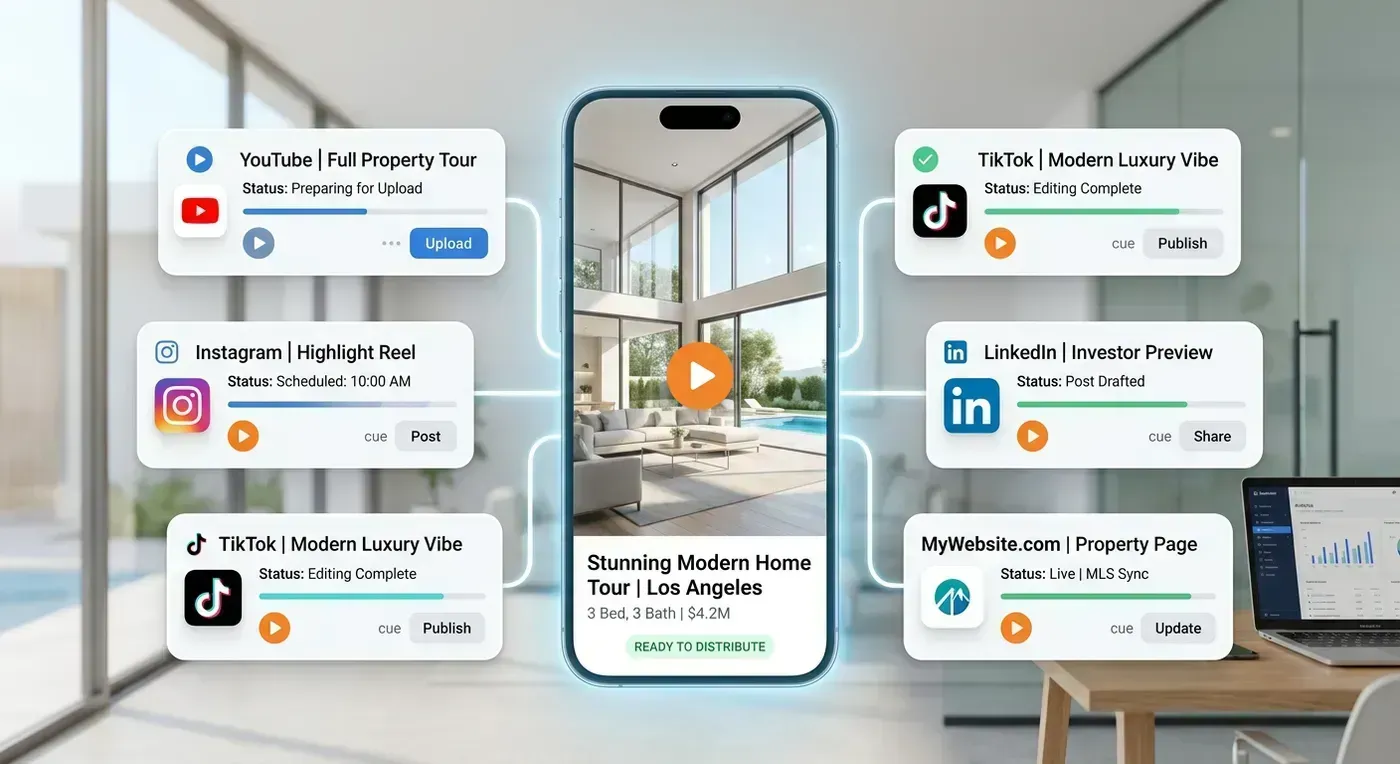
Instagram (Your Primary Platform)
Instagram remains the single most valuable platform for real estate agents in 2026. Here is why: the demographics align perfectly. 67% of home shoppers aged 28 to 45 use Instagram daily, and the platform's DM culture makes lead conversion natural. Buyers literally slide into your DMs after watching a Reel.
What works:
- Reels (9:16 vertical, 15 to 60 seconds): Your highest-reach format. The algorithm still rewards Reels over static posts. Post 3 to 5 Reels per week if you can sustain it. 2 is the minimum to maintain algorithmic visibility.
- Stories: Daily. Even if it is just a photo of your coffee and a quick "heading to a showing" caption. Stories keep you top-of-mind with your existing followers (the people most likely to refer you).
- Carousels: Surprisingly effective for listing content. A carousel with 8 to 10 listing photos, a map in slide 2, and pricing details in the last slide gets saved and shared more than single-image posts.
What does not work: Long IGTV-style videos (dead format), heavily filtered or overly polished content (the algorithm favors authentic over produced), and posting without a caption strategy (your caption should include a call to action, neighborhood name, and 3 to 5 relevant hashtags).
YouTube (Your Long-Term Asset)
YouTube is the only platform where real estate content appreciates in value over time. A neighborhood guide posted in March will still generate views and leads in December. A listing Reel posted in March is irrelevant by April.
What works:
- Property tours (2 to 5 minutes, 16:9): Full walkthroughs with or without narration. Title format: "[Address] | [Beds]BR [Baths]BA | $[Price] | [City] [State] Home Tour"
- Neighborhood guides (5 to 10 minutes): "Living in [Neighborhood]: Everything You Need to Know." These rank in Google search and pull in relocation buyers.
- Market updates (3 to 5 minutes): Monthly data breakdowns. Keep them factual and specific to your local market.
- YouTube Shorts (under 60 seconds, 9:16): Repurpose your Reels here. YouTube Shorts get less reach than Instagram Reels but attract a different audience (more male, slightly older, higher income on average).
Critical YouTube tactic: Embed your YouTube listing videos on your website's property pages. This creates a dual benefit: your website visitors see the video (increasing time on page and inquiry rates), and YouTube's algorithm sees external embedding as a quality signal (boosting your video in search results).
TikTok (Your Reach Amplifier)
TikTok's real estate audience has matured significantly since 2023. First-time homebuyers aged 25 to 34 spend an average of 48 minutes per day on TikTok (Pew Research, 2025). They are not just watching dance videos. They are watching home tours, mortgage explainers, and market commentary.
What works:
- Property reveals (15 to 30 seconds): Quick, punchy walkthroughs with trending audio. The first frame needs to hook immediately.
- Educational content with text overlays: "3 reasons not to skip a home inspection" over footage of you walking through a property. TikTok users prefer to read text on screen while watching.
- Before/after: Renovation reveals, staging transformations, or price-to-feature comparisons ("What $400K gets you in Austin vs. Miami").
What does not work: Overly professional, polished content. TikTok's algorithm and audience both favor raw, authentic, handheld content over studio-quality production. Your iPhone is your best camera on this platform.
Facebook (Your Referral Engine)
Facebook is not dead for real estate. It is just different. The organic reach is lower than Instagram or TikTok, but Facebook's audience skews older (35 to 55), wealthier, and more likely to be repeat homebuyers or sellers. More importantly, Facebook is where your sphere of influence lives: past clients, friends, family, and community members who send you referrals.
What works:
- Listing videos in local community groups (with group admin permission)
- Just-sold celebration posts (social proof for your network)
- Boosted video ads ($5 to $20/day targeting homeowners in your farm area)
LinkedIn (Your B2B Channel)
Underrated for real estate. LinkedIn is where brokers, investors, property managers, and relocation companies find agents. If any part of your business involves commercial referrals, corporate relocations, or investor clients, LinkedIn video should be in your mix. Post market updates and thought leadership content. Skip listing videos (wrong audience).
Listing Portals (MLS, Zillow, Realtor.com)
These are not social platforms, but they are where the most motivated buyers are. Upload your 16:9 horizontal listing video to every portal that accepts it. Zillow listings with video get 2x more saves than photo-only listings (Zillow Research, 2025). For the exact format specs and upload requirements for each portal, see our social media and portal video specs guide.
See What AI-Powered Listing Video Looks Like
Before we get into budgets and ROI, here is a real example. This video was created entirely from still listing photos using AI-generated camera motion, with music synced to transitions. No drone, no videographer, no editing software.
This is the kind of listing video you can produce for every property, every time, without blowing your marketing budget. The total cost per listing on Reel-E's Essential plan ($59/month for 3 listings) is roughly $20 per video. On the Growth plan ($129/month for 10 listings), it drops to $13. That is less than a Zillow Premier Agent zip code click.
Budget Breakdown: What Video Marketing Actually Costs
The biggest myth in real estate video marketing is that it requires a big budget. It does not. It requires a smart budget. Here is a realistic breakdown at three spend levels.
Tier 1: The Starter ($109 to $179/month)
For solo agents doing 3 to 6 transactions per year who want consistent video without breaking the bank.
| Expense | Monthly Cost | What You Get |
|---|---|---|
| Reel-E Essential plan | $59 | 3 listing videos/month, 4 variants each (horizontal + vertical, branded + unbranded) |
| Smartphone tripod + ring light | $5 (amortized) | Stable footage for talking-head and walk-through content |
| CapCut (free) or Canva Pro | $0 to $15 | Text overlays, captions, quick edits for personal brand videos |
| Paid social boost | $50 to $100 | Boost 2 to 4 best-performing videos per month on Instagram/Facebook |
| Total | $109 to $179 |
Output: 3 listing videos (12 variants), 4 to 8 phone-shot authority/brand videos, 2 to 4 boosted posts. Roughly 20 to 30 pieces of video content per month across all platforms.
Tier 2: The Growth Agent ($279 to $479/month)
For agents doing 12 to 24 transactions per year who are serious about building a personal brand and generating inbound leads.
| Expense | Monthly Cost | What You Get |
|---|---|---|
| Reel-E Growth plan | $129 | 10 listing videos/month, 4 variants each, individual clip downloads |
| Professional headshot + brand photos (amortized) | $15 | Polished visuals for thumbnails, social profiles, and video intros |
| Scheduling tool (Later, Buffer, or Metricool) | $25 to $45 | Pre-schedule posts, best-time publishing, basic analytics |
| Paid social promotion | $100 to $250 | Boost top videos, run retargeting to website visitors |
| Captioning tool (Captions app or Zubtitle) | $10 to $20 | Auto-generated captions for all videos (85% of social video is watched on mute) |
| Total | $279 to $479 |
Output: 10 listing videos (40 variants), 8 to 12 authority/brand videos, scheduled and captioned across 3+ platforms, 4 to 6 boosted posts. Roughly 50 to 70 pieces of video content per month.
Tier 3: The Top Producer ($649 to $1,100+/month)
For teams or solo agents doing 30+ transactions per year who want to dominate their market's online presence.
| Expense | Monthly Cost | What You Get |
|---|---|---|
| Reel-E Pro plan | $599 | 50 listing videos/month, 4K output, priority rendering, unlimited variants |
| Part-time VA or marketing assistant | $0 to $300 | Posting, caption writing, engagement management |
| Paid ads (social + YouTube) | $250 to $500 | Targeted campaigns for listings, brand awareness, and retargeting |
| Professional videographer (1 to 2 luxury listings) | $0 to $600 | Custom drone and gimbal footage for your highest-value properties |
| Total | $649 to $1,100+ |
Output: 20 to 50 listing videos (80 to 200 variants), daily content across all platforms, targeted ad campaigns, professional video for luxury listings. Complete market saturation in your farm area.
All Reel-E plans save 25% with annual billing. At the Growth tier, that is $97/month instead of $129. Over a year, that is $384 back in your pocket. Check current pricing here.
The Distribution Checklist: What to Do After You Hit "Export"
You made the video. Now what? Here is the exact distribution workflow I recommend, broken into same-day and same-week actions.
Same Day (15 minutes total)
- Upload 16:9 version to MLS (or YouTube link if MLS requires it)
- Upload 16:9 version to Zillow via listing edit page
- Post 9:16 version as Instagram Reel with property details in caption, 3 to 5 neighborhood-specific hashtags, and location tag
- Post 9:16 version to TikTok with trending audio overlay if appropriate
- Share the Reel to your Instagram Story with a "Swipe up for details" or "DM me for a showing" sticker
- Text the unbranded 9:16 version to the seller so they can share on their own social media
Same Week (30 minutes total)
- Upload 16:9 version to YouTube with optimized title, description (include address, price, neighborhood, agent contact), and tags
- Embed YouTube video on your website's property page
- Post to Facebook (personal profile, business page, and 1 to 2 relevant community groups)
- Include video thumbnail and link in your email newsletter
- Send a personal DM to 5 homeowners in the same neighborhood: "Just listed this beautiful home on [Street]. Thought you might like to see the video. Do you know anyone looking to move to [Neighborhood]?"
- Boost the Instagram Reel for $10 to $25 targeting homeowners within a 3-mile radius of the listing
That is 14 distribution touchpoints from a single listing video. Total time: about 45 minutes spread across the week. Total ad spend: $10 to $25. The listing video that would have sat on MLS collecting dust is now working across seven platforms, inside email inboxes, and in direct messages to potential sellers in the neighborhood.

Measuring ROI: The Metrics That Actually Matter
I promised specific numbers, so here they are. Based on data from agents using Reel-E (self-reported via our quarterly surveys and corroborated by PostHog analytics), here is what video marketing delivers when done consistently over 90+ days:
Tier 1 Metrics (Leading Indicators, Track Weekly)
| Metric | What It Tells You | Benchmark (90 days in) |
|---|---|---|
| Video views per post | Content is being seen | 200 to 1,000 per Reel, 50 to 300 per YouTube video |
| Average watch time | Content is engaging | 50%+ of video length on Reels, 40%+ on YouTube |
| Saves + shares | Content is valuable | 2% to 5% save rate on Instagram |
| Profile visits from video | Viewers want to learn more about you | 10 to 50 per video |
Tier 2 Metrics (Pipeline Indicators, Track Monthly)
| Metric | What It Tells You | Benchmark (90 days in) |
|---|---|---|
| DMs from video viewers | Content is generating conversations | 5 to 15 per month |
| Website clicks from video posts | Content is driving traffic | 20 to 60 per month |
| Email signups from video CTAs | Content is building your list | 5 to 20 per month |
| Showing requests on video listings | Video is influencing buyer behavior | 2x to 3x vs. non-video listings |
Tier 3 Metrics (Revenue Indicators, Track Quarterly)
| Metric | What It Tells You | Benchmark (6 months in) |
|---|---|---|
| Listings won where seller mentioned video | Video is winning you business | 1 to 3 per quarter |
| Buyer clients from video leads | Video is attracting buyers | 2 to 5 per quarter |
| Referrals from sphere citing social media presence | Video is keeping you top-of-mind | 1 to 4 per quarter |
| Closed GCI traceable to video | Hard ROI | $15K to $60K per quarter (market dependent) |
Let me put this in perspective. If you are on the Growth plan at $129/month ($1,548/year) and you close one additional transaction per quarter that is traceable to your video marketing efforts, at an average GCI of $8,000, that is $32,000 in annual revenue from a $1,548 investment. A 20:1 return.
Even if you are conservative and attribute only one extra transaction per year to video, that is still a 5:1 return. Name another marketing channel with that math.
Advanced Tactics: What Top Producers Do Differently
Once you have the basics running (consistent content, multi-platform distribution, ROI tracking), here are the tactics that separate the top 5% of agent video marketers from everyone else.
1. The "Neighborhood Farming" Video Sequence
Pick your farm area (500 to 1,000 homes). Create a 12-part YouTube series about the neighborhood: schools, restaurants, parks, commute routes, housing styles, market trends, hidden gems, upcoming development, HOA details, utility costs, and local culture. Optimize each video for "[Neighborhood Name] + [Topic]" search queries.
Within 6 months, you will own page one of YouTube for that neighborhood. When a relocation buyer Googles "living in [your neighborhood]," your face is what they see. One agent in our user base did this for a suburb of Phoenix and attributed $214,000 in GCI over 18 months directly to YouTube leads from the series.
2. The Seller Pre-Listing Video
When you go on a listing appointment, bring a tablet loaded with a video you created from the seller's own home photos (pulled from the previous listing or Zillow's photo archive). This takes 5 minutes with an AI tool. The seller sees their home transformed into a cinematic video before they have signed with you. That is the "wow" moment that wins the listing.
One agent in Orange County told us she has won 7 out of 9 listing presentations since she started doing this. Her exact words: "The other agents show a PowerPoint. I show them their house as a movie."
3. The Retargeting Loop
Set up a Facebook/Instagram retargeting pixel on your website. Anyone who views a property page gets retargeted with the listing video for that property in their social media feed. The cost is typically $0.02 to $0.05 per view. If 500 people visit a listing page, you can retarget all of them with the video for $10 to $25. These are people who already showed interest. The conversion rate on retargeted video ads is 3x to 5x higher than cold traffic.
4. The "Reverse Prospecting" DM
When you post a listing video and see who viewed or engaged with it, check if any of those viewers are homeowners in your farm area. Then send a personal DM: "Hey [Name], noticed you checked out [address]. Beautiful home, right? I am curious, have you ever thought about what your place on [their street] might be worth in this market?" This works because the DM is contextual (they engaged with your content) and value-driven (you are offering a CMA, not a cold pitch).
5. Batch Production Days
The most efficient agents I know do not create content every day. They batch it. One "content day" per week (usually the same day listing photos come in) where they:
- Upload all new listing photos to Reel-E and generate videos (15 minutes for 2 to 3 listings)
- Record 3 to 4 talking-head videos in one sitting (market update, tips, personal stories)
- Edit and schedule everything for the week using a scheduling tool
Total time: 2 hours. Output: enough content for an entire week across all platforms. The rest of the week, they focus on what actually pays: showings, negotiations, and client calls. They are not scrambling to create content at 9 PM on a Tuesday because they "should post something."
Common Mistakes to Avoid
I have watched hundreds of agents try video marketing and fail. Here are the patterns.
Mistake 1: Starting with YouTube
YouTube is the most valuable long-term platform, but it is the worst place to start. The learning curve is steep (SEO, thumbnails, retention editing), and the feedback loop is slow (it takes 3 to 6 months to gain traction). Start with Instagram Reels. The algorithm gives small accounts real reach, the format is forgiving (15 to 60 seconds, shot on your phone), and the feedback is immediate (you will know within 24 hours if a piece resonated). Graduate to YouTube after you have 30+ Reels under your belt and understand what content your audience responds to.
Mistake 2: Waiting for Perfect
Your first 10 videos will not be great. Post them anyway. The agent who posts 50 imperfect videos in their first 6 months will have more followers, more leads, and more confidence on camera than the agent who spends 6 months planning the perfect video strategy and never hits record. Volume leads to quality. Quality does not emerge from planning alone.
Mistake 3: Ignoring the Audio
85% of social media video is watched without sound initially. If your video relies on narration to make sense, you are losing 85% of your audience in the first 3 seconds. Always add captions to talking-head videos. For listing videos, use music-driven content with text overlays for key details (price, address, bed/bath). The music creates emotional context; the text delivers the information.
Mistake 4: Not Tracking Attribution
When a new lead calls, the first question should be: "How did you hear about me?" Keep a simple spreadsheet logging lead source for every inquiry. After 90 days, you will have data showing which content types and platforms drive actual business. Without this data, you are guessing. And guessing leads to quitting when things feel slow.
Mistake 5: Treating Video as Separate from Your Business
Video marketing is not a side project. It is not something you do "in addition to" your real estate business. It IS your real estate business in 2026. The agents who see it as an integral part of their listing presentation, their prospecting, their client communication, and their brand building are the ones who generate returns. The agents who see it as "marketing homework" will always resent the time it takes.
Your 90-Day Launch Plan
If you are starting from zero, here is the sequence. Do not try to implement everything in this article at once. That is a recipe for overwhelm and quitting by week three.
Days 1 to 7: Foundation
- Sign up for a video creation tool (try Reel-E free)
- Create your first listing video from your best current listing
- Post it as an Instagram Reel
- Set up your content calendar (use the template above)
Days 8 to 30: Build the Habit
- Follow the content calendar: 2 to 3 videos per week
- Create listing videos for every new listing within 24 hours of receiving photos
- Experiment with one authority video (market update or neighborhood spotlight)
- Start tracking which posts get the most engagement
Days 31 to 60: Expand Distribution
- Add a second platform (YouTube or TikTok)
- Implement the same-day distribution checklist from above
- Start boosting your best-performing videos ($50/month minimum)
- Begin the "reverse prospecting" DM tactic with engaged viewers
Days 61 to 90: Optimize and Scale
- Review your metrics across all three tiers
- Double down on the content type that generates the most DMs and website clicks
- Start batching content production (one dedicated content day per week)
- Plan your first neighborhood farming video series
By day 90, you will have roughly 36 videos published, a clear understanding of what works for your audience, and (if you followed the distribution checklist) a measurably larger online presence than you had 90 days ago. The compounding effect kicks in around month 4, when the algorithm starts treating you as a consistent creator and your organic reach increases meaningfully.
The Real Competitive Advantage
Here is what I have learned building a video tool used by thousands of agents: the technology is not the competitive advantage. Every agent has access to the same tools, the same platforms, the same algorithms. The competitive advantage is showing up consistently when 90% of your peers will not.
The agent who posts three videos this week while their competitor is "still thinking about starting" has already won. Not because the videos are perfect. Not because the production is cinematic. But because they are visible. They are present. They are the agent that buyers and sellers see every day in their feed, building familiarity and trust one video at a time.
The strategy in this article works. I have seen it work across every market, price point, and experience level. The only variable is whether you will actually execute it.
Start today. Create your first listing video in under two minutes. Post it before you go to bed. Then do it again tomorrow. That is the entire playbook, condensed into three sentences.
For more on why video outperforms every other listing media type, read our complete video marketing guide. And for the exact video dimensions, file sizes, and format requirements for every platform and portal, bookmark our social media video specs reference.