
AI listing description tools are useful for one reason: they eliminate blank-page time. That is the win. The second they start writing fake luxury poetry about a perfectly normal split-level, they become a liability.
A strong tool helps you get to a usable first draft faster, then lets you edit that draft into something that actually sounds like the property, the market, and your brand. It should save time, not create compliance anxiety.
What to expect from an AI listing description tool
A good tool should do three things well. First, it should structure the first draft quickly from a few inputs like property type, location, bed and bath count, and notable features. Second, it should give you multiple angles instead of one lifeless paragraph. Third, it should still let you keep control over the final voice.
What it should not do is invent facts, oversell the property, or write the same canned paragraph for every listing. Agents can smell that copy from a mile away because they are the ones sending it out while hoping nobody notices the sentence that says the condo has a chef's kitchen when it clearly has a microwave and a dream.

The features that matter most
The most important features are editable tone, flexible input fields, and clear output formats. Agents need one version for MLS, one for email, and shorter derivatives for social. If the tool only creates one generic paragraph, you still end up doing all the real work yourself.
You also want a tool that makes revision easy. The first draft is rarely the final one. Sometimes the issue is tone. Sometimes it is fair housing or disclosure sensitivity. Sometimes the draft is fine but completely disconnected from the video and photo story you are already telling. That disconnect is more expensive than people think because it makes the whole campaign feel stitched together.
| Feature | Why it matters | Red flag |
|---|---|---|
| Tone control | Lets you sound like your actual brand | Every draft sounds the same |
| Channel variants | MLS, email, captions, and ads need different lengths | Only one long paragraph output |
| Editing workflow | Drafts should be easy to revise quickly | Output is hard to steer |
| Compliance awareness | Reduces risky phrasing | Makes grand claims without context |
Do not let the copy drift away from the media
Your listing description and your video should sell the same story. If the copy says peaceful backyard retreat and the video is all kitchen drama, the campaign feels sloppy. This is why agents should think about AI listing description tools and video creation tools together rather than as separate purchases.
When the copy and the visuals are aligned, the listing feels more coherent. The opening sentence, the hero frames, and the email follow-up all point to the same strongest features. That is not just cleaner branding. It is less work because you are no longer reinventing the angle three different times.
A practical workflow agents can actually use
Start with your raw facts and your strongest angle. Generate a first draft. Strip out anything that sounds fake, vague, or overcooked. Then create shorter channel variants from that cleaned-up version. That is the workflow. Do not ask the tool to produce the final voice in one shot. That is how you end up proofreading nonsense at 11:47 p.m.
For agents using AI listing video and social content, the smart move is to finalize the listing angle once, then reuse it across assets. That is the difference between content production and content thrashing. It is also why stronger marketing systems beat isolated clever tools.
- Draft the long MLS description first
- Pull the best lines into email and social variants
- Use the same positioning in the listing video and captions
Where Reel-E fits
Reel-E is not a listing copy tool, but it becomes much more effective when the copy side is disciplined. A strong listing description tells you what the video should emphasize, what the email follow-up should repeat, and where the strongest hook actually lives. In other words, the text clarifies the media brief.
That is why this article belongs next to our AI listing video guide and our disclosure guide. Agents should use AI to move faster, not to produce a bigger pile of inconsistent marketing assets.
If your listing copy is faster but your media still stalls out, the workflow is only half fixed. If you want the video side of the workflow to stop eating your afternoon, start a Reel-E project and turn one listing shoot into multiple finished video assets.
Good inputs make better copy than clever prompts
Most weak listing-description output starts with bad inputs. Agents ask the tool to write from a half-remembered mental summary, then blame the model when the result sounds vague or inflated. If you want stronger copy, give the tool usable material: the real facts, the likely buyer angle, the strongest three features, the neighborhood context that actually matters, and any language you need to avoid. Better inputs usually matter more than more complicated prompt theater.
This is important because listing copy is not supposed to sound generically impressive. It is supposed to sound specifically right for this property, in this market, for this likely buyer. A one-bedroom condo in a walkable downtown area should not be described like a sprawling suburban family estate. A rental listing should not sound like a forever-home fantasy. The inputs have to anchor the draft to reality before the model starts improvising its personality.
Teams should build a simple briefing structure and reuse it. Property type, price band, neighborhood hook, audience fit, strengths, weaknesses that need soft handling, and the channels the copy will feed. That is often enough. Once that information is in place, the tool can help. Before that, it is just trying to write a believable sentence with one hand tied behind its back and an overly enthusiastic marketing coach whispering in its ear.
- Property facts that are actually verified.
- The strongest buyer angle for this specific listing.
- Three features worth emphasizing and three words to avoid overusing.
- The channels the draft needs to support after MLS.
MLS copy, email copy, and social copy are not the same job
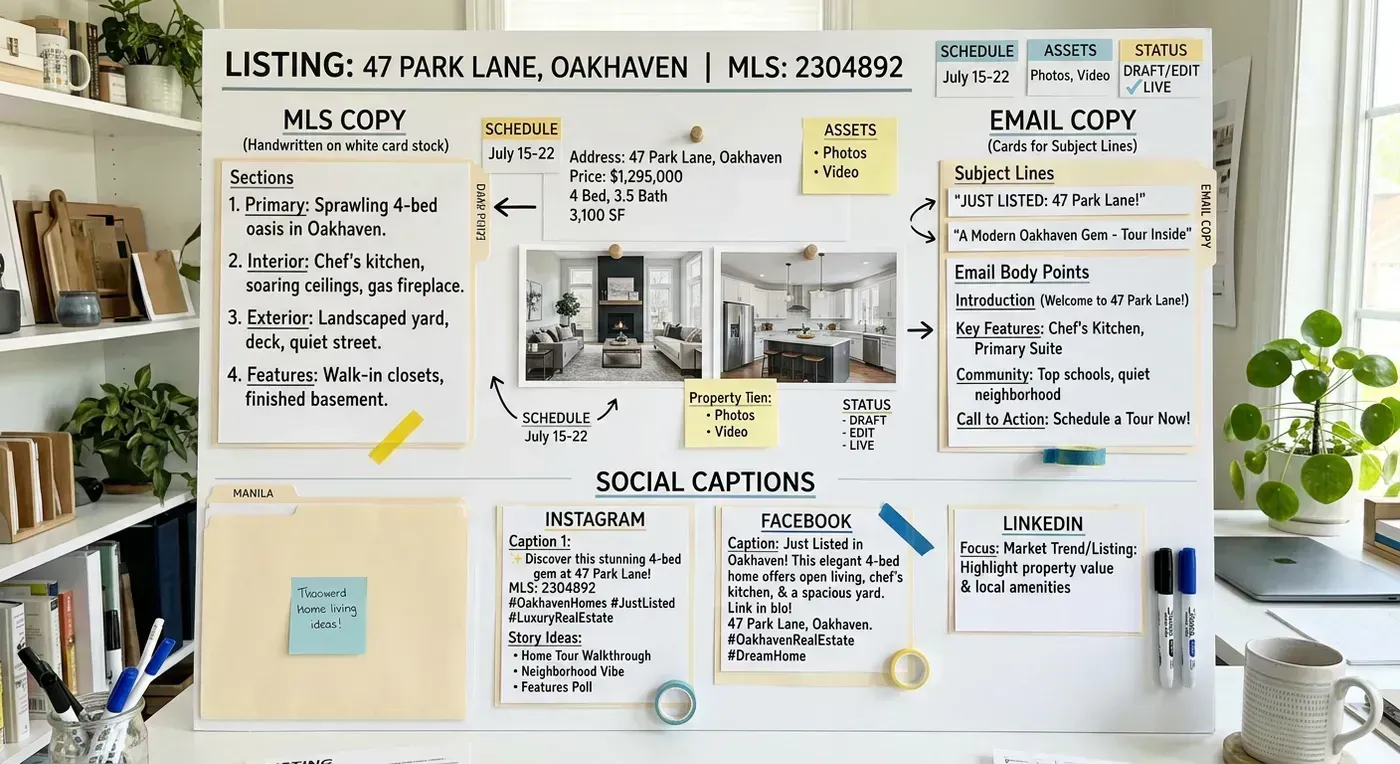
One of the most useful things an AI listing description tool can do is generate channel-specific variants without making the team start from zero each time. MLS copy needs enough structure and detail to carry the factual marketing load. Email copy needs a cleaner hook and faster readability. Social copy needs a narrower angle and a reason to stop scrolling. Treating all three as the same paragraph with different line breaks is why so much real estate marketing feels lazily recycled.
This is also where some tools quietly disappoint. They can write one okay paragraph, but they do not help the team turn that paragraph into a campaign. That means the human still ends up doing the real work. A useful tool should help you create the long MLS version, then spin that into email and caption variants that preserve the same positioning. That is where the time savings become real.
The payoff is not only speed. It is coherence. If the same listing angle carries across MLS, the video, the email, and the caption, the whole campaign feels more intentional. That coherence is what modern buyers actually experience. They do not see one isolated paragraph. They see the accumulation of touchpoints. The copy tool should help those touchpoints line up instead of turning each one into a new writing assignment.
| Channel | What it needs most | Common AI mistake |
|---|---|---|
| MLS | Clear factual detail and strong positioning | Inflated adjectives with thin specifics |
| A fast hook and clean readability | Repeating the MLS paragraph nearly verbatim | |
| Social | One sharp angle and concise phrasing | Trying to summarize the whole listing at once |
| Property site support | Copy that matches the media story | Using different positioning from the visual assets |

The red flags that make AI copy feel fake
There are a few tells that instantly make AI listing copy feel cheap. Overwriting is the big one. If every room is stunning, every feature is luxurious, and every outcome is effortless, the copy starts sounding less like marketing and more like a hostage note written by a lifestyle magazine. Vagueness is another giveaway. When the tool cannot find a real angle, it fills the space with mood words and broad promises that could describe almost any home in the state.
Another red flag is invented confidence. The model may casually imply things the listing did not prove, such as an ideal buyer lifestyle, a stronger school value proposition than you meant to signal, or an amenity story that is more aspirational than factual. This is where founder-grade editing matters. The first draft is a starting point, not a clearance stamp. If the line sounds too smooth to be true, it probably needs a second look.
The good news is that these issues are usually fixable with discipline. Cut the fluff. Replace abstract praise with observable specifics. Remove claims that sound like they belong in a developer brochure. Then make sure the language still aligns with the actual visual story. Strong listing copy does not need to perform genius. It needs to sound like a sharp human saw the property, understands the buyer, and knows how to position the asset cleanly.
Compliance is not a footnote
Real estate teams get into trouble when they treat compliance as the boring part that happens after the creative part. In AI copy, compliance has to be part of the initial workflow because the model is perfectly capable of sounding persuasive in ways that create risk. Fair housing sensitivity, disclosure rules, and market-specific language expectations all matter. A tool that writes quickly is only useful if the team can still trust the review process around it.
That is why every AI description workflow should have a short approval checklist. Confirm facts. Remove unsupported claims. Scan for language that sounds exclusionary, speculative, or disclosure-sensitive. Make sure the strongest angle is still honest. This does not need to become a legal opera. It just needs to be structured enough that the speed gain from AI does not turn into a slower cleanup cycle after publish.
If you work in markets where disclosure sensitivity is especially visible, keep the disclosure conversation close to the copy workflow. The point of the tool is to remove blank-page time, not to create a new category of avoidable brand and compliance headaches. Faster output is only valuable when the business can trust it.
How to connect copy to the rest of the listing campaign
The listing description should not live as a lonely paragraph that gets pasted into MLS and forgotten. It should clarify the message for everything else. If the description says the home is all about indoor-outdoor flow, then the video should emphasize that. If the copy frames the property around convenience and layout efficiency, the captions and follow-up should stay in that lane too. The description is one of the easiest places to lock the campaign angle early.
This is where copy tools become much more useful than people expect. They can help the team settle on the strongest angle faster, which then makes the media workflow cleaner. That is why how Reel-E works belongs next to this topic. The copy is not separate from the media. It is one of the clearest ways to define what the media should reinforce.
When the copy and media drift apart, the campaign feels stitched together. Buyers may not articulate it that way, but they feel the mismatch. One channel talks about calm and privacy while another talks about entertaining and scale. One asset leans practical, another leans luxury. AI can accelerate both the problem and the solution. The win comes when the team uses the draft to sharpen the campaign, not just to fill a text box faster.
A practical review workflow agents will actually use
A healthy AI listing-description workflow should take minutes, not hours. Start with the facts and the best angle. Generate a first draft. Strip out generic praise. Create the MLS version. Then derive the shorter email and social variants from that cleaned-up foundation. One person should own the final pass. That owner should know what language is off limits, what claims need proof, and what tone still sounds like the business.
The review should be fast, but it should not be casual. If the draft still sounds like it could describe any listing, it is not done. If the draft sounds too fancy for the actual property, it is not done. If the draft contradicts the visual story the team is about to publish, it is not done. The first draft only saves time when the team is disciplined enough to finish the job cleanly.
That is why the best tool is often not the one with the most cinematic marketing copy about writing the future. It is the one that helps an agent or coordinator build a repeatable, low-drama review loop. That is the founder-grade answer here. Good systems beat magic tricks. Especially when the magic trick wants to describe every kitchen as chef-inspired and every hallway as elegant circulation space.
How to know the tool is earning its place
After a month, the team should know whether the tool is actually worth keeping. Are drafts getting finished faster? Are the outputs cleaner across multiple channels? Is the team reusing the same angle more consistently in email, captions, and video? Or is the tool simply creating longer first drafts for humans to cut down while calling that efficiency? There is a difference.
The healthiest measurement is not just minutes saved. It is whether the listing campaign feels more coherent. If the copy tool helps the business launch more polished, aligned marketing with less rework, it belongs. If it mostly creates cleanup, then it is just moving the labor from blank-page time to revision time. That is not real leverage. It is a very modern way to stay tired.
A strong AI listing description tool should leave the team with sharper copy, faster channel variants, and cleaner message alignment across the whole campaign. If it does that, great. If not, it should get the same treatment as any other underperforming subscription. Thank you for your service. Please enjoy cancellation.
A briefing format that produces better drafts
If you want the tool to write better copy, give it a better brief. That does not mean a dramatic prompt manifesto. It means a simple repeatable structure. Property facts. Most likely buyer. Strongest angle. Secondary angle. Three details worth emphasizing. Three phrases to avoid. Compliance notes. Channels needed. That is enough to move the draft from generic to genuinely useful most of the time.
The point of the brief is not to impress the model. It is to give the human reviewer a cleaner starting point. Once the team has a standard brief, every draft becomes easier to compare, easier to edit, and easier to keep on brand. Without that structure, agents tend to improvise inputs based on memory and mood, which is how the same condo turns into three different personalities across MLS, email, and captions.
This is also what makes the workflow trainable across a team. A coordinator can use the same brief structure across agents. A founder can audit the quality quickly. A new hire can step into the process without guessing what matters. That kind of repeatability is why systems scale. The prompt is not the hero. The brief is.
- Property facts and non-negotiable details
- Primary buyer angle and secondary support angle
- Features worth emphasizing versus phrases worth avoiding
- MLS, email, social, and media-alignment needs
The fastest edit checklist after the draft comes back
A useful edit checklist should take two minutes. First, cut any sentence that could describe fifty other listings in the same zip code. Second, remove any phrase that sounds inflated compared with the actual property. Third, make sure the opening line matches the strongest visual story. Fourth, check that the shorter channel versions still preserve the same angle instead of drifting into unrelated hype. Then approve or tighten. That is the rhythm.
Most teams waste time because they over-edit the wrong things. They tweak adjectives and rhythm while leaving the core positioning muddy. The bigger win is almost always to simplify, sharpen, and align. If the first line clearly communicates what makes the property worth caring about, the rest of the campaign gets easier. If the first line still sounds like polished fog, no amount of sentence-level fussing will save it.
That is why the best AI copy workflows feel strict in a good way. They are not trying to let the tool become a creative oracle. They are using the tool to get to a good first draft fast, then relying on a clear edit pattern to finish the job. That balance is where the time savings and quality control finally stop fighting each other.
The best AI listing description tool is the one that gives you a better first draft, not the one that tries to replace your judgment. That is still your job, and honestly, it should stay that way.
The real win is not just faster writing. The real win is cleaner positioning across the full listing campaign.