On January 1, 2026, California became the first state to require real estate agents to disclose when listing images are AI-generated or materially altered by artificial intelligence. The law is called AB 723, and if you are licensed in California (or list properties there), it applies to you.
I have read the full text of the bill, the California Association of Realtors' guidance document, and approximately 30 hot takes from real estate attorneys on LinkedIn. Most of what you have heard about this law is either incomplete or wrong. Some agents think it bans AI from real estate entirely. It does not. Others think it only applies to virtual staging. It is broader than that. And a surprising number of agents have no idea it exists, which is a problem when fines can hit $10,000 per violation.
This guide covers exactly what AB 723 says, what it means for your daily workflow, and how to comply without adding more than 30 seconds to your listing process. I also built an AI video tool (Reel-E), so I will be transparent about how this law intersects with what we do and do not do.

What AB 723 Actually Says (Plain English)
The law amends Section 10176 of the California Business and Professions Code. Here is the core requirement stripped of the legalese:
If you are a California-licensed real estate agent and you use AI-generated or AI-materially-altered images in the marketing of a property for sale or lease, you must disclose that fact to consumers.
That is it. One sentence. The rest of the bill defines terms, sets enforcement mechanisms, and establishes exemptions. But the obligation itself is refreshingly simple: if AI changed what the listing looks like, say so.
Key Definitions
The bill defines several terms that matter for how you interpret it:
- "AI-generated image" means any image, rendering, or visual representation created in whole or in substantial part by artificial intelligence or generative technology, where the depicted scene does not correspond to actual conditions at the time of listing.
- "AI-materially-altered image" means a photograph or video that has been modified using AI in a way that changes a buyer's or lessee's perception of the property's physical characteristics, condition, or surroundings.
- "Material alteration" includes but is not limited to: adding or removing furniture (virtual staging), altering landscaping, modifying structural features, changing sky or weather conditions, and removing neighboring structures or obstructions.
Notice what is not in those definitions: standard photo editing. White balance, exposure correction, HDR processing, lens distortion correction, cropping, and straightening are all explicitly excluded. The law targets AI that changes what the property looks like, not AI that makes the photo technically better.
What Triggers Disclosure
Here is a practical checklist. If you answer "yes" to any of these, disclosure is required:
- Did you use virtual staging to add furniture, decor, or other items to empty rooms?
- Did you use AI to remove permanent features from the property (utility poles, neighboring buildings, cracks in the driveway)?
- Did you replace the sky in any exterior photo?
- Did you use AI to enhance landscaping beyond its current condition (fuller trees, greener lawn, flowers that do not exist)?
- Did you use AI to generate a rendering of proposed renovations, additions, or modifications?
- Did you use AI to create an entirely synthetic image of the property (for pre-construction or off-plan marketing)?
If you answered "no" to all six, you almost certainly do not need to disclose. If you answered "yes" to any, disclosure is required.

The Virtual Staging Problem
Let me be direct: AB 723 exists primarily because of virtual staging. The technology got so good in 2024 and 2025 that buyers started having trouble distinguishing between photos of actually-staged properties and AI-generated staging. And some agents were not disclosing the difference.
The stories that pushed this law forward are exactly what you would expect. A buyer drives 45 minutes to see a property, walks in, and finds an empty house with scuffed walls and stained carpet. The listing photos showed a beautifully furnished living room with fresh flowers on the dining table and a designer sofa facing floor-to-ceiling windows. Everything in the photos was real except the furniture, but the buyer had no way of knowing that. The emotional letdown is real, and it wastes everyone's time.
How Virtual Staging Disclosure Works Now
Under AB 723, every virtually staged image must be disclosed. The recommended formats are:
Per-image disclosure (preferred):
- In the photo caption or overlay: "This image has been virtually staged. The room is currently unfurnished."
- Some MLS systems now support per-image flags or labels. If your MLS offers this, use it.
General listing disclosure (minimum):
- In the agent remarks or public remarks: "Photos [3, 5, 7, 9] include virtual staging. These rooms are currently vacant. All other photos represent the property's current condition."
The California Association of Realtors has published model language you can copy directly into your listings. Use it. Do not get creative with your own wording. Legal boilerplate exists for a reason.
The "But Everyone Does It" Defense
I hear this from agents constantly. "Every agent uses virtual staging without disclosing it." That may have been true in 2024. It is now illegal in California. And the DRE does not particularly care that "everyone was doing it" as a defense against a formal complaint. The first few enforcement actions will get attention, and you do not want to be the example case.
The good news: disclosing does not hurt your listing's performance. A 2025 study by the University of Southern California's Lusk Center for Real Estate found that virtually staged photos with clear disclosure received only 6% fewer clicks than those without disclosure. Buyers understood and accepted the practice when it was transparent. What tanked engagement was the absence of any photos, staged or otherwise. The takeaway: use virtual staging, but disclose it. The performance impact is negligible. The legal protection is significant.

Where AI Video Fits In
This is where things get nuanced, and where I have a stake in the outcome since I built an AI video tool. I will try to be as honest as possible about the gray areas.
AI Camera Motion (What Reel-E Does)
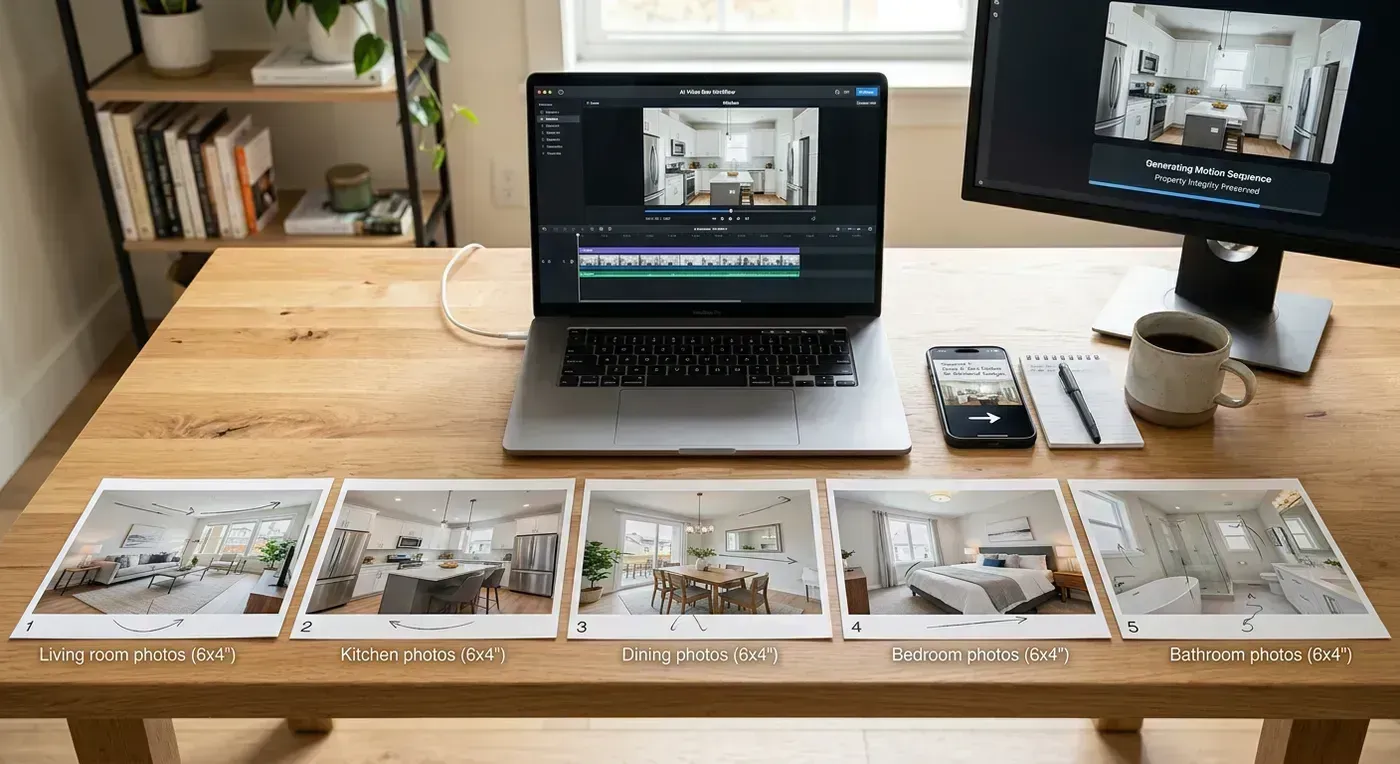
Tools like Reel-E take your actual listing photos and generate synthetic camera movement. The AI adds orbits, push-ins, pull-outs, and lateral slides to create the appearance of a physical camera moving through the scene. The underlying photograph is not altered. No furniture is added. No features are removed. The property looks exactly like it does in the original photo.
Here is what that output looks like:
Does this trigger AB 723? The strict reading of the law suggests probably not, because the visual representation of the property is not materially altered. The rooms look the same. The furniture (or lack thereof) is unchanged. The AI is not changing what the buyer sees about the property. It is changing how the camera appears to move.
However, the California Association of Realtors has recommended that agents disclose any use of AI in listing content as a best practice, even if it may not be strictly required. This is the approach we recommend too. Adding "Listing video created from photos using AI motion technology" to your remarks takes five seconds and eliminates all ambiguity.
AI Video with Virtual Staging
If you virtually stage your photos and then create AI video from those virtually staged photos, the disclosure obligation is clear and unambiguous. You must disclose both the virtual staging and the AI video generation. The fact that the virtual staging happened at the photo stage does not exempt the video from disclosure.
A recommended disclosure for this scenario: "Listing photos include virtual staging. Rooms marked as 'virtually staged' are currently vacant. Listing video was created from these photos using AI motion technology."
The Frame Synthesis Question
Here is the genuinely tricky part. When AI camera motion tools generate video from a still photo, they need to create new pixels at the edges of the frame as the virtual camera moves. This is called inpainting or frame synthesis. The AI predicts what "should" be just outside the original photo's borders and generates that content.
Is this a "material alteration"? It depends on what the AI synthesizes. If the inpainted area shows a continuation of a white wall, that is pretty clearly not material. If the AI hallucinates a window, a door, or a design feature that does not exist, that could be material. In practice, the inpainted areas in modern tools are small (a few percent of the frame at the edges) and typically consist of wall, floor, or ceiling continuations. The risk is low but not zero.
This is another reason to include a general AI disclosure in your listing. It covers edge cases like frame synthesis without requiring you to analyze the technical details of each individual video clip.
How to Comply: A Step-by-Step Workflow
Here is the practical compliance workflow I recommend for California agents using any AI tools in their listing marketing.
Step 1: Audit Your Current Listings
Go through every active listing you have right now. For each one, answer these questions:
- Are any photos virtually staged? If yes, which ones?
- Have any photos been AI-altered (sky replacement, object removal, landscaping enhancement)?
- Were any videos created using AI tools?
- Are any renderings or concept images being used?
For most agents, this audit takes about 15 minutes. If you find undisclosed AI alterations, update your listing remarks immediately. Do not wait until someone complains.
Step 2: Create Your Disclosure Templates
Write two or three standard disclosure statements that you can paste into listings going forward:
Template 1 (Virtual Staging Only):
"Certain listing photographs include virtual staging to illustrate potential furniture placement. Rooms identified as virtually staged are currently vacant. All other photographs depict the property's current condition."
Template 2 (AI Video Only):
"The listing video was created from property photographs using AI motion technology. All photographs used as source material depict the property's actual current condition."
Template 3 (Virtual Staging + AI Video):
"Certain listing photographs include virtual staging; rooms identified as virtually staged are currently vacant. The listing video was created from property photographs (including virtually staged images) using AI motion technology."
Save these somewhere you can grab them fast. A note on your phone, a text expansion shortcut, a pinned note in your CRM. The less friction the better. For more on MLS-specific formatting, see our MLS video requirements guide.
Step 3: Label Your Photos
When uploading photos to the MLS, label any AI-altered images in the caption field. Most MLS systems support captions on individual photos. Use clear, simple language:
- "Virtually staged" (for rooms with added furniture)
- "Sky enhanced" (for sky replacement)
- "AI rendering" (for pre-construction or renovation concepts)
Do not bury the disclosure in fine print or agent-only remarks. The point is buyer transparency, not legal box-checking.
Step 4: Update Your Listing Checklist
Add "AI disclosure check" to whatever pre-listing checklist you use. Before hitting publish on any listing, run through these four questions:
- Are any photos AI-generated or AI-altered? If yes, add disclosure.
- Are any photos virtually staged? If yes, label each one and add general disclosure.
- Is the listing video AI-generated? If yes, add video disclosure.
- Are there any AI renderings or concept images? If yes, clearly label as renderings.
Four questions. Takes 10 seconds. Protects your license.
What Other States Are Doing
California is first, but it will not be last. Here is where other states stand as of February 2026:
| State | Bill/Status | Effective Date | Scope | Key Differences from AB 723 |
|---|---|---|---|---|
| California | AB 723 (enacted) | Jan 1, 2026 | All AI-generated/altered listing images | Broadest scope, covers all image types |
| New York | S.4812 (introduced) | TBD (2026 session) | Virtual staging + AI imagery on portals | Adds portal-level disclosure requirements |
| Colorado | SB 26-043 (enacted) | Jul 1, 2026 | Virtual staging only | Narrower scope, staging-specific |
| Illinois | HB 2847 (committee) | TBD | AI-generated listing content broadly | Includes written descriptions by AI |
| Texas | SB 1192 (committee) | TBD | AI-altered photos in listings | Enforcement via TREC, not separate statute |
| NAR | Voluntary guidelines | Effective now | All AI use in listings (recommended) | No penalties, but sets professional standard |
The trend is obvious: mandatory AI disclosure is coming to most major real estate markets. If you start disclosing now regardless of your state, you are ahead of the curve when your state's version inevitably passes. And there is genuinely no downside. Buyers do not penalize transparent agents. They reward them.
Common Misconceptions About AB 723
I have heard all of these from agents in the past two months. None of them are correct.
Misconception #1: "AB 723 Bans AI in Real Estate"
False. The law does not restrict or prohibit any AI technology. It requires disclosure, not prohibition. You can use virtual staging, AI video, AI-generated renderings, and any other AI tool you want. You just have to tell people you are using them. The distinction between "you cannot do this" and "you must disclose this" is the entire point of the law.
Misconception #2: "It Only Applies to Photos, Not Video"
The law covers "any image" used in property marketing. Video is a sequence of images. The CAR guidance explicitly includes AI-generated video in its interpretation. Even if you believe video falls in a gray area, the safest (and easiest) approach is to disclose.
Misconception #3: "HDR Photography Requires Disclosure"
No. The law explicitly exempts standard photographic techniques including HDR bracketing, exposure correction, white balance adjustment, and lens distortion correction. These are technical improvements to image quality, not alterations to the property's appearance. Your photographer's standard editing workflow is not affected.
Misconception #4: "The Listing Agent Is Not Responsible If the Photographer Used AI"
Wrong. The disclosure obligation falls on the listing agent, not the photographer. If your photographer delivers virtually staged images and you publish them without disclosure, you are the one who violated AB 723. Ask your photographer explicitly: "Are any of these images AI-generated or AI-altered in any way?" Get the answer in writing. Add it to your photographer contract going forward.
Misconception #5: "Only California Licenses Are Affected"
AB 723 applies to properties listed in California, not just agents licensed in California. If you hold an out-of-state license and list a property in California through a cooperation agreement, the disclosure requirements still apply to that listing. The jurisdiction is the property location, not the agent's license state.
The Bigger Picture: AI Transparency as a Competitive Advantage
Here is what I genuinely believe, and I realize this is a strong take from someone selling AI tools: mandatory AI disclosure is good for the industry and good for agents who use AI well.
When virtual staging first became widespread, the agents who used it without disclosure were getting a short-term advantage. Listings looked better, got more clicks, generated more showings. But the long-term effect was eroding buyer trust in listing photos as a category. Research from the 2025 NAR Home Buyer and Seller Generational Trends report showed that 34% of buyers under 40 "somewhat or strongly distrust" listing photos. That number was 19% in 2020. The distrust is not because of bad photos. It is because buyers have been burned by photos that do not match reality.
Mandatory disclosure reverses this trend. When buyers know that AI-altered images are labeled, they can trust that unlabeled images are accurate. The label itself becomes a trust signal. "This agent is transparent about their marketing tools" reads very differently from "this agent might be hiding something."
Agents who embrace disclosure proactively, before being forced to, position themselves as trustworthy professionals. That reputation is worth more than any short-term engagement boost from undisclosed virtual staging.
How AI Video Benefits from Transparency
AI-generated listing video, the kind that creates camera motion from still photos, actually benefits the most from a culture of disclosure. Here is why: when buyers watch an AI listing video and see a disclosure that says "Video created from listing photos using AI motion technology," they understand what they are seeing. The photos are real. The camera movement is synthetic. The property looks exactly like it does in the photos. No surprises at the showing.
Contrast this with undisclosed virtual staging, where the buyer shows up expecting a fully furnished home and walks into an empty room. The AI video disclosure sets accurate expectations. The virtual staging non-disclosure sets false ones. As AI tools become more prevalent, the agents who are upfront about how they use technology will be the agents buyers prefer to work with.
For a deep dive into how AI listing video works technically, our AI listing video guide covers the full pipeline. And for photo quality best practices that make both your photos and videos look their best, see our real estate photography guide.
Practical Impact on Your Business
Let me quantify how much time and money AB 723 compliance actually costs.
Time Cost
| Task | Time (Per Listing) | Frequency |
|---|---|---|
| Checking photos for AI alterations | 2 minutes | Every listing |
| Adding disclosure to listing remarks | 30 seconds | Only when AI is used |
| Labeling individual staged photos | 1 minute | Only when staging is used |
| Updating photographer contract | 15 minutes | One time |
| Initial audit of active listings | 15 minutes | One time |
Total ongoing cost per listing: under 4 minutes. Total one-time setup: about 30 minutes. If 4 minutes per listing feels burdensome, consider that a single DRE complaint investigation takes months to resolve and costs thousands in legal fees.
Financial Cost
Zero. There is no fee associated with disclosure. There is no registration, no certification, no annual compliance filing. You write a sentence in your listing remarks. That is the full extent of the financial obligation.
The financial risk of non-compliance, on the other hand, is significant: up to $10,000 per violation, potential license suspension, and civil liability if a buyer claims reliance on undisclosed AI imagery. One complaint from one buyer on one listing can cost more than every commission check you collect in a quarter.
Reel-E's Approach to AB 723
I will be fully transparent about how we handle this at Reel-E, because I think tool providers have a responsibility to make compliance easy, not hard.
Reel-E generates video from your actual, unaltered listing photos using AI camera motion. We do not perform virtual staging, sky replacement, object removal, or any alteration to the property's appearance. The property in the video looks identical to the property in your photos.
Under the strict reading of AB 723, our output likely does not trigger the disclosure requirement because the property's visual representation is unchanged. However, we recommend disclosing anyway for three reasons:
- Zero risk. If you disclose and disclosure was not required, nothing happens. If you do not disclose and disclosure was required, you face potential enforcement action.
- Buyer trust. Transparency about your tools builds credibility. "This agent uses professional technology and tells me about it" is a positive signal.
- Industry standard. As more states pass similar laws, universal disclosure becomes the norm. Getting ahead of that norm costs nothing and positions you well.
We provide a recommended disclosure statement ("Listing video created from photos using AI motion technology") that you can copy and paste into any MLS system. We are also working with several MLS boards on standardized disclosure fields for AI-generated video content. When those fields become available, we will integrate them into our workflow so the disclosure is automatic.
If you want to see how AI listing video works with full disclosure, start a free trial and generate a video from your next listing's photos. The entire process takes about two minutes, and the disclosure takes about five seconds.
Looking Ahead: 2026 and Beyond
AB 723 is version 1.0 of AI real estate regulation. It will evolve. Here is what I expect to see over the next 12 to 24 months:
- Federal legislation. The FTC has signaled interest in AI disclosure requirements across industries. A federal standard for AI-altered marketing imagery would supersede the patchwork of state laws and create uniform requirements nationwide.
- MLS-level enforcement. Individual MLS boards will add AI disclosure fields and eventually require their completion. This moves enforcement from the state licensing board to the local MLS, which can act faster and more specifically.
- Automated disclosure detection. AI tools that analyze listing photos and flag likely AI alterations are already in development. MLS systems could use these to automatically flag listings that may need disclosure.
- Tool-level compliance. AI tool providers (including Reel-E) will build disclosure into the export workflow. When you download a video or set of photos, the disclosure text is automatically generated and ready to paste into your listing.
- Buyer expectations shifting. As AI becomes standard in real estate marketing, buyers will come to expect disclosure the way they expect lead paint disclosure or HOA disclosure. It will become table stakes, not a differentiator.
The agents who will thrive in this environment are the ones who treat disclosure as a feature, not a burden. Your listing is professionally photographed, AI-enhanced with cinematic video, and fully transparent about how that content was created. That is the pitch. It is a stronger pitch than "here are some photos, trust me."
For a complete walkthrough of creating compliant AI listing videos from your photos, check our AI listing video guide. And if you want to make sure your source photos are as strong as possible before creating video, our real estate photography guide covers the fundamentals that make both AI and traditional video look their best.