If you are comparing Reel-E and Matterport, you are really asking a more fundamental question: should I invest in cinematic listing video or interactive 3D virtual tours? The two products do genuinely different things, and the answer depends on where your marketing dollars create the most visibility for your listings.
Here is the short version. Matterport creates 3D digital twins. Buyers navigate a property like a video game, clicking through rooms and examining dollhouse views. It is impressive technology that requires a special camera, time on site, and a monthly subscription. Reel-E creates AI-powered cinematic videos from listing photos you already have. No camera purchase, no on-site capture session, no post-production timeline. Upload your photos, pick music, and the platform delivers four finished video variants (horizontal and vertical, branded and unbranded) in under two minutes.
Both tools can help you market homes. But if you have fifteen minutes and need to decide where your marketing budget goes, this comparison will make the decision clear.
Quick verdict: Matterport is best for luxury listings where buyers expect immersive 3D exploration before visiting in person. Reel-E is best for consistent video marketing across all your listings, using the photos you already have. For most residential agents, video drives more leads per dollar than virtual tours.
The Fundamental Difference: Passive Exploration vs. Active Marketing
This is the distinction most comparison articles miss entirely. Matterport and Reel-E are not competing products the way two video editors compete. They serve different moments in the buyer journey.
Matterport virtual tours are passive assets. They sit on your listing page and wait for someone to click in and explore. The experience is impressive once a buyer commits to navigating it. But virtual tours do not perform well as social content, they do not autoplay in email campaigns, they do not work as Instagram Reels or TikTok content, and they do not stop the scroll on Zillow or Realtor.com the way video does.
Reel-E videos are active marketing assets. They travel. They work on MLS, on social platforms, in email, and as website hero content. A listing video does not wait for attention. It grabs it. The cinematic camera movements, beat-synced music, and professional pacing create the kind of emotional first impression that motivates a buyer to schedule a showing.
Think of it this way: a Matterport tour is like an open house that only works for people who already showed up. A listing video is the yard sign, the social post, and the email teaser that gets people to show up in the first place.
Pricing Breakdown: What Each Platform Actually Costs
This is where the comparison gets uncomfortable for Matterport.
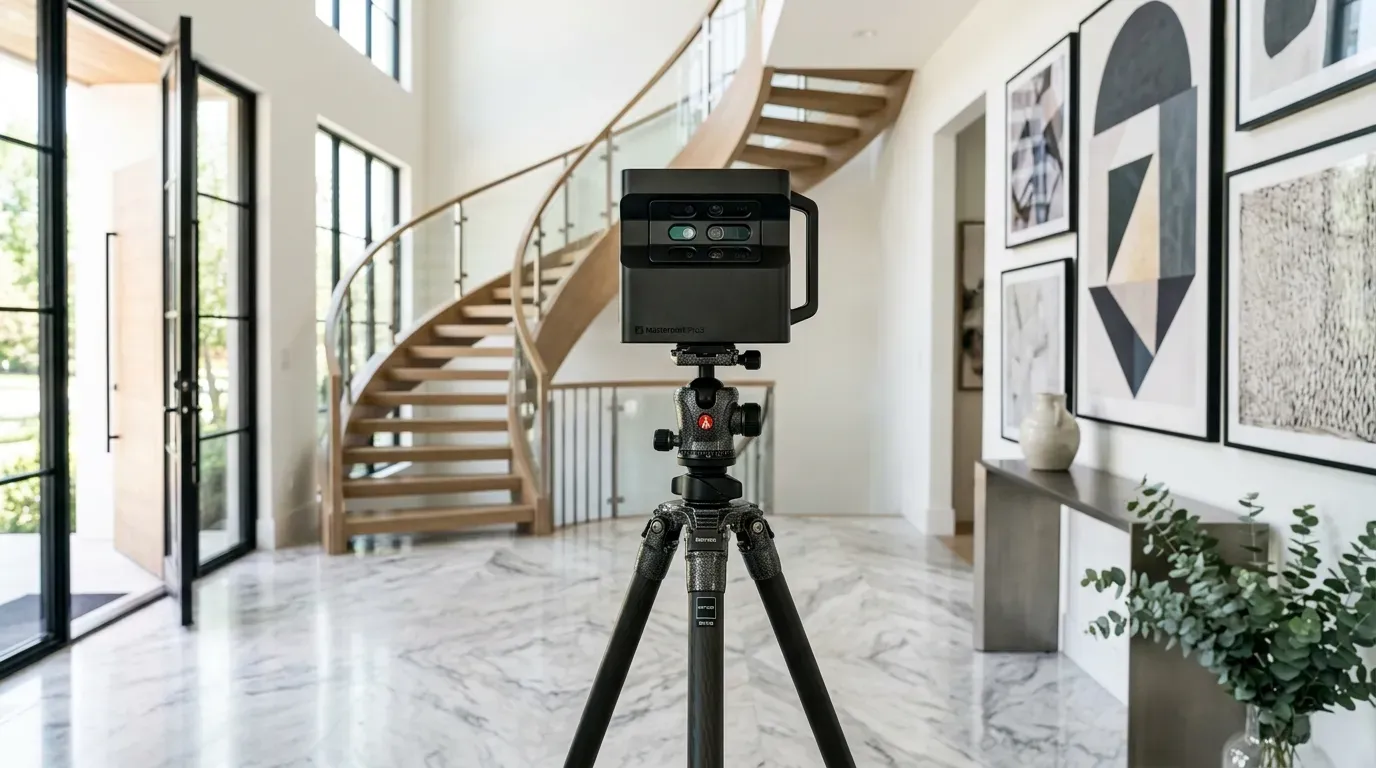
Matterport requires a dedicated 3D camera. The Matterport Pro3 retails for approximately $5,000. Even the more affordable Matterport ONE costs around $400. On top of hardware, you need a Matterport subscription: the Starter plan is free but limited to one active space, Professional is $69/month, and Business is $279/month. And that is before you factor in the time cost of physically scanning each property.
A typical Matterport scan takes 45 minutes to 2 hours on site, depending on property size. Then processing time. Then adjustments. For a team doing ten listings per month, the labor cost alone adds up fast.
Reel-E has a fundamentally different cost structure. There is no hardware to buy. The Essential plan is $59/month ($44/month billed annually) and covers 3 listings per month with 1080p output. Growth is $129/month for 10 listings. Pro is $599/month for 50 listings in 4K. Every plan includes a 7-day free trial.
| Cost Factor | Matterport | Reel-E |
|---|---|---|
| Hardware required | $400 to $5,000 (3D camera) | None |
| Monthly subscription | $69 to $279/month | $59 to $599/month |
| Effective cost billed yearly | Similar (annual discounts vary) | $44/month (Essential) |
| Time per listing | 45 min to 2 hours on site + processing | Under 2 minutes |
| Year-one cost (10 listings/mo, mid-tier) | ~$5,000 camera + $3,348 ($279 x 12) = ~$8,348 | $1,548 ($129 x 12) with no hardware |
The math is stark. A Matterport setup costs $400 to $5,000 upfront plus $69 to $279/month, plus your time on site for every scan. Reel-E costs $59/month and creates videos from photos already sitting on your hard drive. For agents who need consistent marketing across all their listings (not just the expensive ones), that difference is not trivial.
Feature-by-Feature Comparison
Here is how these platforms compare across the features agents actually care about when deciding between real estate video marketing and virtual tour technology.

| Feature | Reel-E | Matterport | Winner |
|---|---|---|---|
| Input required | Listing photos (any source) | 3D camera + on-site scan | Reel-E |
| Output format | 4 MP4 video variants | Browser-based 3D walkthrough | Depends on use case |
| Time to create | Under 2 minutes | 45 min to 2+ hours | Reel-E |
| Social media native | Yes (MP4 uploads to all platforms) | No (link sharing only) | Reel-E |
| MLS compatible | Yes (video + tour link) | Yes (virtual tour link) | Tie |
| Email marketing | Embeddable with thumbnail | Link-only (click to browser) | Reel-E |
| Mobile experience | Native vertical video | Browser-based 3D viewer | Reel-E |
| Branding control | Branded + unbranded variants | Limited (Business plan) | Reel-E |
| Floor plans | Not included | Yes (schematic + 3D) | Matterport |
| Spatial measurements | Not included | Yes (built-in) | Matterport |
| AI camera motion | Orbit, push-in, pull-out, Ken Burns | Guided tour (pre-set path) | Reel-E |
| Music synchronization | Beat-synced transitions | Background audio only | Reel-E |
| Hardware cost | $0 | $400 to $5,000 | Reel-E |
When Matterport Makes More Sense
I am going to be honest here, because a useful comparison acknowledges where the other tool wins.
Matterport earns its place in a few specific scenarios:
- Luxury properties above $2M where buyers frequently preview remotely before flying in for a showing. A 3D tour lets a relocating executive in Chicago explore a $3.4M coastal property in Malibu room by room before committing to a weekend trip.
- Commercial real estate where floor plans, spatial measurements, and square footage verification matter for due diligence. A 50,000 sq ft office space needs documentation, not just a sizzle reel.
- New construction and development marketing where the same model can be reused across multiple buyer presentations over months or years.
- Property management showing rental units where a virtual tour can reduce unnecessary in-person showings and save leasing staff time.
- MLS or brokerage mandates where virtual tours are a required deliverable, not an optional enhancement.
These are legitimate reasons to use Matterport, and they are not going away. If your business fits one of these profiles, the platform is a reasonable investment.
When Reel-E Is the Better Choice
For the vast majority of residential agents, Reel-E solves the marketing gap that actually costs you leads.
You already have the photos. You do not have the video. That is the gap for 90% of listings. Agents already hire photographers or take photos themselves for MLS. Those same photos can become a polished listing video with Reel-E in under two minutes. No second appointment, no extra equipment, no coordination headache.
Video outperforms static content on every platform. Listings with video receive 403% more inquiries than those without, according to NAR data. Video is the single highest-impact marketing asset most agents skip, simply because traditional production is too slow and expensive for ordinary inventory. That $475,000 three-bedroom in Tampa deserves a video too, not just your $2.8M waterfront listing.
Social media runs on video, not virtual tours. Instagram, TikTok, YouTube Shorts, and Facebook all prioritize video content in their algorithms. You cannot post a Matterport 3D tour as a Reel. You can post a Reel-E video as a Reel, a Short, a TikTok, and an email hero, all from the same export. For agents serious about social media video for real estate, this distinction matters more than any feature list.
You do not need to buy hardware or visit the property again. If the listing photos exist, you can create the video from your office, your car, or your couch. That changes the economics entirely. Instead of reserving video production for your top three listings per quarter, you can create video for every listing in your portfolio.
The Four-Variant Advantage
This is something Matterport simply does not offer, and it is one of the biggest practical differences for working agents.
Every Reel-E project generates four distinct video variants:
- Horizontal branded (16:9 with your logo and contact card) for listing websites and YouTube
- Horizontal unbranded (16:9 clean) for MLS compliance
- Vertical branded (9:16 with your logo) for Instagram Reels and TikTok
- Vertical unbranded (9:16 clean) for clean social sharing and syndication
One upload covers your MLS listing, your Instagram Reels, your TikTok content, your email campaigns, and your listing website. No reformatting. No re-editing. No asking your video editor to crop the same video three different ways.
Matterport gives you one experience in one format: a browser-based 3D tour. Reel-E gives you four finished assets ready for four different marketing channels. That is a fundamentally different value proposition for agents who need to be everywhere their buyers are scrolling.

Real-World Workflow Comparison
Let me walk through what actually happens when you use each platform on a real listing. Not the demo version. The Tuesday-afternoon-with-three-other-things-on-your-plate version.
Matterport workflow: Drive to the property with your camera and tripod. Set up in the first room. Scan each room (usually 30 to 60+ scan positions for a standard 2,000 sq ft home). Move furniture if anything blocks the scan path. Wait for cloud processing (30 minutes to several hours). Review the model for errors or artifacts. Edit highlights and tags. Publish the tour and share the link. Total hands-on time: 2 to 4 hours per listing.
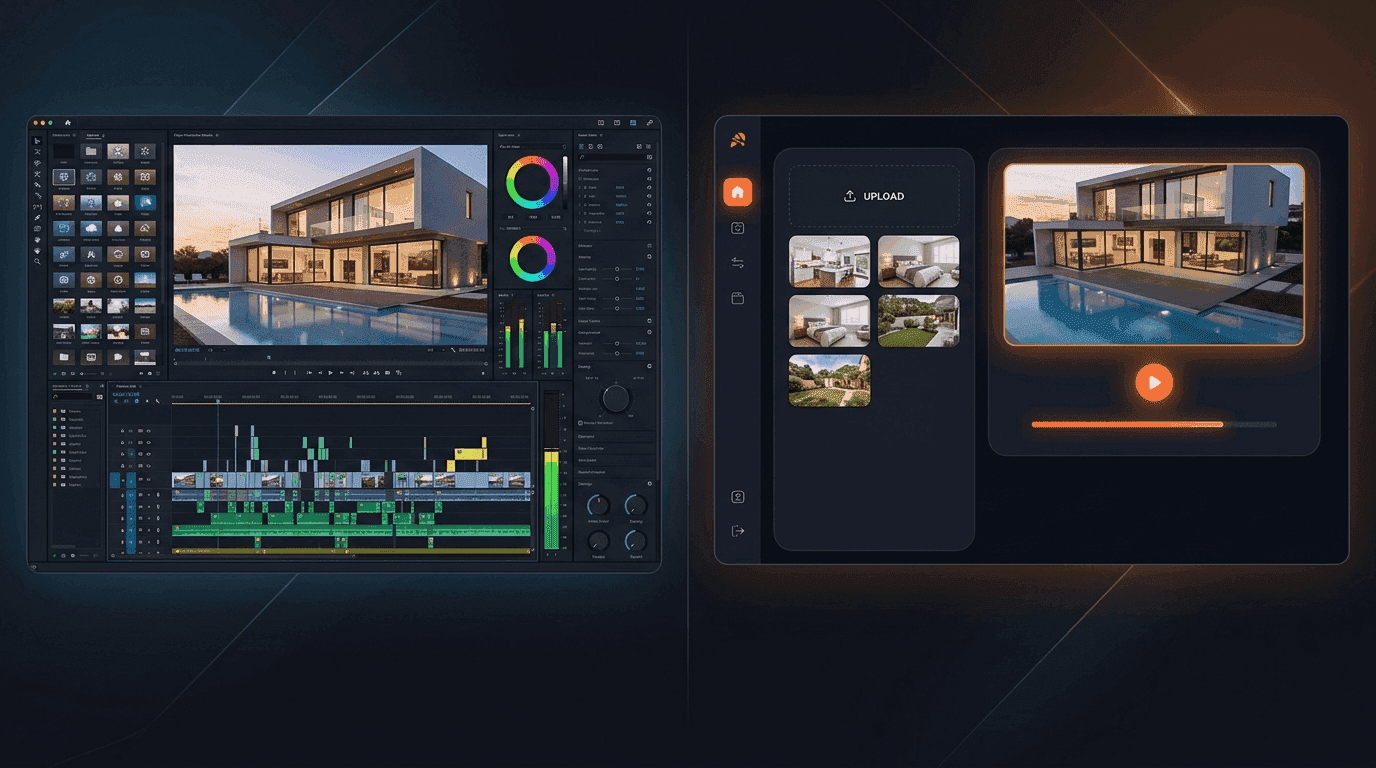
Reel-E workflow: Open the platform. Upload your listing photos (the ones already on your laptop from the photographer). Choose a music track. Add your branding. Click create. Pick up the four finished video variants a couple minutes later. Total hands-on time: about 5 minutes per listing.
The time difference is not marginal. It is an entirely different operating model. For agents handling multiple listings per week, the Reel-E workflow means every listing gets professional video. The Matterport workflow means only your highest-priority listings get the full treatment, and the rest go to market with photos alone.
What the Engagement Data Says
The research on video vs. virtual tours in real estate has become increasingly clear over the past few years, and it overwhelmingly favors video for marketing effectiveness.
- Properties with video receive 403% more inquiries than those without (NAR).
- Real estate video generates 1,200% more shares on social media than text and images combined.
- The average buyer spends 2 to 3 minutes watching a property video but only 30 to 60 seconds navigating a virtual tour before closing the tab.
- Fewer than 15% of buyers who click into a virtual tour complete the full walkthrough. Video, by contrast, is designed to tell the complete story in 60 to 90 seconds.
Virtual tours have a completion problem that video does not. A well-paced listing video shows the entire property in the time it takes a buyer to navigate two rooms in a 3D tour. That is not a knock on 3D technology. It is a recognition that most buyers are browsing on their phones during a commute, not sitting at a desktop with twenty minutes to click through a dollhouse model.
Social algorithms reinforce this gap. Posting a Matterport link on Instagram generates almost no engagement because the algorithm penalizes link-based content. Posting a native Reel-E video gets the full algorithmic boost. For agents tracking their real estate video statistics, the platform-native advantage of actual video files is hard to overstate.
The AI Motion Technology Difference
Reel-E is not a slideshow tool with crossfade transitions. It runs a custom AI inference stack that generates genuine camera motion from static photos: orbit shots, push-ins, pull-outs, and Ken Burns effects that look like they came from a professional videographer with a gimbal and a drone, not a PowerPoint with a fade timer.
The platform also beat-syncs every video transition to the music you choose. Every cut and camera movement lands on a musical downbeat. That is the kind of detail that separates professional production from the "uploaded a slideshow to YouTube" look that most agents are secretly embarrassed by. It is also the kind of detail that is genuinely hard to replicate manually without spending an hour in a timeline editor.
Matterport uses AI for room identification, automatic tagging, and model cleanup. These are useful features for organizing the 3D environment. But the output is still fundamentally a point-cloud reconstruction of the physical space. It creates documentation. Reel-E creates marketing. Those are different jobs.
Can You Use Both?
Absolutely. And for luxury agents or teams with the budget and bandwidth, combining both is a strong play. Use Matterport for the immersive on-page experience on your listing website. Use Reel-E for the marketing push across social, email, and MLS.
The 3D tour lets serious buyers explore the floorplan in detail. The video is what gets them to the listing page in the first place. One creates interest. The other satisfies it. That is a complementary relationship, not a competitive one.
But if you have to pick one (and most agents do, because time and money are finite), video marketing produces more leads per dollar spent. The listing video is the advertisement. The virtual tour is the product demo. Most properties need the advertisement more urgently than they need the demo.
Who Should Choose What: A Decision Framework
Rather than a vague "it depends," here is a concrete framework:
| Your Situation | Best Choice | Why |
|---|---|---|
| Residential agent, 5+ listings/month | Reel-E | Consistent video for every listing without on-site scans |
| Luxury agent, properties above $2M | Both (Matterport + Reel-E) | 3D for deep exploration, video for marketing reach |
| Solo agent competing with larger teams | Reel-E | 4 video variants per listing for the cost of one subscription |
| Commercial real estate / property management | Matterport | Floor plans, measurements, and spatial documentation matter |
| Social media-focused marketing | Reel-E | Native video for Instagram, TikTok, YouTube, email |
| New construction / development sales | Matterport | Reusable 3D model for repeated buyer presentations |
| Budget-conscious agent, under $200/month | Reel-E | No hardware cost, lower monthly, and higher output volume |
Migration Is Not Really the Right Word
You do not "migrate" from Matterport to Reel-E or vice versa, because they solve different problems. If you currently use Matterport and feel like you are not getting enough marketing traction, the issue is probably not with the 3D tours themselves. The issue is that 3D tours are not marketing assets. They are listing enhancements. The difference is that a marketing asset generates attention. An enhancement improves the experience after attention already exists.
Adding Reel-E to your workflow does not mean canceling Matterport. It means filling the marketing gap that virtual tours cannot fill. For agents comparing real estate video costs across different production methods, Reel-E represents the lowest cost per finished asset by a significant margin.
The two tools occupy different positions in the funnel. Recognizing that distinction is what separates strategic marketing from an expensive checklist of "things other agents seem to have."
Ready to see what your listing photos look like as cinematic video? Start a free Reel-E trial and turn one listing into four finished video assets in under two minutes. No camera required.
FAQ
Is Reel-E a replacement for Matterport?
Not exactly. Reel-E creates cinematic listing videos for marketing distribution (social, MLS, email). Matterport creates interactive 3D virtual tours for on-page property exploration. They serve different purposes, but for most residential agents, video marketing delivers significantly more leads per dollar than virtual tours alone.
How much does Matterport cost compared to Reel-E?
Matterport requires a 3D camera ($400 to $5,000) plus a monthly subscription ($69 to $279/month). Reel-E starts at $59/month ($44/month billed annually) with no hardware purchase required. Year-one costs for a mid-volume agent are roughly $8,000+ for Matterport vs. $1,500 for Reel-E.
Can I use Matterport tours on social media?
Matterport does not produce traditional video files. You can share a link to the 3D tour, but you cannot upload a Matterport tour as a native Reel, Short, or TikTok. The platform algorithms penalize link-based content, which limits organic reach. Reel-E produces MP4 video files that upload natively to every social platform.
Do virtual tours or videos get more real estate engagement?
Video consistently outperforms virtual tours in engagement metrics. Listings with video receive 403% more inquiries (NAR), and video generates 1,200% more social shares. Virtual tours have completion rates below 15%, while video is designed to deliver the full property story in 60 to 90 seconds.
Which is faster to create: a Matterport tour or a Reel-E video?
A Matterport scan takes 45 minutes to 2+ hours on site plus cloud processing time. A Reel-E video is created in under 2 minutes from existing listing photos with no site visit required.
Do I need special equipment for Reel-E?
No. Reel-E works with the listing photos you already have. No 3D camera, no tripod, no special hardware. Upload photos from your phone, your photographer's delivery folder, or your MLS photo set.
Can I use both Matterport and Reel-E for the same listing?
Yes, and luxury agents often should. Use Matterport for the immersive deep-dive experience on the listing website and Reel-E for the marketing push across social, email, and MLS video. The video drives traffic. The 3D tour converts serious interest.
Which platform is better for commercial real estate?
Matterport has a stronger case for commercial properties where spatial measurements, floor plans, and square footage verification matter for due diligence. For commercial marketing and tenant attraction campaigns, Reel-E video is still the more effective marketing tool because it produces shareable, platform-native content.
Does Reel-E work with MLS?
Yes. Reel-E produces standard MP4 video files and automatically generates both branded and unbranded versions. The unbranded versions comply with MLS policies that restrict agent branding in certain media fields.
What makes Reel-E different from a slideshow video tool?
Reel-E runs a custom AI inference stack that generates real camera motion (orbits, push-ins, pull-outs, Ken Burns effects) from static photos. It also beat-syncs transitions to music downbeats. The result looks like professional videography, not a PowerPoint export. For a deeper look, see our comparison of real estate video makers.
Is Matterport worth it for a solo real estate agent?
For most solo agents, the hardware cost and per-listing time commitment make Matterport hard to justify unless you specialize in luxury or commercial properties. A real estate video maker like Reel-E delivers more marketing assets per hour at a fraction of the cost, which is usually the bottleneck for solo agents competing against larger teams.