
Real estate lead generation gets sold like a faucet. Turn on ads, buy a list, publish a guide, and watch appointments pour out. In practice, the expensive leak is often after the form: slow response, weak qualification, unclear routing, duplicate records, and no shared definition of a good lead. Fix the operating path before buying more volume.
Operating Reel-E for the last few years has made lead generation feel much less like a traffic problem and much more like a system problem. Interest has a source, a promise, a destination, a response time, a qualification rule, and a human being who either owns the next step or does not.
Who this is for: real estate agents, teams, and brokerages deciding where to invest time and budget for qualified seller and buyer opportunities.
Research note: Researched vertical operating framework using current fair-housing and video-practice sources where applicable. Local rules, asset facts, platform terms, and performance claims require project-specific verification.

Choose Channels by Qualified Economics
Define a qualified conversation before you buy more leads. A channel that fills the CRM while the team responds slowly or inconsistently is not scaling demand. It is scaling the evidence that the handoff is broken.
| Path | Use It When | Reconsider It When |
|---|---|---|
| Database and Referral Demand | This audience is the constraint on qualified appointments and attributable pipeline at a sustainable acquisition and response cost and the team has proof and response capacity for it. | The same creative and destination are being used for a different stakeholder journey. |
| Owned Search and Content Demand | owned search and content demand is the constraint on qualified appointments and attributable pipeline at a sustainable acquisition and response cost, and the team can prove useful property media plus clear offer and destination at the owned destination. | database and referral demand and owned search and content demand still share one generic promise, response queue, or campaign page. |
| Paid, Portal, and Partner Demand | paid, portal, and partner demand depends on longer-cycle trust, permissioned response-time commitment, and a response path through referral partners or paid search/social. | The real estate lead generation team cannot maintain response-time commitment or identify the owner who advances paid, portal, and partner demand. |
Database and Referral Demand
- Best Fit: This audience is the constraint on qualified appointments and attributable pipeline at a sustainable acquisition and response cost and the team has proof and response capacity for it.
- Pause If: The same creative and destination are being used for a different stakeholder journey.
- Review: Share of the real estate lead generation audience taking the defined action that advances qualified appointments and attributable pipeline at a sustainable acquisition and response cost within database and referral demand, owned search and content demand, or paid, portal, and partner demand. Improve the promise, specific market expertise, destination, or qualification for the weak real estate lead generation journey.
- Control: Volume Reported as Pipeline. Track source, qualified status, appointment, represented opportunity, closed value, and cost separately.
Owned Search and Content Demand
- Best Fit: owned search and content demand is the constraint on qualified appointments and attributable pipeline at a sustainable acquisition and response cost, and the team can prove useful property media plus clear offer and destination at the owned destination.
- Pause If: database and referral demand and owned search and content demand still share one generic promise, response queue, or campaign page.
- Review: Time and conversion between named real estate lead generation stages under a consistent cohort and source definition. Fix the owner, listing and client evidence, or handoff between database and referral demand, owned search and content demand, and paid, portal, and partner demand.
- Control: Slow or Unowned Response. Set routing, service level, backup owner, disposition reason, and readback before spending.
Paid, Portal, and Partner Demand
- Best Fit: paid, portal, and partner demand depends on longer-cycle trust, permissioned response-time commitment, and a response path through referral partners or paid search/social.
- Pause If: The real estate lead generation team cannot maintain response-time commitment or identify the owner who advances paid, portal, and partner demand.
- Review: Contribution toward qualified appointments and attributable pipeline at a sustainable acquisition and response cost compared with production, past-client database distribution, and response cost. Change the real estate lead generation channel, scope, or audience instead of optimizing impressions alone.
- Control: Privacy, Consent, or Housing-Ad Exposure. Verify current channel, outreach, data, fair-housing, brokerage, and local requirements.
What Running a Platform Taught Me About Demand
A Form Fill Is a Moment, Not a Lead Strategy
Source, intent, property or service context, consent, response, qualification, and next action all matter. Treating every submission as equal makes reporting easier and operating decisions worse.
Response Quality Travels With Speed
Fast follow-up helps, but speed without context can feel random. Route the inquiry with enough information for the first response to be useful, and make ownership visible when the primary person is unavailable.
Cheap Volume Can Be Expensive Work
Include media, spend, software, list cost, qualification time, appointments, no-shows, and capacity in the economics. A low cost per lead can hide a very high cost per conversation the team would actually want.
One Rule Before Adding a New Source
Prove the Team Can Close the Existing Loop
Take a recent cohort from inquiry through first response, contact, qualification, appointment, outcome, and reason lost. Reconcile duplicates and missing owners. If the team cannot explain what happened to the demand it already purchased or earned, a new source will add volume without adding much knowledge. Fix the definitions and handoffs first, then use the next channel as a controlled test rather than a rescue mission.
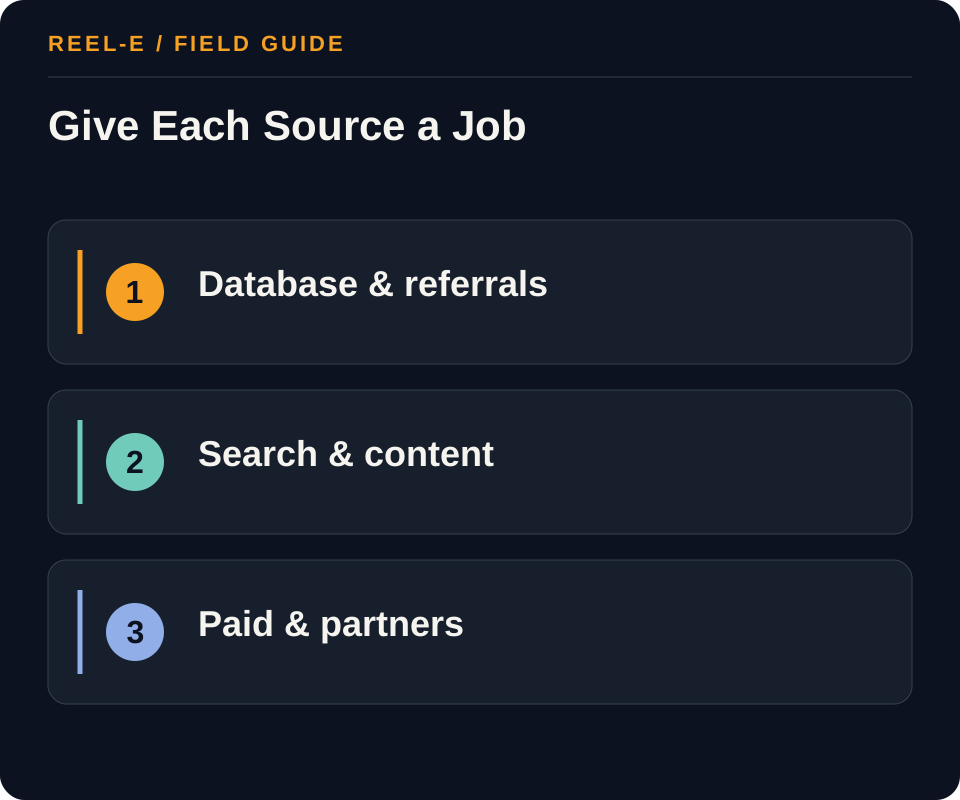
Three Source Families, Three Different Operating Jobs

Database and Referral Demand
This demand begins with a relationship, so relevance, service, consent, and memory matter more than raw reach. Segment by real context, make introductions and replies easy, and record the source accurately. Review which client experiences and explanations create referrals rather than treating the database as a free advertising audience. Familiarity is valuable. It is not permanent permission to send every listing to everyone who once signed a form.
Owned Search and Content Demand
Build pages and media around decisions the business can answer with evidence, give each query family one owner, and connect informational readers to an appropriate next step. This source takes time and creates durable assets, but attribution is rarely tidy. Measure queries, useful engagement, replies, signups, and visitor-associated conversion carefully. Refresh existing owners before publishing a near-duplicate because the editorial calendar feels energetic.
Paid, Portal, and Partner Demand
Define the audience, promise, source economics, consent, routing, speed, qualification, and stop rule before scaling. Separate placement metrics from qualified conversations and downstream outcomes. Paid demand can accelerate a working path and expose a broken one quickly. Partner and portal leads also arrive with different context, so the first response should acknowledge where the person came from rather than behaving as if every inquiry was born in the CRM.
The Reason Codes That Make the Funnel Useful
Record Why a Lead Did Not Progress
Use a small controlled list such as unreachable, invalid, duplicate, wrong service or market, timing, budget or fit, already represented, no response after defined attempts, appointment no-show, or another documented reason appropriate to the business. Train the team and review samples. Reason codes turn a vague loss rate into an operating question and reveal when a source problem is actually a response, promise, routing, or qualification problem.
Record Why a Qualified Person Chose the Next Step
Capture the question, property or service context, source, useful content or referral, response experience, and stated reason for the appointment where the person provides it. Do not force a neat attribution story onto a long relationship. The notes help the team understand which promises and proof create confidence and which source combinations assist the decision. Positive progression deserves the same curiosity as the leads that disappeared.
The Weekly Funnel Review in Twenty Minutes
Review New Demand and the Oldest Unowned Item
Confirm every new inquiry has a source, context, consent state, owner, first response, and next step. Then inspect the oldest item without a clear owner or outcome. This keeps the meeting close to service instead of only totals. One neglected high-intent conversation can teach more about the system than a chart celebrating the week's form fills. Resolve the record during the meeting or assign a person and time.
Choose One Stage to Improve
Compare source quality, response speed, contact, qualification, appointment, completion, and reasons lost. Select the constrained stage and one change to the promise, routing, response, script, availability, or source allocation. Record what will remain stable and when the team will review it. The meeting is complete when the path has one clearer decision, not when every channel has explained why its number deserves more context.
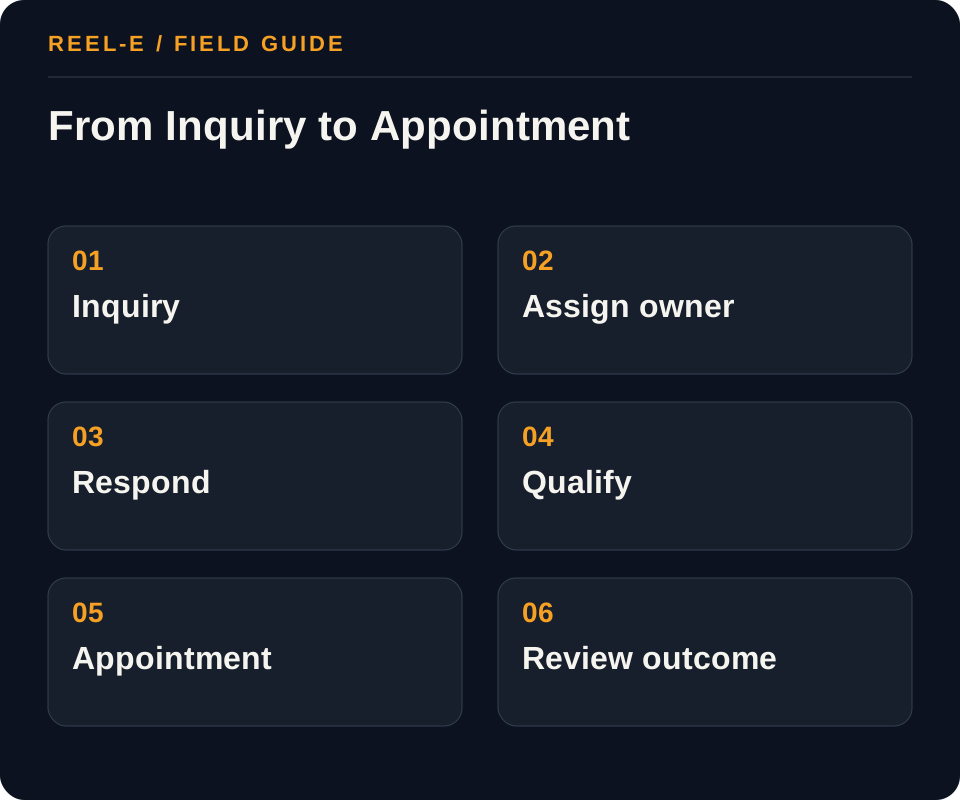
Fix the Path From Inquiry to Appointment

Define a Lead as a Stage, Not a Form Fill
Separate contact, reachable contact, relevant inquiry, qualified opportunity, appointment set, appointment held, represented client or listing opportunity, active transaction, and closed outcome. Define market, timing, intent, property fit, service area, and disqualifiers. A portal notification, guide download, and personal referral do not carry the same context. Stable stages prevent channels from being compared on raw names while quality and effort are hidden.
Approve stages and qualification fields before volume.
Treat Source, Response, and Economics as One System
Select database, referral, owned search, local, listing media, portal, partner, event, paid search, or paid social from audience behavior, evidence, response capacity, economics, and compliance. Set business-hours and after-hours response, primary and backup owner, source context, sequence, appointment method, disposition, suppression, and escalation. Count spend, production, software, response labor, held appointments, represented pipeline, contribution, and maturation window.
Test alert-to-disposition and calculate contribution before scale.
Use Honest Attribution and Compliance Boundaries
First-touch, last-touch, self-reported source, campaign parameters, CRM activity, and transaction records answer different questions. Define rules before review and label modeled, observed, associated, or attributed results. Do not add DataForSEO estimates to first-party visits. Review housing creative, targeting, exclusions, optimization, delivery, forms, automation, data, consent, unsubscribe, suppression, and channel preference under current requirements.
Publish attribution limits and run source-specific preflight.
Build the Lead System Before Scaling Traffic
Build the source-to-appointment path first, then add volume where the team can respond and learn. Every stage needs a definition, owner, timestamp, reason code, and review rhythm.
1. Separate the Journeys
Map database and referral demand, owned search and content demand, and paid, portal, and partner demand independently. For each, record the triggering event, core uncertainty, required facts, people involved, typical objections, destination, conversion action, response owner, and sales or leasing stage.
- Record: Source and Contact in the Source-To-Appointment Funnel
- Control: Track source, qualified status, appointment, represented opportunity, closed value, and cost separately.
- Review: Share of the real estate lead generation audience taking the defined action that advances qualified appointments and attributable pipeline at a sustainable acquisition and response cost within database and referral demand, owned search and content demand, or paid, portal, and partner demand. Improve the promise, specific market expertise, destination, or qualification for the weak real estate lead generation journey.
2. Create the Verified Proof Set
Assemble current, permissioned evidence such as specific market expertise, listing and client evidence, useful property media, clear offer and destination, response-time commitment, source and stage tracking. Date time-sensitive facts, disclose renderings or staged imagery, distinguish aspiration from delivered condition, and remove any asset that cannot be licensed or substantiated.
- Record: Production and Software in the Lead-Source Economics Calculator
- Control: Set routing, service level, backup owner, disposition reason, and readback before spending.
- Review: Time and conversion between named real estate lead generation stages under a consistent cohort and source definition. Fix the owner, listing and client evidence, or handoff between database and referral demand, owned search and content demand, and paid, portal, and partner demand.
3. Build the Owned Destination
Give the real estate lead generation campaign an owned page or sales asset that combines specific market expertise, listing and client evidence, and useful property media with the current status, next action, accessibility, and analytics needed for qualified appointments and attributable pipeline at a sustainable acquisition and response cost. Posts in past-client database and search and local discovery should route to this source rather than carry every changeable detail.
- Record: Qualified in the Source-To-Appointment Funnel
- Control: Verify current channel, outreach, data, fair-housing, brokerage, and local requirements.
- Review: Contribution toward qualified appointments and attributable pipeline at a sustainable acquisition and response cost compared with production, past-client database distribution, and response cost. Change the real estate lead generation channel, scope, or audience instead of optimizing impressions alone.
4. Plan Capture and Derivatives
Write the real estate lead generation media brief from unanswered questions in database and referral demand and owned search and content demand. Capture specific market expertise, listing and client evidence, useful property media, then produce horizontal, vertical, still, thumbnail, presentation, or email derivatives only for named jobs in past-client database, search and local discovery, listing content and video, referral partners. Label exceptions that affect paid, portal, and partner demand instead of hiding them in cinematic coverage.
- Record: Qualified Opportunities in the Lead-Source Economics Calculator
- Control: Keep one verified real estate lead generation asset library, but give database and referral demand, owned search and content demand, and paid, portal, and partner demand distinct messages, destinations, and actions.
- Review: Share of the real estate lead generation audience taking the defined action that advances qualified appointments and attributable pipeline at a sustainable acquisition and response cost within database and referral demand, owned search and content demand, or paid, portal, and partner demand. Improve the promise, specific market expertise, destination, or qualification for the weak real estate lead generation journey.
5. Assign Channel Roles
Use past-client database, search and local discovery, listing content and video, referral partners, paid search/social, portals and events selectively. Label each as discovery, proof, nurture, retargeting, sales enablement, or retention; set owner, cadence, spend, audience rule, destination, and stop condition.
- Record: Appointment Held in the Source-To-Appointment Funnel
- Control: Define the qualified action, movement toward qualified appointments and attributable pipeline at a sustainable acquisition and response cost, and source economics before launching through past-client database.
- Review: Time and conversion between named real estate lead generation stages under a consistent cohort and source definition. Fix the owner, listing and client evidence, or handoff between database and referral demand, owned search and content demand, and paid, portal, and partner demand.
6. Run the Operating Review
For the real estate lead generation program, review specific market expertise completion and response through past-client database weekly, movement toward qualified appointments and attributable pipeline at a sustainable acquisition and response cost biweekly, and source economics monthly. Diagnose whether database and referral demand, owned search and content demand, or paid, portal, and partner demand is constrained by proof, destination, channel, or follow-up before concluding that demand is weak.
- Record: Represented Pipeline in the Lead-Source Economics Calculator
- Control: Track source, qualified status, appointment, represented opportunity, closed value, and cost separately.
- Review: Contribution toward qualified appointments and attributable pipeline at a sustainable acquisition and response cost compared with production, past-client database distribution, and response cost. Change the real estate lead generation channel, scope, or audience instead of optimizing impressions alone.

A 90-Day Rollout
| Window | Work | Finish Line |
|---|---|---|
| Days 1-30 | Separate the Journeys; Create the Verified Proof Set | Baseline and first complete path |
| Days 31-60 | Build the Owned Destination; Plan Capture and Derivatives | Repeatable production and handoff |
| Days 61-90 | Assign Channel Roles; Run the Operating Review | Review, correction, and next allocation |
A Worked Example: Real Estate Lead Generation Campaign with Three Stakeholder Journeys
The situation: The team has credible property assets but one generic brochure and campaign currently attempts to serve database and referral demand, owned search and content demand, and paid, portal, and partner demand. Engagement is reported, but nobody can show which journey advances.

The approach: The team creates separate messages and destinations, reuses one verified media library, and shows specific market expertise, listing and client evidence, useful property media only where each is relevant. past-client database, search and local discovery, listing content and video receive distinct hooks and next actions, while one owner handles every qualified response.
The result to review: Reporting now shows which journey contributes to qualified appointments and attributable pipeline at a sustainable acquisition and response cost. The team can improve the weak stage without replacing the entire campaign or publishing more generic content.
The team does not celebrate a smaller lead count for its own sake. It celebrates a cleaner path that creates more qualified conversations from demand it can actually serve.
Measure the Conversation, Not the Form Fill
Track cost per qualified conversation, response time, contact rate, qualification, appointment completion, close context, and source contribution. Keep association separate from causation, especially across long and messy real estate journeys.
| Metric | Definition | How to Use It |
|---|---|---|
| Real Estate Lead Generation Qualified Next-Action Rate | Share of the real estate lead generation audience taking the defined action that advances qualified appointments and attributable pipeline at a sustainable acquisition and response cost within database and referral demand, owned search and content demand, or paid, portal, and partner demand. | Improve the promise, specific market expertise, destination, or qualification for the weak real estate lead generation journey. |
| Real Estate Lead Generation Stage Velocity | Time and conversion between named real estate lead generation stages under a consistent cohort and source definition. | Fix the owner, listing and client evidence, or handoff between database and referral demand, owned search and content demand, and paid, portal, and partner demand. |
| Real Estate Lead Generation Contribution Economics | Contribution toward qualified appointments and attributable pipeline at a sustainable acquisition and response cost compared with production, past-client database distribution, and response cost. | Change the real estate lead generation channel, scope, or audience instead of optimizing impressions alone. |
Tools You Can Use
Source-To-Appointment Funnel
Make stages and leakage visible.
- Source and Contact: Current fact, source, owner, approval date, effect on separate the journeys, and fit with database and referral demand.
- Reachable: Current fact, source, owner, approval date, effect on create the verified proof set, and fit with owned search and content demand.
- Qualified: Current fact, source, owner, approval date, effect on build the owned destination, and fit with paid, portal, and partner demand.
- Appointment Set: Current fact, source, owner, approval date, effect on plan capture and derivatives, and fit with database and referral demand.
- Appointment Held: Current fact, source, owner, approval date, effect on assign channel roles, and fit with owned search and content demand.
- Represented Opportunity: Current fact, source, owner, approval date, effect on run the operating review, and fit with paid, portal, and partner demand.
- Closed: Current fact, source, owner, approval date, effect on separate the journeys, and fit with database and referral demand.
- Disposition: Current fact, source, owner, approval date, effect on create the verified proof set, and fit with owned search and content demand.
- Response Time: Current fact, source, owner, approval date, effect on build the owned destination, and fit with paid, portal, and partner demand.
Lead-Source Economics Calculator
Compare sources with labor and quality included.
- Spend: Current fact, source, owner, approval date, effect on create the verified proof set, and fit with owned search and content demand.
- Production and Software: Current fact, source, owner, approval date, effect on build the owned destination, and fit with paid, portal, and partner demand.
- Response Labor: Current fact, source, owner, approval date, effect on plan capture and derivatives, and fit with database and referral demand.
- Qualified Opportunities: Current fact, source, owner, approval date, effect on assign channel roles, and fit with owned search and content demand.
- Held Appointments: Current fact, source, owner, approval date, effect on run the operating review, and fit with paid, portal, and partner demand.
- Represented Pipeline: Current fact, source, owner, approval date, effect on separate the journeys, and fit with database and referral demand.
- Contribution: Current fact, source, owner, approval date, effect on create the verified proof set, and fit with owned search and content demand.
- Maturation: Current fact, source, owner, approval date, effect on build the owned destination, and fit with paid, portal, and partner demand.
- Capacity: Current fact, source, owner, approval date, effect on plan capture and derivatives, and fit with database and referral demand.
Where This Usually Breaks
Consent, privacy, fair-housing rules, list provenance, duplicate records, unowned response, and misleading attribution need controls before scale. A spreadsheet with thousands of names remains a spreadsheet until the operating path gives it meaning.
| Risk | Practical Control |
|---|---|
| Volume Reported as Pipeline | Track source, qualified status, appointment, represented opportunity, closed value, and cost separately. |
| Slow or Unowned Response | Set routing, service level, backup owner, disposition reason, and readback before spending. |
| Privacy, Consent, or Housing-Ad Exposure | Verify current channel, outreach, data, fair-housing, brokerage, and local requirements. |
| One Creative for Every Real Estate Lead Generation Stakeholder | Keep one verified real estate lead generation asset library, but give database and referral demand, owned search and content demand, and paid, portal, and partner demand distinct messages, destinations, and actions. |
| Real Estate Lead Generation Vanity Measurement | Define the qualified action, movement toward qualified appointments and attributable pipeline at a sustainable acquisition and response cost, and source economics before launching through past-client database. |
Volume Reported as Pipeline
- Control: Track source, qualified status, appointment, represented opportunity, closed value, and cost separately.
- Review Stage: Separate the Journeys
- Early Warning: Share of the real estate lead generation audience taking the defined action that advances qualified appointments and attributable pipeline at a sustainable acquisition and response cost within database and referral demand, owned search and content demand, or paid, portal, and partner demand.
- Response: Improve the promise, specific market expertise, destination, or qualification for the weak real estate lead generation journey.
Slow or Unowned Response
- Control: Set routing, service level, backup owner, disposition reason, and readback before spending.
- Review Stage: Create the Verified Proof Set
- Early Warning: Time and conversion between named real estate lead generation stages under a consistent cohort and source definition.
- Response: Fix the owner, listing and client evidence, or handoff between database and referral demand, owned search and content demand, and paid, portal, and partner demand.
Privacy, Consent, or Housing-Ad Exposure
- Control: Verify current channel, outreach, data, fair-housing, brokerage, and local requirements.
- Review Stage: Build the Owned Destination
- Early Warning: Contribution toward qualified appointments and attributable pipeline at a sustainable acquisition and response cost compared with production, past-client database distribution, and response cost.
- Response: Change the real estate lead generation channel, scope, or audience instead of optimizing impressions alone.
One Creative for Every Real Estate Lead Generation Stakeholder
- Control: Keep one verified real estate lead generation asset library, but give database and referral demand, owned search and content demand, and paid, portal, and partner demand distinct messages, destinations, and actions.
- Review Stage: Plan Capture and Derivatives
- Early Warning: Share of the real estate lead generation audience taking the defined action that advances qualified appointments and attributable pipeline at a sustainable acquisition and response cost within database and referral demand, owned search and content demand, or paid, portal, and partner demand.
- Response: Improve the promise, specific market expertise, destination, or qualification for the weak real estate lead generation journey.
Real Estate Lead Generation Vanity Measurement
- Control: Define the qualified action, movement toward qualified appointments and attributable pipeline at a sustainable acquisition and response cost, and source economics before launching through past-client database.
- Review Stage: Assign Channel Roles
- Early Warning: Time and conversion between named real estate lead generation stages under a consistent cohort and source definition.
- Response: Fix the owner, listing and client evidence, or handoff between database and referral demand, owned search and content demand, and paid, portal, and partner demand.
Verify current primary guidance for the actual jurisdiction, platform, campaign, property, and professional relationship. This researched guide is not individualized legal, aviation, financial, privacy, or compliance advice.
My Bottom Line
Define the conversation you want, fix the path that creates it, and buy or build demand only where the team can respond well. Lead generation becomes far less mysterious when every handoff has an owner.
Sources and Research Notes
Open the source ledger- HUD guidance on digital housing advertising. Primary federal guidance on Fair Housing Act considerations in digital targeting and delivery. Accessed August 12, 2026.
- National Association of REALTORS Fair Housing resources. Industry resource for fair-housing education; local counsel and brokerage policy remain controlling. Accessed August 12, 2026.
- FTC CAN-SPAM compliance guide. Primary federal guide for commercial email requirements; state and industry rules may add obligations. Accessed August 12, 2026.
- NAR video marketing practice article. Industry practice source for concise, audience-centered real-estate video planning. Accessed August 12, 2026.
- NAR marketing resources. Format and coverage reference. Authoritative but distributed across resources rather than one source-to-appointment system. Accessed August 12, 2026.
- Commercial lead-generation SERP. Format and coverage reference. Many vendor and listicle claims; neutral source economics and response operations are inconsistent. Accessed August 12, 2026.
- HousingWire marketing ideas. Format and coverage reference. Current tactical coverage; less emphasis on stable stages, cash, response, and attribution limits. Accessed August 12, 2026.
Sources support only the claims described in their notes. Reopen current primary sources before a purchase, launch, or compliance decision.