
A marketing plan is useful only if someone can run it on a Wednesday without reopening the strategy deck. It needs audiences, offers, proof, channels, destinations, owners, budget rules, response standards, and a review rhythm. A list of goals and inspirational arrows is a mood board with quarterly meetings.
Building Reel-E has made me suspicious of marketing plans that do not name an owner, a budget boundary, or what happens when the lead arrives. A plan should help the team make decisions during the week, not merely look organized during the meeting.
Who this is for: agents, teams, and brokerages that need one operating plan across listings, brand, nurture, referrals, and paid distribution.
Research note: Researched planning framework informed by current Reel-E organic/conversion observations. Forecasts should use separate first-party, modeled, and third-party inputs.

Make the Tradeoffs Before Spending
Pick one ninety-day business outcome and make the tradeoffs visible. When every channel is a priority, the plan has politely declined to plan.
| Path | Use It When | Reconsider It When |
|---|---|---|
| Listing-Led Growth | Current inventory and seller acquisition create the most credible proof and distribution inputs. | The team lacks consistent listing access or permissioned media. |
| Expertise-Led Growth | Local, property-type, or process knowledge can attract durable search and referral demand. | The content cannot be differentiated or evidenced. |
| Relationship-Led Growth | Past clients, partners, and owned contacts are strong but under-nurtured. | List provenance, consent, response ownership, or value cadence is weak. |
Listing-Led Growth
- Best Fit: Current inventory and seller acquisition create the most credible proof and distribution inputs.
- Pause If: The team lacks consistent listing access or permissioned media.
- Review: Production and distribution spend divided by qualified opportunities under a consistent definition. Fix audience, destination, follow-up, or channel mix.
- Control: Channel List Without Strategy. Assign each channel one funnel role and measurable action.
Expertise-Led Growth
- Best Fit: Local, property-type, or process knowledge can attract durable search and referral demand.
- Pause If: The content cannot be differentiated or evidenced.
- Review: Permissioned contacts or repeat direct visitors added with known provenance. Improve the value exchange and capture path.
- Control: Modeled Forecast Presented as Revenue. Keep modeled, observed, and cash data separate.
Relationship-Led Growth
- Best Fit: Past clients, partners, and owned contacts are strong but under-nurtured.
- Pause If: List provenance, consent, response ownership, or value cadence is weak.
- Review: Planned marketing work completed without displacing revenue or client commitments. Reduce cadence or add accountable capacity.
- Control: Unowned Follow-Up. Set response owner, time, route, and CRM readback.
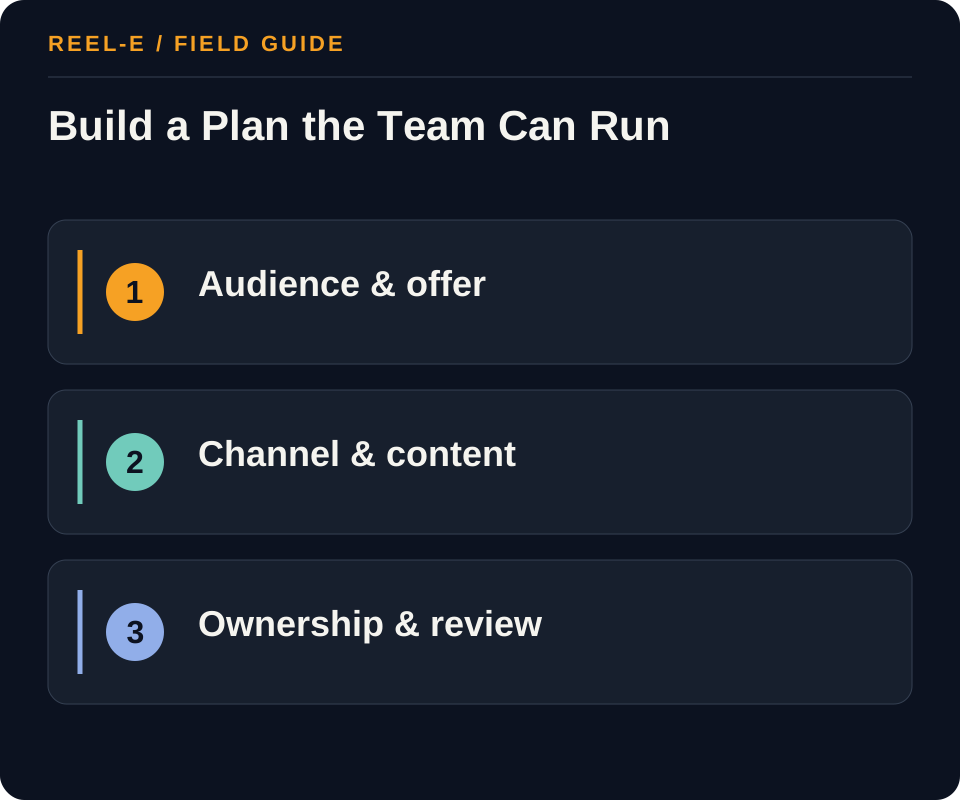
What I Want to See Before a Plan Gets Funded
The Outcome Must Fit Capacity
More inquiries are not automatically helpful if response, qualification, or listing capacity is already full. Start with the constraint the team can actually change.
Proof Needs a Source
Decide which listings, client artifacts, explanations, and media support the promise. A channel cannot keep producing credibility from an empty asset folder.
Follow-Up Belongs in the Budget
Media, spend, landing pages, CRM routing, and human response are one path. Funding the click while leaving the response owner to chance is a very modern way to waste money.
Seven Lines the One-Page Plan Needs
One Outcome
Write the business result the next ninety days should improve and the baseline used to judge movement. The outcome may involve qualified listing opportunities, buyer relationships, owner leads, leasing progression, repeat clients, or another defined stage. Avoid goals that simply restate the activity, such as publishing more or increasing awareness without saying among whom and toward what.
One Primary Audience
Describe the person, decision, context, and evidence they need. Demographics alone rarely explain the job. The plan becomes sharper when it knows whether it is helping a homeowner prepare, an investor evaluate, a renter choose, or a referral partner understand the service. Compliance still governs targeting and language, especially in housing contexts.
A Promise With Limits
Say what the team helps the audience do and what it can genuinely support. Then write what the promise does not mean. Clear limits make creative and sales review easier, and they keep the campaign from stretching a strong service into an unsupported outcome claim. Confidence sounds better when it does not need to imply certainty.
A Proof Inventory
List the current properties, case material, process artifacts, explanations, testimonials with permission, product output, and data that support the promise. Name gaps honestly. If the proof is thin, the first campaign job may be producing better evidence through the actual work rather than purchasing more distribution for a claim the team cannot yet show.
Channel Roles and Destinations
Give search, email, social, video, partnerships, events, portals, and paid media a specific job only when they fit the audience and capacity. Name the owned destination and the next action for each. Channels can share source assets, but they should not all repeat the same message and send traffic to the home page because the plan ran out of decisions.
The Full Cost and Owner
Budget creative, media, software, placement, landing pages, response, qualification, follow-up, and review. Attach a person to each handoff and state the response expectation. A campaign is not inexpensive because the ad spend was low if the team manually cleans, routes, and chases poor-fit demand for the next month.
A Rule for What Changes
Choose a review date, stable metric definitions, and the signal that would cause the team to pause, expand, or revise the plan. Compare observed first-party behavior with modeled market estimates without blending them. A review should change the constrained stage, not reward every channel with one more month because the reporting meeting was pleasant.
How I Would Allocate the First Ninety Days
Fund the Bottleneck First
If the business lacks proof, fund capture and case material. If the audience cannot find the offer, fund distribution and an owned destination. If inquiries wait, fund response and routing. If many conversations fail to qualify, improve the promise and intake. Budget follows the constrained stage, not the channel with the most persuasive salesperson. This makes allocation less glamorous and much easier to explain when the team reviews what happened.
Keep a Controlled Test Budget
Reserve a small portion for one clear hypothesis with a defined audience, asset, destination, owner, cost boundary, and review date. Change one important variable at a time where practical. A test does not need statistical theater, but it does need enough discipline to teach the team something. Three new channels launched together may create activity. They rarely create a clean answer about why the activity occurred.
Invest in Assets the Team Can Reuse
A thoughtful property shoot, client explanation, market guide, calculator, case study, or product demonstration can support search, email, social, sales, and partnerships when rights and source files are organized. Reuse does not make the asset free, but it changes the economics. Prefer work that can keep answering a real question over disposable volume built only to satisfy the calendar's emotional needs.
Protect the Human Response Budget
Assign time for comments, replies, qualification, appointments, partner follow-up, CRM hygiene, and reporting. If demand performs, this work grows. If the team cannot absorb it, scale will reduce response quality exactly when the campaign appears successful. Capacity is not an afterthought to marketing. It is one of the inputs that determines which promise and channel mix the company can responsibly support.
Make the Review Capable of Saying No
At the review date, compare observed behavior with the baseline and the decision rule. Continue what is creating a useful path, revise the constrained handoff, and stop work that cannot justify its cost or audience burden. Do not split the difference by keeping every channel at a smaller budget. A plan becomes credible when it can remove an activity, not only add one with a hopeful arrow.
The Review Meeting in Plain English
What Did the Audience Actually Do?
Review first-party reach, useful engagement, replies, inquiries, qualification, appointments, and downstream movement with stable definitions. Separate observed behavior from modeled demand and third-party benchmarks. Look at cohorts and channels only where the data supports the comparison. The purpose is to understand the path, not to produce one large number that makes every activity feel jointly responsible and therefore individually impossible to stop.
Where Did the Handoff Lose People?
Inspect the promise, creative, destination, speed, response, qualification, appointment, and service capacity. Read real conversations and test the mobile journey. The biggest opportunity may sit after the click, where media reports have historically shown less curiosity. Fix the constrained handoff before increasing traffic. More visitors are useful when the path can help them, and surprisingly efficient at proving when it cannot.
What Will We Change for the Next Thirty Days?
Choose one allocation, message, asset, destination, response rule, or audience change with an owner and review date. Record what remains constant so the team can learn. Stop or pause work that no longer has a defensible job. The output of the meeting is a smaller set of clearer decisions, not another dashboard tab and a group promise to keep an eye on things.
What Did We Learn About Capacity?
Compare production time, approval time, response load, qualification work, sales availability, and service delivery with the original plan. A channel can be economically promising and operationally mistimed. Adjust the promise, audience, automation, staffing, or volume without blaming the channel for revealing a real constraint. Capacity is allowed to change the marketing plan because capacity was always part of the product the campaign offered.
A Worked Budget Without Fake Precision
Allocate Percentages Only After the Jobs Are Clear
A small team might reserve meaningful effort for source assets and owned destinations, a defined amount for distribution, enough for response and qualification, and a limited test pool. The exact percentages depend on the existing library, margins, audience, team, and constraint. Model a range and state the assumptions instead of presenting one confident allocation as universal. The useful output is a decision the company can revise, not a pie chart that looks certain from across the room.
Write the Baseline Before the Campaign Starts
Record the current audience, traffic, inquiries, qualified conversations, response performance, appointments, conversion context, cost, and capacity using stable definitions and a stated window. Note what cannot be measured reliably. Without the baseline, the team will compare the campaign to memory, and memory is unusually generous to a new initiative with a nice launch video. A modest, imperfect baseline with honest limitations is more useful than a precise after-the-fact story.
Document the Attribution Boundary
State which events are directly observed, which identities can be joined, which conversions are only visitor-associated, and where offline or long-cycle behavior disappears. Do not turn a shared path into single-touch credit because the software offered a chart. Marketing, sales, relationships, market conditions, and the property itself may all contribute. The plan can still make decisions under uncertainty as long as it does not disguise uncertainty as a percentage with two decimal places.
Compare the Plan With the Work the Company Wants
A channel can produce qualified activity that is still a poor fit for margin, service model, geography, timing, or the founder's attention. Review the kinds of opportunities, not only the count. The plan should help the business become more intentional about the work it accepts and the proof it builds next. Growth that quietly pulls the company away from its strongest work deserves a strategic review, even when the dashboard is having a lovely quarter.
Include the Cost of the Founder and Team
Estimate interview, capture, review, response, sales, and reporting time at a realistic internal cost. Add vendors, software, media, travel, and production. This reveals whether the plan depends on invisible labor and whether batching or a simpler channel mix would improve it. Founder time is not free because it did not arrive with an invoice. It is often the rarest input in the system and should be used where judgment changes the result.
Turn Strategy Into an Operating Sheet
Start with Capacity, Margin, and One Outcome
Set a 90-day outcome such as qualified seller appointments, buyer consultations, listings launched, community visits, or represented pipeline. Record baseline, service capacity, average contribution, response capacity, and constraints. Avoid selecting lead volume when the team cannot respond or accept work. The plan must make a tradeoff: which audience and service receive attention, and what work is reduced or stopped.
Approve one outcome, baseline, capacity limit, and stop list.
Define Audience, Promise, Proof, and Source
Describe a decision context rather than a broad demographic. Write the specific problem, credible promise, objections, proof, and next action. Name where property facts, availability, process, brand claims, and market data live and who approves them. Every campaign derivative should pull from this source. Conflicting decks, captions, and vendor systems require an information-governance task before promotion.
Create a claim-to-source map with one accountable approver.
Give Channels Roles and Budget the Full Path
Assign search, local, social, video, email, portals, referrals, partnerships, events, and paid media to discovery, proof, nurture, sales enablement, or retention. Record source asset, owner, cadence, budget, destination, response, metric, and stop. Include research, production, software, rights, publishing, advertising, response labor, CRM, follow-up, analytics, refresh, and retirement. Review with stable definitions and explicit keep, revise, expand, pause, or stop decisions.
Complete one accountable row per active channel.
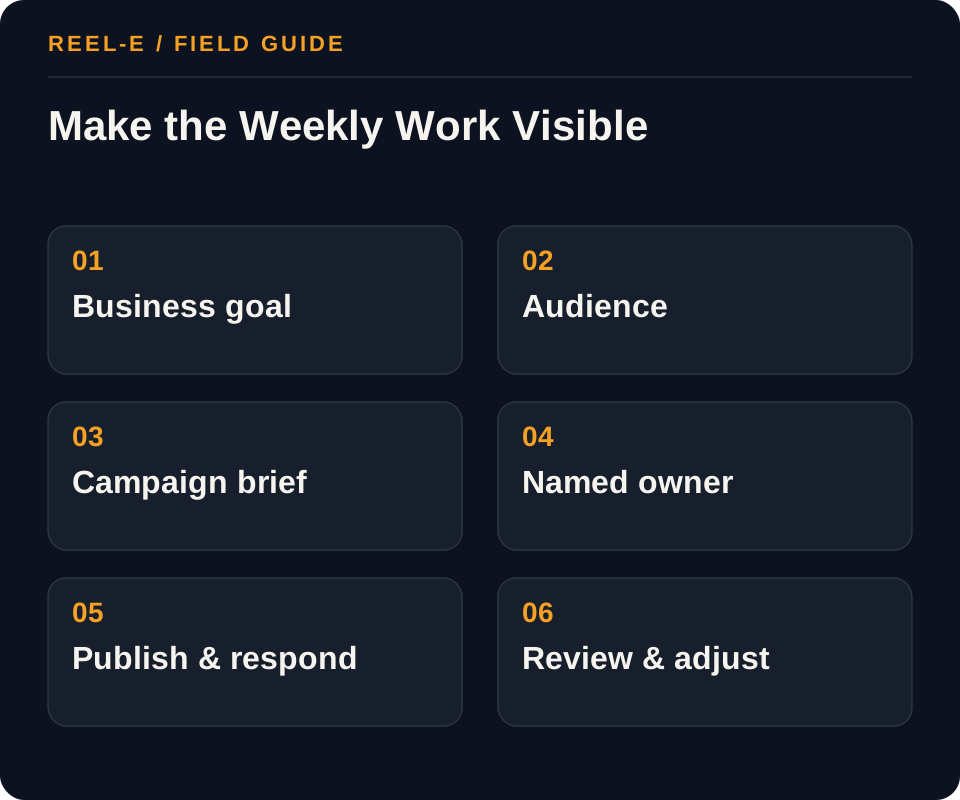
Build the Plan From Baseline to Quarterly Review
Build the plan from outcome to audience, proof, channel role, destination, response, and review. That order keeps the template tied to a business decision instead of a list of platforms.
1. Set One 90-Day Outcome
Choose a measurable business outcome constrained by capacity: qualified seller conversations, listings won, recurring property accounts, photographer partners, or direct inquiries. Record the baseline and do not substitute impressions for the outcome.
- Record: 90-Day Outcome in the One-Page Marketing Plan
- Control: Assign each channel one funnel role and measurable action.
- Review: Production and distribution spend divided by qualified opportunities under a consistent definition. Fix audience, destination, follow-up, or channel mix.
2. Define Audience and Promise
Specify the decision context, geography, property or service need, pain, evidence, and why the team is credible. Review housing language and targeting for current fair-housing requirements.
- Record: First-Party Result in the Quarterly Channel Review
- Control: Keep modeled, observed, and cash data separate.
- Review: Permissioned contacts or repeat direct visitors added with known provenance. Improve the value exchange and capture path.
3. Map the Funnel
For discovery, proof, nurture, conversion, and retention, name the source asset, channel, destination, action, owner, and response standard. Find dead ends before increasing traffic.
- Record: Promise in the One-Page Marketing Plan
- Control: Set response owner, time, route, and CRM readback.
- Review: Planned marketing work completed without displacing revenue or client commitments. Reduce cadence or add accountable capacity.
4. Build the Content and Media Engine
Select recurring questions, listing inputs, proof artifacts, video formats, email jobs, and publishing cadence. Estimate real production hours and approvals so the calendar matches team capacity.
- Record: Cost in the Quarterly Channel Review
- Control: Review audience, creative, targeting, delivery, and vendor automation under current guidance.
- Review: Production and distribution spend divided by qualified opportunities under a consistent definition. Fix audience, destination, follow-up, or channel mix.
5. Allocate Budget by Constraint
Separate owned infrastructure, production, distribution, software, paid media, partnerships, and contingency. Fund tracking and follow-up. Use modeled volume for opportunity context, not as a revenue forecast.
- Record: Source of Truth in the One-Page Marketing Plan
- Control: Assign each channel one funnel role and measurable action.
- Review: Permissioned contacts or repeat direct visitors added with known provenance. Improve the value exchange and capture path.
6. Install the Review Rhythm
Review production and leading actions biweekly, pipeline and cash monthly, and strategy quarterly. Stop channels with no role or follow-up, refresh assets already near opportunity, and preserve distinct search demand before consolidation.
- Record: Quality in the Quarterly Channel Review
- Control: Keep modeled, observed, and cash data separate.
- Review: Planned marketing work completed without displacing revenue or client commitments. Reduce cadence or add accountable capacity.

A 90-Day Rollout
| Window | Work | Finish Line |
|---|---|---|
| Days 1-30 | Set One 90-Day Outcome; Define Audience and Promise | Baseline and first complete path |
| Days 31-60 | Map the Funnel; Build the Content and Media Engine | Repeatable production and handoff |
| Days 61-90 | Allocate Budget by Constraint; Install the Review Rhythm | Review, correction, and next allocation |
A Worked Example: Three-Agent Team Seeking More Seller Conversations
The situation: The team posts listings inconsistently, has a large past-client list, and spends on ads without a useful seller destination.
The approach: It builds a seller marketing-process page, turns each listing into proof content, launches a monthly seller email, uses social to distribute two recurring formats, and sends paid traffic only to a measurable valuation/consultation path.
The result to review: The plan has owners, capacity, a 90-day outcome, and a budget by role. Reach is reported separately from qualified conversations and won listings.
The team does less at once, but the work now reaches a destination and a named owner. That usually feels slower on the planning day and much faster everywhere else.
Use Numbers That Change the Next Move
Use qualified opportunity cost, owned-audience growth, response performance, and capacity. Keep modeled forecasts separate from observed revenue and change the constrained stage first.
| Metric | Definition | How to Use It |
|---|---|---|
| Qualified Opportunity Cost | Production and distribution spend divided by qualified opportunities under a consistent definition. | Fix audience, destination, follow-up, or channel mix. |
| Owned-Audience Growth | Permissioned contacts or repeat direct visitors added with known provenance. | Improve the value exchange and capture path. |
| Capacity Utilization | Planned marketing work completed without displacing revenue or client commitments. | Reduce cadence or add accountable capacity. |
Tools You Can Use
One-Page Marketing Plan
Turn strategy into an operating contract.
- 90-Day Outcome: Current fact, source, owner, approval date, effect on set one 90-day outcome, and fit with listing-led growth.
- Audience: Current fact, source, owner, approval date, effect on define audience and promise, and fit with expertise-led growth.
- Promise: Current fact, source, owner, approval date, effect on map the funnel, and fit with relationship-led growth.
- Proof: Current fact, source, owner, approval date, effect on build the content and media engine, and fit with listing-led growth.
- Source of Truth: Current fact, source, owner, approval date, effect on allocate budget by constraint, and fit with expertise-led growth.
- Channel Roles: Current fact, source, owner, approval date, effect on install the review rhythm, and fit with relationship-led growth.
- Budget: Current fact, source, owner, approval date, effect on set one 90-day outcome, and fit with listing-led growth.
- Response Sla: Current fact, source, owner, approval date, effect on define audience and promise, and fit with expertise-led growth.
- Metrics: Current fact, source, owner, approval date, effect on map the funnel, and fit with relationship-led growth.
- Decision Dates: Current fact, source, owner, approval date, effect on build the content and media engine, and fit with listing-led growth.
Quarterly Channel Review
Keep, revise, expand, or stop with stable evidence.
- Channel and Job: Current fact, source, owner, approval date, effect on define audience and promise, and fit with expertise-led growth.
- First-Party Result: Current fact, source, owner, approval date, effect on map the funnel, and fit with relationship-led growth.
- Modeled Opportunity: Current fact, source, owner, approval date, effect on build the content and media engine, and fit with listing-led growth.
- Cost: Current fact, source, owner, approval date, effect on allocate budget by constraint, and fit with expertise-led growth.
- Capacity: Current fact, source, owner, approval date, effect on install the review rhythm, and fit with relationship-led growth.
- Quality: Current fact, source, owner, approval date, effect on set one 90-day outcome, and fit with listing-led growth.
- Constraint: Current fact, source, owner, approval date, effect on define audience and promise, and fit with expertise-led growth.
- Decision: Current fact, source, owner, approval date, effect on map the funnel, and fit with relationship-led growth.
- Owner: Current fact, source, owner, approval date, effect on build the content and media engine, and fit with listing-led growth.
Where This Usually Breaks
Watch for invented forecasts, unowned follow-up, housing-ad exposure, and a channel list masquerading as strategy. A plan should make uncertainty visible, not decorate it.
| Risk | Practical Control |
|---|---|
| Channel List Without Strategy | Assign each channel one funnel role and measurable action. |
| Modeled Forecast Presented as Revenue | Keep modeled, observed, and cash data separate. |
| Unowned Follow-Up | Set response owner, time, route, and CRM readback. |
| Fair-Housing Exposure | Review audience, creative, targeting, delivery, and vendor automation under current guidance. |
Channel List Without Strategy
- Control: Assign each channel one funnel role and measurable action.
- Review Stage: Set One 90-Day Outcome
- Early Warning: Production and distribution spend divided by qualified opportunities under a consistent definition.
- Response: Fix audience, destination, follow-up, or channel mix.
Modeled Forecast Presented as Revenue
- Control: Keep modeled, observed, and cash data separate.
- Review Stage: Define Audience and Promise
- Early Warning: Permissioned contacts or repeat direct visitors added with known provenance.
- Response: Improve the value exchange and capture path.
Unowned Follow-Up
- Control: Set response owner, time, route, and CRM readback.
- Review Stage: Map the Funnel
- Early Warning: Planned marketing work completed without displacing revenue or client commitments.
- Response: Reduce cadence or add accountable capacity.
Fair-Housing Exposure
- Control: Review audience, creative, targeting, delivery, and vendor automation under current guidance.
- Review Stage: Build the Content and Media Engine
- Early Warning: Production and distribution spend divided by qualified opportunities under a consistent definition.
- Response: Fix audience, destination, follow-up, or channel mix.
Verify current primary guidance for the actual jurisdiction, platform, campaign, property, and professional relationship. This researched guide is not individualized legal, aviation, financial, privacy, or compliance advice.
My Bottom Line
A useful marketing plan is a small set of funded choices with owners and review rules. If someone can run it on Wednesday without reopening the strategy deck, it is doing its job.
Sources and Research Notes
Open the source ledger- HUD guidance on digital housing advertising. Primary federal guidance on Fair Housing Act considerations in digital targeting and delivery. Accessed August 12, 2026.
- National Association of REALTORS Fair Housing resources. Industry resource for fair-housing education; local counsel and brokerage policy remain controlling. Accessed August 12, 2026.
- NAR video marketing practice article. Industry practice source for concise, audience-centered real-estate video planning. Accessed August 12, 2026.
- Matterport marketing plan. Format and coverage reference. Clear eight-step structure but not a complete workbook with source truth and response ownership. Accessed August 12, 2026.
- Zillow marketing plan template. Format and coverage reference. Useful audience and budget context; less detailed production and measurement governance. Accessed August 12, 2026.
- NAR marketing hub. Format and coverage reference. Authoritative collection but not one copyable, measurement-ready plan. Accessed August 12, 2026.
Sources support only the claims described in their notes. Reopen current primary sources before a purchase, launch, or compliance decision.
Keep Reading
- implement the social channel
- implement the email channel
- align positioning and proof before distribution
- measure the path from source to appointment
- adapt the operating plan for a home builder's community pipeline
- build the content engine
- create a Reel-E listing video
- compare the strongest real estate video-maker workflows
- see how Reel-E turns approved photos into listing video