Key Takeaways
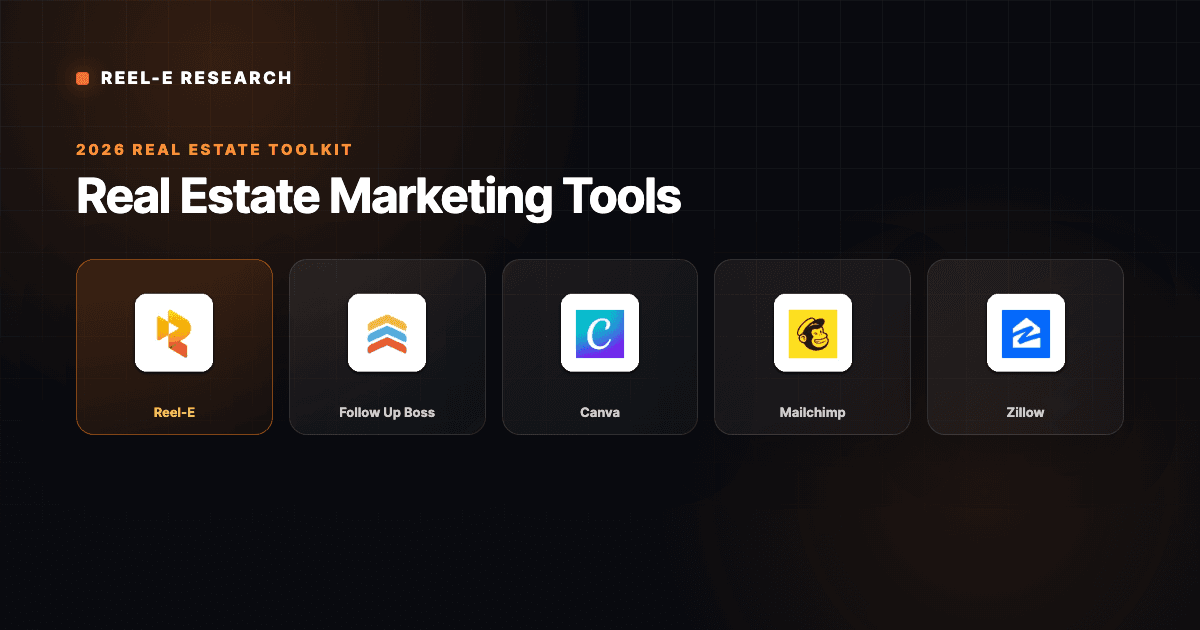
- Best for video marketing: Reel-E. Purpose-built for listings, AI-powered motion, four video variants from one upload in under two minutes.
- Best CRM: Follow Up Boss. Fast lead routing, high adoption rates, 250+ integrations.
- Best for design: Canva. Massive template library, Brand Kit, free tier covers most agents.
- Best for photo editing: BoxBrownie. Virtual staging, day-to-dusk, and image enhancement at pay-per-image pricing.
- We evaluated each tool based on its category-specific strengths, ease of use, integration with a real estate workflow, and value for money.
- The right stack connects categories: polished photos feed into video, video feeds into social and email, leads feed into CRM.
Our Top Picks at a Glance
1 Reel-EBest for Video Marketing
4.9
From $44/mo
2
Reel-EBest for Video Marketing
4.9
From $44/mo
2
 Follow Up BossBest CRM for Teams
4.7
From $69/mo
3
Follow Up BossBest CRM for Teams
4.7
From $69/mo
3
 BoxBrownieBest for Photo Editing
4.6
From $1.60/image
4
BoxBrownieBest for Photo Editing
4.6
From $1.60/image
4
 CanvaBest for Social Design
4.5
Free / $13/mo
5
CanvaBest for Social Design
4.5
Free / $13/mo
5
 AgentFireBest Agent Website
4.4
From $149/mo
6
AgentFireBest Agent Website
4.4
From $149/mo
6
 MailchimpBest for Email Marketing
4.3
Free / $13/mo
7
MailchimpBest for Email Marketing
4.3
Free / $13/mo
7
 kvCOREBest All-in-One CRM
4.2
From $499/mo
8
kvCOREBest All-in-One CRM
4.2
From $499/mo
8
 LaterBest for Scheduling
4.1
Free / $25/mo
9
LaterBest for Scheduling
4.1
Free / $25/mo
9
 Zillow Premier AgentBest for Buyer Leads
4.0
From $300/mo
10
Zillow Premier AgentBest for Buyer Leads
4.0
From $300/mo
10
 BoldLeadsBest for Seller Leads
3.8
From $399/mo
BoldLeadsBest for Seller Leads
3.8
From $399/mo
The Best Real Estate Marketing Tools Compared
The average real estate agent spends 10+ hours per week on marketing tasks that could be done in two. That is not a motivational guess. It is what happens when you try to run a CRM, edit listing videos, schedule social posts, send email campaigns, and update your website using tools that were not built for real estate.
This guide covers the best real estate marketing tools in 2026 across every category that matters: video, CRM, social media, email, websites, lead generation, and photography. Every tool on this list was picked because it solves a specific problem for agents, not because it has the flashiest demo. If you are building or rebuilding your marketing stack this year, this is the reference.
One note before we start. The categories are listed in order of impact on listing marketing. Video comes first because it is the single biggest gap in most agents' workflows, and closing that gap changes the math on everything else.
How We Evaluated Each Tool
To keep this comparison fair, we scored every platform across five dimensions:
- Category strength: How well does it solve the specific problem it claims to solve?
- Ease of use: Can a non-technical agent get value on the first day?
- Real estate focus: Does it understand listing workflows, or is it a generic tool with a real estate skin?
- Integration: Does it connect to the rest of your marketing stack?
- Value: What do you actually get for the price?
The 10 Best Real Estate Marketing Tools Reviewed

1. Reel-E: Best Video Marketing Tool for Real Estate
Editor's Choice - Video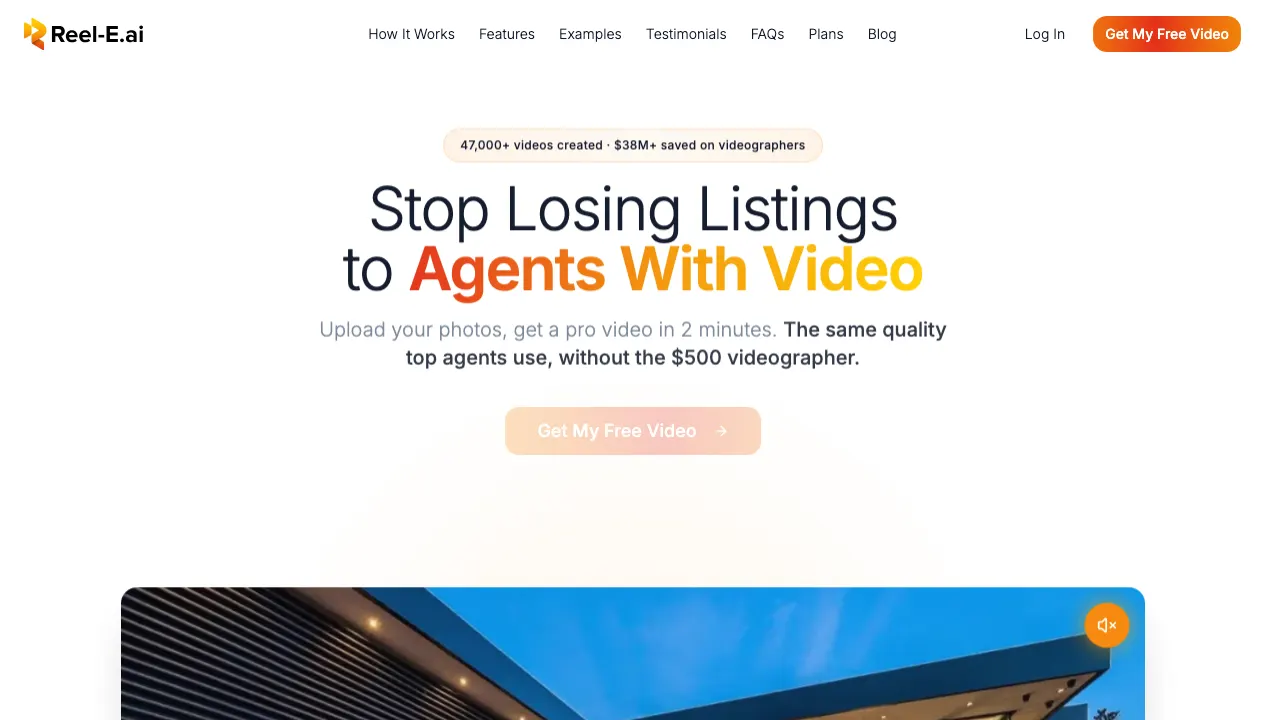
Video is the most skipped category in real estate marketing, and it is also the one with the highest ROI when you actually do it. Listings with video get 403% more inquiries than those without (full stats here). The reason agents skip it is not that they do not believe in video. It is that traditional production costs $300 to $1,500 per listing and takes days to turn around.
Reel-E fixes that. Upload your listing photos, pick a music track, and Reel-E's AI generates four video variants (horizontal branded, horizontal unbranded, vertical branded, vertical unbranded) in under two minutes. The AI handles camera motion, beat-synced transitions, speed ramps, and professional pacing. No editing timeline. No render queue. No back-and-forth with a videographer about revision three.
Why Reel-E is the #1 pick for video
- Custom AI inference stack. Reel-E runs its own models for camera motion and scene composition. This is not a wrapper around Google Veo or Kling with a real estate skin. The output quality, camera control, and consistency are noticeably different because the models were built specifically for property footage.
- Four variants from one upload. Horizontal for MLS and YouTube. Vertical for Instagram Reels and TikTok. Branded with your logo and contact card. Unbranded for MLS compliance. One upload, four finished assets.
- Beat-synced transitions. The AI analyzes the music track's downbeats and aligns transitions to the rhythm. This is the kind of detail that separates "slideshow with motion" from "this looks like it was professionally edited."
- Under two minutes. From photo upload to four finished videos. Compare that to the three-to-five-day turnaround from most videographers.
- Speed ramps and AI+ effects. Control camera motion per clip, add speed ramps between transitions, or use AI+ for atmospheric elements like fire and water reflections.
Pros
- AI-powered cinematic camera motion (not just Ken Burns)
- Four video formats from a single upload
- Beat-synced transitions matched to music
- Under 2 minutes from photos to finished video
Cons
- Real estate only, not general-purpose
- No timeline editor for manual frame editing
- No free tier (paid plans start at $44/mo)
The fastest path from listing photos to cinematic video. If you list 3+ properties a month, nothing else comes close on efficiency and output quality. See the full pricing breakdown.

2. Follow Up Boss: Best CRM for Real Estate Teams
Best CRM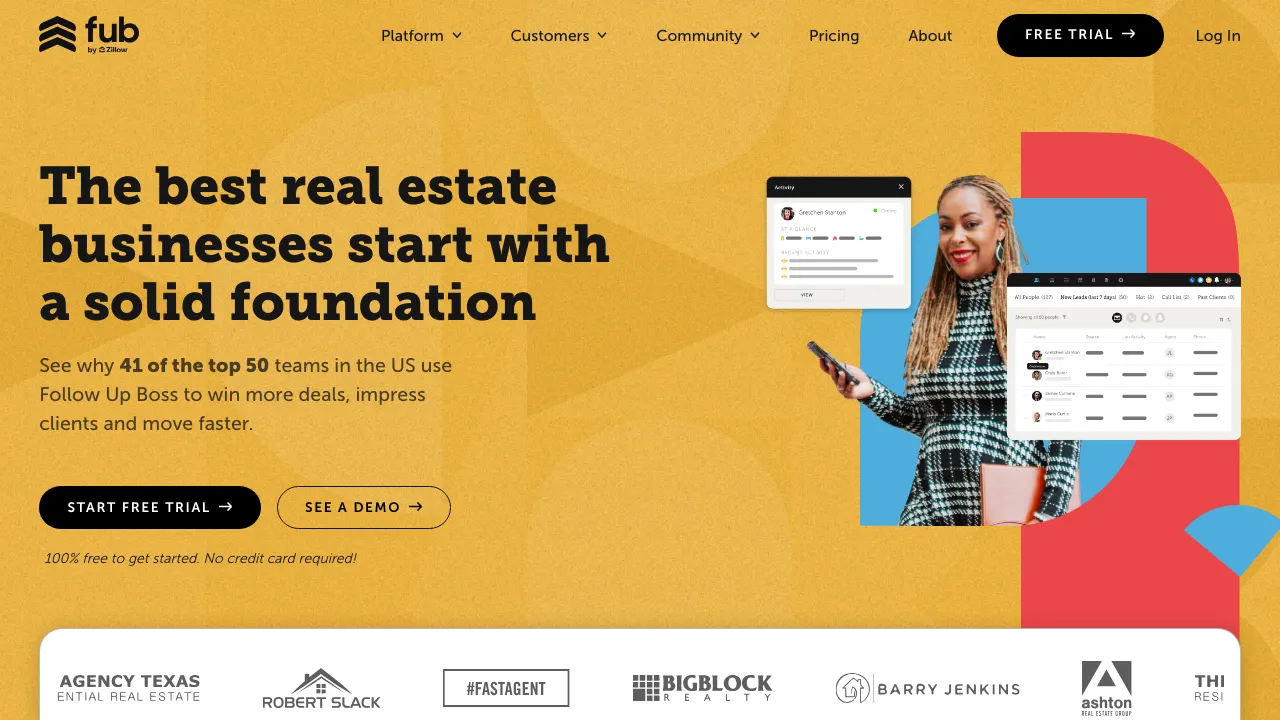
A CRM is not a marketing tool in the traditional sense, but it is the backbone that makes every other marketing tool work. Without a CRM, your lead sources are disconnected, your follow-up is manual, and your pipeline leaks at every stage.
Follow Up Boss is the CRM that agents actually use. That is not a small thing. The real estate industry is littered with CRM platforms that look great in demos and then collect dust because agents find them cumbersome. Follow Up Boss survives because it nails the core job: lead routing, follow-up automation, and pipeline visibility.
- Lead routing. Leads from Zillow, Realtor.com, your website, and 250+ other sources flow into one inbox with automatic assignment rules. Round-robin, geographic, price-based, or custom. This alone saves team leaders hours of manual distribution.
- Smart Lists. Filter your database by any combination of lead source, last contact, tag, stage, or custom field. This is where you find the "contacted six months ago, never got a reply, in the $400K to $600K range" segment that turns into a win-back campaign.
- Action Plans. Automated sequences of calls, texts, and emails triggered by lead stage changes. Not as sophisticated as a dedicated email platform, but strong enough for one-to-one follow-up.
- Integrations. Connects with basically everything: Zillow, BoomTown, Ylopo, Calendly, and most dialer and transaction management platforms.
Pros
- Fast lead routing from 250+ sources
- High adoption rate among agents (actually gets used)
- Smart Lists for targeted follow-up campaigns
- Connects with virtually every real estate tool
Cons
- No built-in website or IDX
- Email broadcast features weaker than dedicated platforms
- Per-user pricing adds up for larger teams
The CRM agents actually open every morning. Best for teams that need fast lead routing and consistent follow-up. Pair it with Reel-E for video, Mailchimp for email, and you have a connected stack.

3. BoxBrownie: Best for Real Estate Photo Editing
Best Photo Editing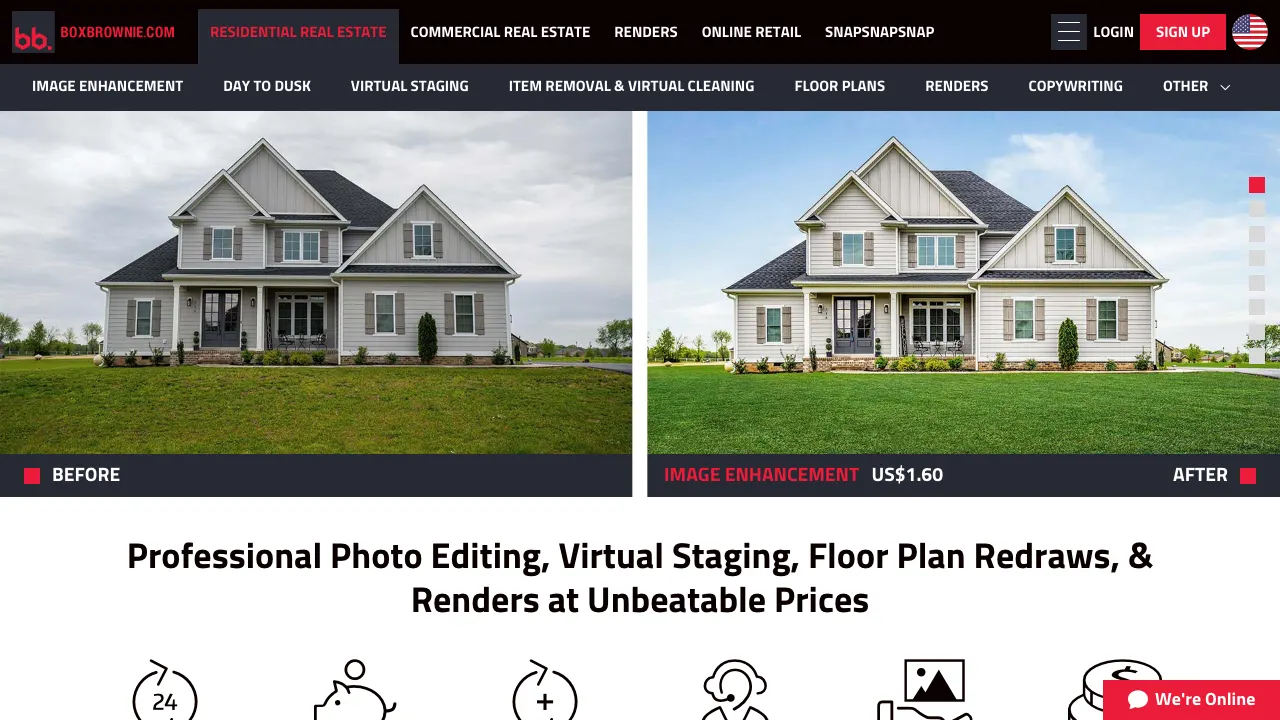
Photos are the foundation of every other marketing asset. Your video quality depends on your photo quality. Your social posts depend on your photo quality. Your listing's first impression depends on your photo quality. If the photos are bad, nothing downstream can fix them. BoxBrownie is the best tool for making sure your listing photos are polished before they enter any other workflow.
- Image Enhancement. Color correction, exposure adjustment, lens correction, and sky replacement. Turns "good enough" listing photos into "clean and professional" listing photos. Starting at $1.60 per image.
- Virtual Staging. Add furniture and decor to empty rooms. BoxBrownie's virtual staging is the most realistic in the category, with natural lighting, shadows, and fabric textures that do not look obviously AI-generated. From $24 per image.
- Day-to-Dusk conversion. Transform daytime exterior shots into dramatic twilight images. This is the single highest-ROI photo enhancement for listings: twilight shots consistently generate more clicks and saves on Zillow and MLS. $4 per image.
- Item Removal. Remove clutter, personal items, and distracting objects from photos. Useful for lived-in listings where the owner cannot or will not stage. From $4 per image.
- Floor Plans. 2D and 3D floor plan creation from your measurements or photos. Increasingly expected by buyers, especially for larger homes.
- Virtual Renovation. Show buyers what a kitchen or bathroom could look like after renovation. Powerful for properties that need updating but have strong bones.
The photo-to-video pipeline: Here is where the categories connect. Get your photos edited with BoxBrownie, then upload the polished set to Reel-E to create listing videos. Better input photos produce better video output. Virtual staging photos run through Reel-E's AI motion create especially compelling video because the staged rooms look lived-in with camera motion applied.
Pros
- Most realistic virtual staging in the category
- Day-to-dusk conversion is highest-ROI photo enhancement
- Pay-per-image, no subscription required
- Polished photos improve downstream video quality
Cons
- Not instant (turnaround is hours, not minutes)
- Virtual staging at $24/image adds up for large projects
- No built-in video or social features
The foundation of a great listing marketing workflow. Polish your photos with BoxBrownie, then feed them into Reel-E for video. Every agent should use this, even if your photographer is excellent.

4. Canva: Best Design Tool for Real Estate Social Media
Best for Design
Canva is the default design tool for real estate social media in 2026, and for good reason. The real estate template library is enormous (open house flyers, just-listed posts, market update carousels, story templates), the drag-and-drop editor is genuinely fast, and the Brand Kit feature keeps your fonts, colors, and logos consistent across everything.
- Real estate templates. Hundreds of purpose-built templates for Instagram posts, stories, Facebook ads, YouTube thumbnails, and print flyers. Most can be customized in under five minutes.
- Brand Kit. Upload your logo, set your brand colors and fonts, and every template auto-applies them. This is what prevents the "every post looks different" problem that plagues agents without a design system.
- Magic Resize. Design once, resize for every platform. One design becomes an Instagram post, Facebook cover, story, and flyer without starting from scratch.
- Team features. Shared brand folders, template locking (so agents on a team cannot accidentally change the brokerage logo), and approval workflows.
Where Canva falls short: Video. Canva's video editor is functional for basic slideshows and text-on-video, but it is nowhere close to what you need for proper listing video. There are no AI camera motion effects, no beat-synced transitions, no speed ramps, and the output quality does not compete with purpose-built real estate video tools. Use Canva for static graphics and Reel-E for video. That combination covers both sides of the visual marketing workflow without overlap. (For the full breakdown, see our Reel-E vs Canva comparison.)
Pros
- Massive real estate template library
- Brand Kit keeps everything consistent
- Magic Resize saves hours on multi-platform content
- Generous free tier for getting started
Cons
- Video editor is basic (no AI motion, no beat-sync)
- Not a replacement for dedicated video tools
- Team features require paid plan
Every agent should have Canva in their stack for social graphics and print materials. Pair it with Reel-E for video and you have both sides of visual marketing covered.

5. AgentFire: Best Real Estate Agent Website Builder
Best Website
Your website is the only piece of marketing real estate you actually own. Social media profiles can be throttled, shadowbanned, or algorithm-changed overnight. Your email list can be affected by deliverability shifts. But your website is yours. In 2026, the best website builder for real estate agents is AgentFire.
AgentFire stands out because the designs are genuinely good (not just "good for a real estate template"), the SEO infrastructure is solid, and the IDX integration works without feeling bolted on.
- Hype System design framework. AgentFire's proprietary design system produces sites that look custom-built. Multiple homepage layouts, area pages, and listing presentations that do not scream "template."
- IDX integration. Direct MLS feed integration with property search, map search, and saved search functionality. Leads can search, save, and receive alerts without leaving your site.
- Area pages and neighborhood guides. Pre-built templates for hyperlocal content. This is where long-tail SEO happens. A well-built area page for "homes for sale in Coral Gables" can drive organic traffic for years.
- CRM integrations. Connects with Follow Up Boss, kvCORE, LionDesk, and other major CRMs. Lead capture forms feed directly into your pipeline.
- Blog engine. Built-in blogging with SEO controls (meta titles, descriptions, schema markup). Essential for organic traffic.
- Speed and mobile optimization. Fast load times and responsive design. Google's Core Web Vitals directly affect search rankings, and most real estate websites fail mobile speed tests.
Where to embed Reel-E video: AgentFire listing pages support video embeds. Adding your Reel-E listing video to each property page increases time-on-page and gives visitors a reason to engage beyond scrolling through a photo gallery.
Pros
- Best design quality among real estate website builders
- IDX integration with property search and alerts
- Area pages drive long-tail organic traffic
- Connects with major CRMs
Cons
- Higher price point than budget builders
- Full-service setup adds to initial cost
- WordPress-based (requires occasional updates)
The best real estate website builder for agents serious about organic lead generation. Not the cheapest option, but the quality gap between AgentFire and budget builders is visible to every visitor.

6. Mailchimp: Best Email Marketing for Real Estate
Best Email
Email marketing is the most underrated category in real estate. Agents spend thousands on lead generation and then fail to nurture those leads with consistent, professional email. The result is a database of contacts that slowly forgets you exist. A good email platform fixes that by making it easy to send market updates, listing alerts, and drip campaigns without spending an hour per email.
Mailchimp remains the best email marketing tool for real estate agents in 2026, and it is not particularly close for the combination of features, price, and ease of use.
- Drag-and-drop email builder. Build professional emails without touching HTML. The template library includes newsletter layouts, announcement emails, and promotional designs that work for real estate.
- Automation (Journeys). Set up automated email sequences triggered by sign-up, tag, date, or custom event. New lead nurture sequences, anniversary emails, and post-close check-ins all run without manual intervention once built.
- Audience segmentation. Segment your list by engagement, location, tag, purchase history, or custom fields. Send your luxury listing announcement to the $1M+ segment and your first-time buyer tips to everyone else.
- Landing pages. Built-in landing page builder for lead capture. Not as powerful as a dedicated page builder, but sufficient for open house sign-ups and lead magnets.
- Analytics. Open rates, click rates, revenue attribution, and audience growth over time. The data is clean enough to actually inform decisions about what content resonates.
Why not your CRM's built-in email? Most CRM email tools (including Follow Up Boss Action Plans) are built for one-to-one follow-up sequences, not broadcast email marketing. They lack the template design tools, deliverability infrastructure, and segmentation depth that a dedicated platform provides. Use your CRM for drip follow-up and Mailchimp for everything else.
Pro tip: Embed your Reel-E listing videos directly in your email campaigns. Video thumbnails in email increase click-through rates by 65%. Mailchimp supports video thumbnail embedding with a play button that links to the video.
Pros
- Best email automation (Journeys) in the category
- Advanced audience segmentation
- Free tier covers 500 contacts
- Video thumbnail embedding boosts click-through
Cons
- Not real-estate-specific (generic templates)
- Pricing scales with contact list size
- Landing page builder is basic
The best email platform for real estate agents who want to nurture their database without spending hours on each campaign. Every agent with 100+ contacts should be using this.

7. kvCORE: Best All-in-One Real Estate Platform
All-in-One
kvCORE takes a different approach from Follow Up Boss. Instead of being a standalone CRM, it is an all-in-one platform: CRM, IDX website, lead generation landing pages, email and text campaigns, and reporting. If Follow Up Boss is the specialist, kvCORE is the Swiss Army knife.
- Built-in IDX website. Property search, forced registration, and lead capture without a separate website vendor.
- Behavioral automation. Triggers based on what leads actually do on your site (saved searches, favorited properties, price-drop alerts) rather than just time-based drips.
- AI assistant (Kelle). Handles initial lead qualification via text, which can save significant time on low-intent leads.
- Team and brokerage tools. White-labeled for brokerages with agent-level subaccounts and reporting.
Pros
- CRM, website, and lead gen in one platform
- Behavioral automation based on lead activity
- AI lead qualification saves time on low-intent leads
- White-label options for brokerages
Cons
- Each component is "good enough" but not best-in-class
- Medium-high learning curve
- Expensive for individual agents ($499+/mo for teams)
Best for brokerages and teams that want one platform for CRM, website, and lead gen. Agents who prefer fewer vendors and are willing to accept a "good enough" version of each component rather than best-in-class across categories.

8. Later: Best Social Media Scheduling for Real Estate
Best Scheduling
Once your content is designed (Canva for graphics, Reel-E for video), you need somewhere to schedule and publish it. Later is the best social media scheduling tool for real estate agents who post primarily visual content.
- Visual content calendar. Drag-and-drop calendar with thumbnail previews. You can see exactly how your Instagram grid will look before anything publishes, which matters more than most agents realize for profile aesthetics.
- Auto-publishing. Direct publishing to Instagram (including Reels and carousels), Facebook, TikTok, Pinterest, and LinkedIn. No more phone notification reminders to manually post.
- Linkin.bio. A mini landing page linked from your Instagram bio that turns every post into a clickable link. Great for driving traffic to listings.
- Best time to post. AI-suggested posting times based on when your specific audience is most active. Not generic "post at 9 AM" advice, but data from your account's engagement patterns.
Pros
- Visual calendar with Instagram grid preview
- Auto-publishing to all major platforms
- AI-suggested optimal posting times
- Linkin.bio drives listing traffic from Instagram
Cons
- Free tier limited to 1 profile, 5 posts/month
- No content creation tools (design elsewhere)
- Analytics depth limited on lower tiers
The best scheduling tool for agents who batch-create content. Pairs perfectly with Canva (graphics) and Reel-E (video clips for Reels and TikTok).

9. Zillow Premier Agent: Best for Buyer Lead Generation
Best Buyer Leads
Lead generation tools are the most expensive category in the real estate marketing stack, and the one where agents waste the most money. The problem is not that the tools do not work. The problem is that most agents buy leads and then fail to follow up consistently. If your CRM and follow-up systems are solid, lead generation tools become powerful. If they are not, save your money until they are.
Zillow Premier Agent remains the largest source of real estate buyer leads in the US. The model is straightforward: you pay for placement in specific ZIP codes, and Zillow routes leads from active home shoppers to you.
- ZIP code-based targeting. You buy share of voice in specific ZIP codes. More competitive ZIPs cost more. A prime ZIP in Miami or Los Angeles can run $1,000+ per month, while a suburban ZIP in the Midwest might be $200.
- Connection calls. Zillow's concierge team can pre-qualify and connect leads to you via live phone call. This increases contact rates significantly compared to form fills that sit in an inbox.
- Profile and reviews. Your Zillow profile becomes a lead conversion asset. Agents with 50+ reviews and a complete profile convert leads at materially higher rates.
- Flex program. Performance-based pricing where you pay a referral fee at closing instead of monthly. Lower upfront cost, higher per-deal cost.
The uncomfortable truth: Zillow Premier Agent works best for agents who answer the phone immediately, follow up relentlessly, and have systems in place to nurture leads over months. If your average speed-to-lead is over five minutes, you are probably burning money. Fix the follow-up before buying the leads.
Pros
- Largest source of high-intent buyer leads in the US
- Connection calls increase contact rates
- Flex program available for pay-at-close model
- Profile reviews compound lead conversion over time
Cons
- Expensive in competitive ZIP codes ($1,000+/mo)
- ROI requires fast follow-up systems
- Leads are shared with other agents in your ZIP
The highest-volume buyer lead source available. Only worth the investment if your CRM and follow-up systems are already in place. Fix the follow-up before buying the leads.

10. BoldLeads: Best for Seller Lead Generation
Best Seller Leads
BoldLeads takes a different approach from Zillow: instead of routing existing traffic, it runs Facebook and Google ads on your behalf and captures leads through landing pages. You get seller leads (home valuation landing pages) and buyer leads (property search landing pages) delivered to a built-in CRM with automation.
- Managed ad campaigns. BoldLeads builds and manages the ad campaigns. You do not need to learn Facebook Ads Manager or Google Ads. They handle targeting, creative, and optimization.
- Seller lead focus. The home valuation landing page is their strongest asset. Homeowners enter their address to get an estimated value, and you get a seller lead with their contact info and property address. In a market where listings are gold, this matters.
- Built-in CRM and automation. Leads land in BoldLeads' CRM with automated text and email follow-up. Not as robust as Follow Up Boss, but functional for agents who want a simpler stack.
- Exclusivity. BoldLeads typically grants ZIP code exclusivity to one agent per area, which means you are not competing with other agents on the same platform for the same leads.
Pros
- Managed ad campaigns require no ad expertise
- Seller lead focus via home valuation pages
- ZIP code exclusivity reduces competition
- Built-in CRM with automated follow-up
Cons
- Expensive: platform fee plus ad spend ($650-900+/mo total)
- Lead quality varies by market
- Built-in CRM is basic compared to dedicated platforms
The best managed platform for seller lead acquisition. ZIP code exclusivity is a real advantage. Only worth it if you have budget for both the platform fee and ad spend, and a CRM to nurture leads over months.
How to Build Your Real Estate Marketing Stack
The mistake most agents make is buying tools one at a time, based on whatever ad they saw last or whatever software a colleague mentioned at a conference. The result is a frankenstack: five tools with overlapping features, no integration between them, and a workflow that requires manual effort at every handoff.
A better approach: start with the marketing jobs that matter most, pick one tool per job, and make sure the tools connect.
The essential stack (solo agent, under $300/month)
| Category | Tool | Approx. Cost | Job it does |
|---|---|---|---|
| Video | Reel-E | From $29/mo | Listing video from photos, 4 variants per listing |
| CRM | Follow Up Boss | $69/mo | Lead routing, pipeline, follow-up automation |
| Design | Canva Pro | $13/mo | Social graphics, flyers, brand consistency |
| Mailchimp (Free) | $0 | Database nurture, market updates, listing alerts | |
| Photo editing | BoxBrownie | ~$50-100/mo* | Image enhancement, virtual staging, day-to-dusk |
*BoxBrownie is pay-per-image, so monthly cost depends on listing volume. Estimated for 3-5 listings per month.
This five-tool stack covers the entire listing marketing workflow: photos get polished (BoxBrownie), video gets created (Reel-E), social graphics get designed (Canva), leads get nurtured (Mailchimp), and everything flows through one CRM (Follow Up Boss). Total cost: roughly $160 to $260 per month depending on listing volume.
The growth stack (team or high-volume agent, $500-1,000/month)
Add to the essential stack:
- Scheduling: Later ($25/month) for batch social scheduling and auto-publishing.
- Website: AgentFire ($149/month) for IDX, area pages, and organic lead generation.
- Lead gen: Zillow Premier Agent or BoldLeads ($300-900/month) for active lead flow.
- Email upgrade: Mailchimp Standard ($20/month) for automation journeys and advanced segmentation.
- Video upgrade: Reel-E Growth or Pro tier for more listings, 4K output, and clip downloads.
At this level, the marketing system runs semi-automatically. New listings trigger a sequence: photos go to BoxBrownie, polished photos go to Reel-E, video and graphics get scheduled through Later, email goes out through Mailchimp, and leads flow into Follow Up Boss. The agent's job shifts from production to review and approval.
Emerging Tools Worth Watching in 2026
The real estate marketing tools category is moving fast, especially on the AI side. A few tools and trends worth monitoring even if they are not ready for your primary stack yet:
- AI listing descriptions. Tools like Listing AI and ChatGPT-based integrations generate MLS descriptions from property details. Useful for first drafts, but still require human review for accuracy and compliance. Most CRMs and real estate platforms are adding this as a built-in feature, so standalone tools in this category may become redundant.
- AI-powered virtual tours. Several platforms are working on generating 3D virtual tours from 2D photos using AI depth estimation. The technology is not there yet for production use (spatial accuracy is still unreliable), but it is worth tracking.
- Voice AI for lead follow-up. AI phone agents that call and qualify leads on your behalf. The conversational quality has improved dramatically, and platforms like Air.ai and Synthflow are specifically targeting real estate. Still early, but the speed-to-lead advantage is significant.
- Predictive analytics. Platforms like SmartZip and Offrs use public data to predict which homeowners are likely to sell. The accuracy rates are improving, and combining predictive seller data with targeted direct mail or email can be powerful for listing acquisition.
The Integration Question: Should You Go All-in-One?
Every year, some real estate platform promises to be the one tool that replaces everything. Every year, that tool is mediocre at most things and good at one or two. The pattern has not changed in 2026.
All-in-one platforms (kvCORE, Chime, RealGeeks, and similar) work well for agents who value simplicity over optimization. If the idea of managing five different subscriptions gives you a headache, an all-in-one platform is a reasonable choice. You will get a website, CRM, email, and landing pages in one login. Each component will be "good enough" but not best-in-class.
Best-of-breed stacks (picking the best tool in each category) work better for agents who want maximum performance from each component and are willing to manage the integrations. The trade-off is complexity, but the performance gap is real. A Follow Up Boss + Reel-E + Mailchimp + AgentFire + Canva stack will outperform the equivalent all-in-one platform in every individual category.
My recommendation (and yes, I am biased, since Reel-E is the video component): go best-of-breed for the categories that directly affect listing marketing (video, photos, website), and accept "good enough" in categories where the performance gap is smaller (social scheduling, basic automation). The categories that touch your listings touch your revenue. Those deserve the best tools.
How to Evaluate Any Real Estate Marketing Tool
Before adding anything to your stack, run it through these five questions. I have seen too many agents sign up for tools based on a webinar demo and then never log in again.
- What specific bottleneck does this remove? If you cannot name the exact problem in one sentence, you do not need the tool. "It would be nice to have" is not a bottleneck.
- How many minutes per listing does it save? Multiply that by your monthly listing volume. That is the real ROI. A tool that saves 45 minutes per listing across 8 listings per month is saving you 6 hours. That is worth paying for.
- Does it connect to what I already use? A tool that does not integrate with your CRM or existing workflow creates a data island. Data islands create manual work. Manual work is the thing you are trying to eliminate.
- What happens to my data if I leave? Can you export your contacts, content, and assets? Tools that hold your data hostage are a liability.
- Does it solve a real problem or a demo problem? Demo problems look impressive on a screen share but do not map to your actual Tuesday afternoon workflow. Real problems are the ones you complain about to your assistant or spouse.
Common Mistakes When Building a Real Estate Marketing Stack
After a decade building marketing tools for real estate (here is the full story), here are the patterns that waste the most money and time:
- Buying lead gen before fixing follow-up. The most expensive mistake. $800/month in leads going into a CRM nobody checks is $9,600/year in the trash. Get the CRM and follow-up system working first. Then buy leads.
- Skipping video because it "seems expensive." The irony is that skipping video is the expensive choice. Listings without video sell slower and for less. The agent who skips video on a $650,000 listing to save $50 is not doing great math. With tools like Reel-E, video is now cheaper and faster than most social media graphic creation.
- Having three tools that do the same thing. If your CRM has email, and you have Mailchimp, and you also have Constant Contact from that training you attended, pick one and cancel the others. Overlapping tools create confusion about which system is the source of truth.
- Ignoring the website. Social media reach is declining. Email open rates fluctuate. Your website is the asset you control completely. An agent spending $500/month on social ads and $0 on their website has the priority inverted.
- Not tracking ROI per tool. At minimum, know your cost-per-lead and cost-per-closing by source. If a tool cannot demonstrate positive ROI after 90 days, it should be on trial or removed.
The 2026 Real Estate Marketing Tools Landscape at a Glance
| Category | Top Pick | Runner-Up | Starting Price | Key Differentiator |
|---|---|---|---|---|
| Video Marketing | Reel-E | N/A (purpose-built category) | From $29/mo | AI listing video from photos, 4 variants, under 2 min |
| CRM | Follow Up Boss | kvCORE | $69/mo | Best lead routing and adoption rates |
| Social Design | Canva | Adobe Express | Free/$13/mo | Real estate templates + Brand Kit |
| Social Scheduling | Later | Buffer | Free/$25/mo | Visual calendar + Instagram grid preview |
| Mailchimp | Brevo (Sendinblue) | Free/$13/mo | Automation journeys + segmentation | |
| Website | AgentFire | Jeeves.ai | $149/mo | Best design quality + IDX |
| Lead Gen (Buyer) | Zillow Premier Agent | Realtor.com | $300+/mo | Highest-intent buyer leads |
| Lead Gen (Seller) | BoldLeads | Offrs | $399+/mo | Managed seller ad campaigns |
| Photo Editing | BoxBrownie | PhotoUp | From $1.60/image | Virtual staging + day-to-dusk |
Final Thoughts: The Stack That Actually Gets Used
The best real estate marketing tools are the ones you actually use on every listing. Not the ones you signed up for after a conference. Not the ones your broker mandated but never trained you on. The ones that are part of your actual Tuesday morning workflow.
For most agents in 2026, the highest-impact change is adding video to every listing. It is the category with the biggest gap between "agents who do it" and "agents who skip it," and the gap in results is proportional. The statistics are not subtle.
Build your stack around the listing launch. Photos get edited (BoxBrownie). Video gets created (Reel-E). Graphics get designed (Canva). Everything gets scheduled (Later). The database gets nurtured (Mailchimp). The pipeline gets managed (Follow Up Boss). The website captures organic traffic (AgentFire). Each tool does its job, the integrations connect them, and you spend your time on the parts of real estate that actually require a human: relationships, negotiations, and local expertise.
The tools have never been better. The only remaining variable is whether you set them up and use them.
FAQ
What are the best real estate marketing tools in 2026?
The best real estate marketing tools depend on the category. For video: Reel-E. For CRM: Follow Up Boss or kvCORE. For social media design: Canva. For email: Mailchimp. For websites: AgentFire. For lead gen: Zillow Premier Agent. For photo editing: BoxBrownie. A strong stack picks one strong tool per category instead of stacking overlapping software.
How much should a real estate agent spend on marketing tools?
Most solo agents can build a competitive marketing stack for $200 to $500 per month. Teams spend more, but the biggest gains come from covering every category (video, CRM, email, social, website) rather than overspending in one area. The tools that save the most time on listing launches tend to pay for themselves within one or two transactions.
Do I need a CRM and a separate email marketing tool?
In most cases, yes. CRMs like Follow Up Boss handle pipeline and lead routing well, but their email broadcast and automation features are weaker than dedicated platforms like Mailchimp. Use the CRM for contact management and one-to-one follow-up, and a separate email tool for drip campaigns and newsletters.
What is the best video marketing tool for real estate agents?
Reel-E is the best video tool for listing marketing. It turns listing photos into branded and unbranded videos in both horizontal and vertical formats in under two minutes. For agents who want AI-powered listing video without hiring a videographer for every property, it removes the biggest bottleneck in the marketing workflow.
Can AI tools replace a real estate marketing team?
AI tools can replace specific production tasks (video creation, photo editing, first-draft copywriting) but not strategy, client relationships, or local market expertise. The best approach is using AI to handle the repetitive production work so you or your team can focus on the parts of marketing that require a human.
How do I choose between free and paid marketing tools?
Free tiers work well for agents doing fewer than five listings per month. Once volume increases, paid tools save enough time to justify the cost. The break-even point for most paid marketing tools is one extra transaction per year, which makes the math straightforward for any agent closing regularly.
What marketing tools do top-producing real estate agents use?
Top producers typically run a focused stack: a CRM for pipeline management, a video tool for listing marketing, a social scheduling tool, an email platform for nurture campaigns, and a dedicated website. The common thread is automation and consistency, not a massive number of tools.
Is Canva good enough for real estate marketing?
Canva is excellent for static social media graphics, flyers, and presentations. It falls short on video (limited real estate templates, no AI motion) and does not replace a dedicated CRM, email platform, or listing website. Use it for what it does well and pair it with category-specific tools for everything else.