Key Takeaways
- Best AI video for listings: Reel-E. Purpose-built for real estate, AI-generated camera motion, four video variants from one photo upload.
- Best AI writing tool: ChatGPT. Most versatile and highest cumulative time savings per week for agents who write anything.
- Best AI CRM: Follow Up Boss. AI lead scoring trained on real estate conversion data, not generic sales data.
- Best AI photo editing: BoxBrownie. Hybrid AI + human review eliminates artifacts that pure AI editors miss.
- Most agents need exactly four AI tools (video, writing, photo editing, CRM). Everything else is optional until you are closing more than 20 deals a year.
- We tested or evaluated each tool listed here across five criteria: time saved, learning curve, pricing for solo agents, output quality, and workflow integration.
Our Top Picks at a Glance
1 Reel-EBest AI Video for Listings
4.9
From $44/mo
2
Reel-EBest AI Video for Listings
4.9
From $44/mo
2
 ChatGPTBest AI Writing Tool
4.6
Free / $20/mo
3
ChatGPTBest AI Writing Tool
4.6
Free / $20/mo
3
 Follow Up BossBest AI CRM
4.5
From $69/mo
4
Follow Up BossBest AI CRM
4.5
From $69/mo
4
 BoxBrownieBest AI Photo Editing
4.5
From $1.60/image
5
BoxBrownieBest AI Photo Editing
4.5
From $1.60/image
5
 CanvaBest AI Design Tool
4.4
Free / $15/mo
6
CanvaBest AI Design Tool
4.4
Free / $15/mo
6
 Apply DesignBest Virtual Staging
4.0
From $15/image
7
Apply DesignBest Virtual Staging
4.0
From $15/image
7
 HouseCanaryBest Market Analysis
4.1
Custom pricing
8
HouseCanaryBest Market Analysis
4.1
Custom pricing
8
 OffrsBest Predictive Analytics
3.7
From $399/mo
9
OffrsBest Predictive Analytics
3.7
From $399/mo
9
 HootsuiteBest AI Social Media
3.9
From $49/mo
10
HootsuiteBest AI Social Media
3.9
From $49/mo
10
 JasperBest AI Copy Platform
3.8
From $49/mo
JasperBest AI Copy Platform
3.8
From $49/mo
The Best AI Tools for Real Estate Agents Compared
There are roughly 400 tools claiming to be "AI for real estate" right now. Most of them are wrappers around the same foundation models with a real estate skin slapped on. Some are genuinely useful. A few will save you five to ten hours a week. And the rest will eat $30/month while you forget to cancel.
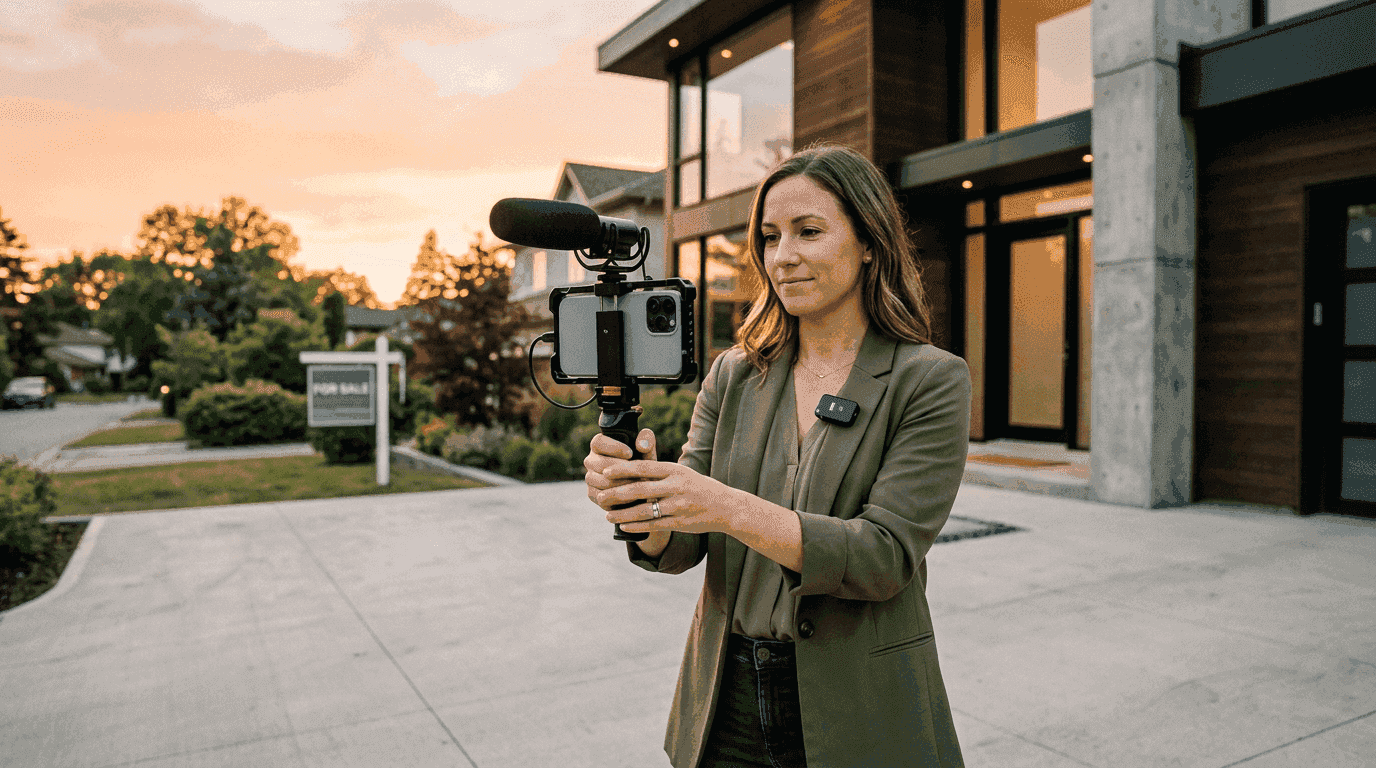
I built Reel-E after running a traditional real estate media company for a decade, so I have a particular bias toward tools that reduce the gap between "I just got the listing" and "the marketing is live." But this guide covers every category of AI tool an agent actually needs in 2026, not just video. I tested or evaluated each tool listed here, and I will be specific about what works, what does not, and what costs real money versus what costs you time.
If you want the short version: most agents need exactly four AI tools (video, writing, photo editing, CRM). Everything else is optional until you are closing more than 20 deals per year.
How We Evaluated These AI Tools
Every tool in this roundup was evaluated on five criteria that matter to working agents, not feature-checklist criteria that matter to software reviewers:
- Time saved per listing: Does this tool measurably reduce hours spent on a repeatable task? If the answer is "it is cool but I still do the same work," it failed.
- Learning curve: Can a non-technical agent use this within 15 minutes of signing up? Real estate agents are not software engineers. If it requires a YouTube tutorial longer than the task it replaces, that is a problem.
- Pricing for solo agents: Evaluated at the tier a solo agent listing 3-8 properties per month would realistically purchase. Enterprise pricing for teams of 50 is irrelevant to most readers.
- Output quality: Does the output look professional enough to put in front of a $500,000 seller? Or does it look like it was made by an intern who just discovered AI?
- Integration with real estate workflows: Does it connect to MLS, CRM, or social posting? Or does it live on its own island, creating one more tab to manage?
I also tracked which tools have genuine AI functionality versus which ones just put "AI" in the name because it is good marketing in 2026. You would be surprised (or maybe you would not) how many "AI-powered" real estate tools are really just template engines with auto-fill fields.
The 10 Best AI Tools for Real Estate Agents Reviewed

1. Reel-E: Best AI Video for Listings
Editor's Choice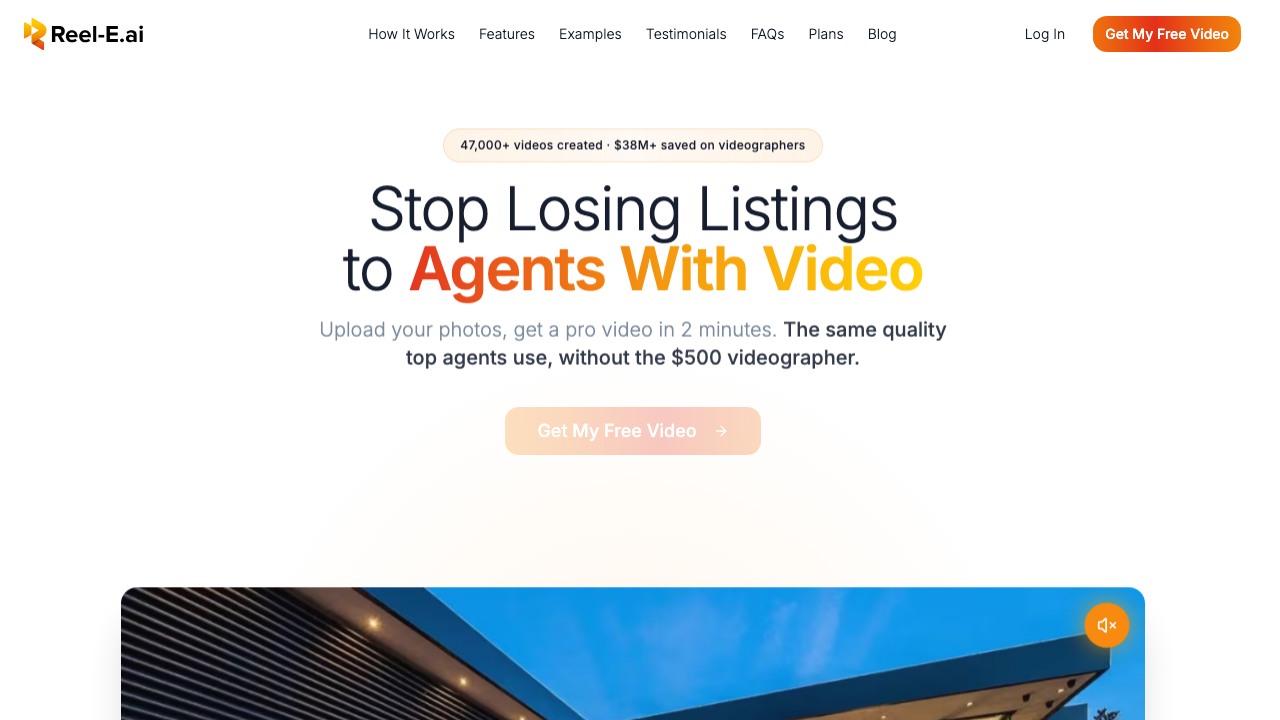
What it is: Reel-E turns listing photos into professional listing videos with AI-generated camera motion, beat-synced music transitions, and automatic branding. Upload photos, pick a track, and download four video variants (horizontal branded, horizontal unbranded, vertical branded, vertical unbranded) in under two minutes.
Why it ranks #1: I built it, so take that with the appropriate grain of salt. But here is the honest case: most real estate video makers are slideshow tools that pan across your photos. Reel-E runs a custom AI inference stack (not off-the-shelf Google Veo or Kling) that generates actual camera movement with parallax depth. The system analyzes your music selection for BPM and downbeats, then aligns every transition to the beat. That rhythmic sync is the difference between a video that feels professional and one that feels like a PowerPoint deck with background noise.
The four-variant output is the other big differentiator. One upload gives you MLS-ready horizontal, social-ready vertical, branded versions for your website, and unbranded versions for platforms that restrict agent branding. In 2026, an agent who only posts horizontal video to Instagram is leaving engagement on the table. The Reels data is unambiguous on this point.
Pros
- True AI motion effects (orbit, push-in, pull-out, Ken Burns) with parallax depth
- Beat-synced transitions matched to music downbeats
- Four video variants from a single upload (covers MLS, website, Instagram, TikTok)
- Under 2 minutes from upload to all four finished videos
Cons
- Photos only for now (no drone footage integration)
- Credit card required for the free trial
- Essential plan caps at 3 listings/month and 20 photos per project
The fastest path from listing photos to cinematic video. If you want every listing to have video but do not want to spend $400-$800 per property on traditional videography, nothing else comes close. The cost comparison is stark.

2. ChatGPT: Best AI Writing Tool for Real Estate
Best for Writing
What it is: ChatGPT (OpenAI) is a general-purpose AI writing assistant. For real estate agents, it replaces the blank page for listing descriptions, social captions, email newsletters, blog posts, and client follow-up messages.
Why it ranks #1 for writing: Because it is the most versatile tool here and the one that saves the most cumulative minutes per week for agents who write anything. A good listing description takes 15-20 minutes when you start from scratch. With ChatGPT, you paste the property details and MLS data, give it a tone direction ("luxury but approachable, highlight the chef's kitchen and the backyard entertaining space"), and get a solid first draft in 30 seconds. You edit for accuracy and voice, and you are done in 5 minutes instead of 20.
The real power is not any single use case. It is the compounding effect of using it for every writing task across the week: listing descriptions, Instagram captions, open house announcements, neighborhood guides for your blog, client birthday messages, and "just listed / just sold" emails. Each one saves 10-15 minutes. Multiply that by 15-20 tasks per week, and you are getting back 3-4 hours.
One thing I will say directly: ChatGPT writes acceptable first drafts, not great final copy. If you publish the raw output without editing, your listing descriptions will sound like every other agent who uses ChatGPT. The agents who get the most from it treat it as a first-draft machine that they then rewrite in their own voice.
Pros
- Fast first drafts for any writing task (listing copy, emails, social posts, blog content)
- Custom GPTs let you save your preferred style, tone, and MLS formatting permanently
- Multilingual output for agents serving diverse markets
- The free tier is genuinely useful for most agents
Cons
- Raw output sounds generic without editing and personalization
- No direct MLS or CRM integration (copy-paste workflow)
- Factual accuracy is not guaranteed for market statistics
The broadest time savings per dollar of any AI tool on this list. Every agent should be using ChatGPT for first-draft writing. The agents who win treat it as a starting point, not a finished product.

3. Follow Up Boss: Best AI-Powered CRM
Best AI CRM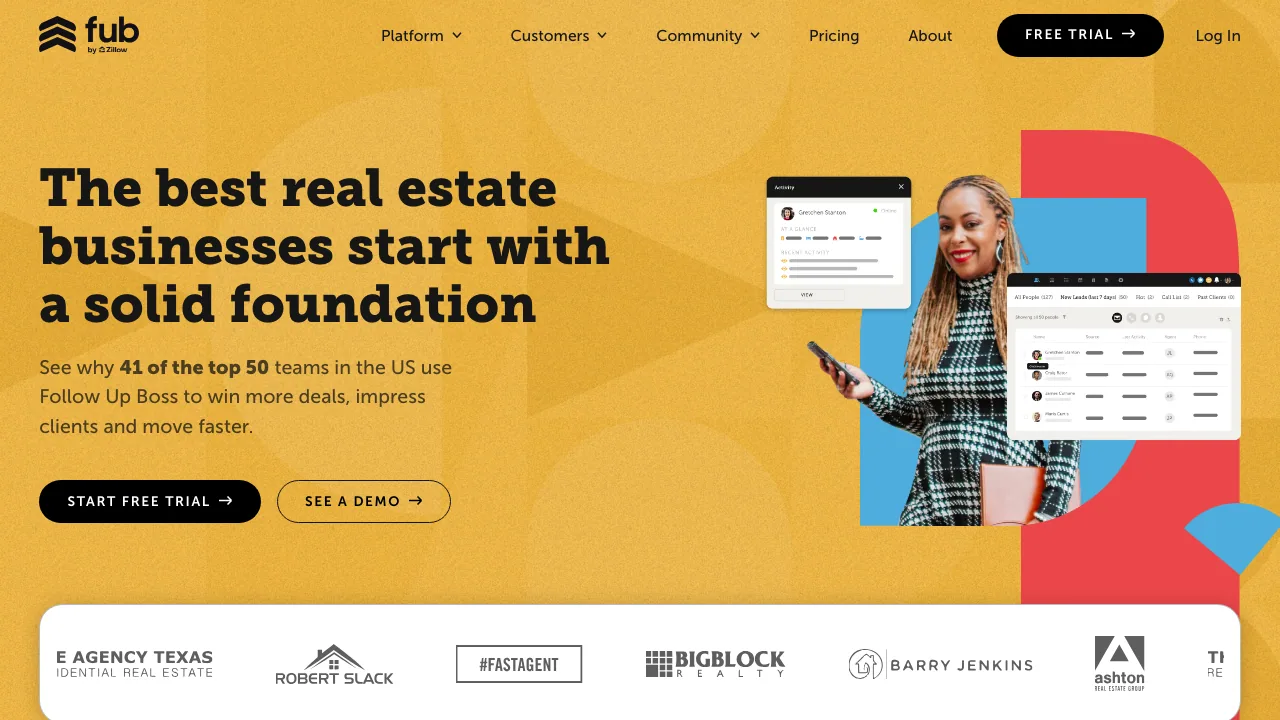
What it is: Follow Up Boss is a real estate CRM that added AI-powered lead scoring, automated follow-up sequences, and smart action plans in its 2025-2026 updates. The AI layer prioritizes which leads to call first based on engagement signals (website visits, email opens, property saves) and suggests personalized follow-up messages.
Why it ranks #1 in CRM: Follow Up Boss was already the CRM most top-producing agents used before the AI features arrived. The AI layer makes it meaningfully better at the thing agents struggle with most: knowing which of their 200+ leads to call right now. The lead scoring model is trained on real estate conversion data, not generic sales data, which means the priority rankings actually correlate with who is likely to transact.
The automated follow-up sequences are the bigger time saver. You can set rules like "if a lead views the same listing three times in a week, send this specific text and schedule a call reminder." That kind of behavioral trigger used to require a marketing automation platform on top of your CRM. Now it is built in.
Runner-up: kvCORE. Its AI chatbot ("Kelle") handles initial lead response and qualification via text. The all-in-one approach (CRM + website + IDX + marketing) appeals to agents who want fewer logins. The tradeoff is that each individual feature is less polished than a best-of-breed tool like Follow Up Boss.
Pros
- AI lead scoring based on real estate-specific behavioral signals
- Smart action plans that trigger follow-up based on lead behavior
- Integrates with 250+ lead sources (Zillow, Realtor.com, social ads)
- Clean mobile app that actually works for agents in the field
Cons
- $69/mo per user gets expensive fast for teams
- AI features are mostly in the higher-tier plans
- No built-in transaction management (need Dotloop or SkySlope)
Worth it when your lead volume exceeds what you can manage with spreadsheets and memory. The AI lead scoring alone pays for itself if it helps you convert even one additional lead per quarter.

4. BoxBrownie: Best AI Photo Editing for Real Estate
Best Photo Editing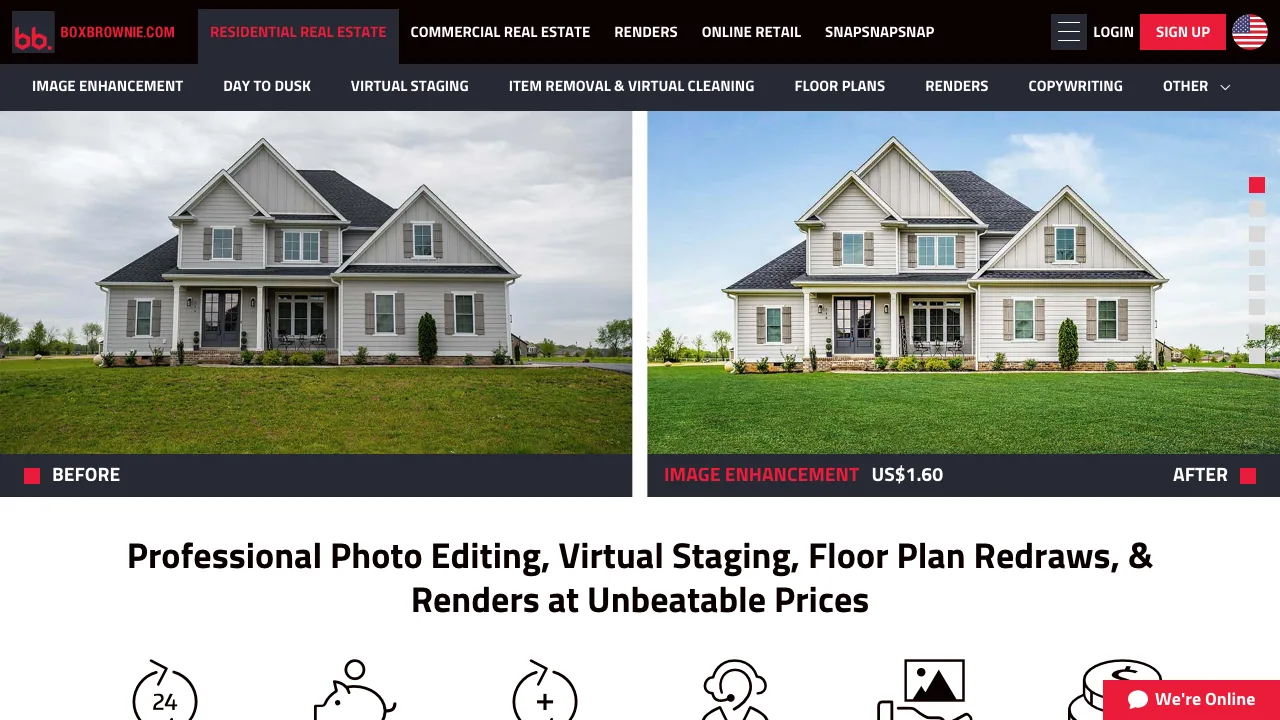
What it is: BoxBrownie offers AI-assisted real estate photo editing: sky replacement, image enhancement, day-to-dusk conversion, item removal, and virtual renovation. The AI handles the heavy lifting, and human editors review the output for quality control.
Why it ranks #1 for photo editing: The hybrid AI + human review model is why BoxBrownie consistently produces the most reliable output. Pure AI photo editors sometimes create artifacts: weird reflections in windows, furniture that floats slightly above the floor, or sky replacements that do not match the lighting direction. BoxBrownie catches these because a human editor reviews every image before delivery.
For most agents, the photo enhancement service ($1.60/image) is the highest-ROI feature. It corrects white balance, adjusts exposure, fixes lens distortion, and makes rooms look the way they actually looked when you walked in. The day-to-dusk conversion ($4/image) is the other feature worth highlighting. These twilight shots get significantly more clicks in MLS search results.
One more thing on photo editing: the photos you feed into a video tool like Reel-E directly affect the video quality. Enhanced photos produce better AI motion effects. If you are investing in listing video, investing the extra $24 per listing in photo enhancement first is a force multiplier.
Runner-up: Pedra. Instant AI processing (no human review delay), combined virtual staging and video in one platform. Better for agents who need speed over perfection.
Pros
- Hybrid AI + human review eliminates common AI artifacts
- Pay-per-image pricing with no monthly commitment
- Fast turnaround (most edits within 24 hours, rush available)
- Virtual renovation for showing potential of dated properties
Cons
- Not instant (24-hour turnaround versus real-time AI editors)
- Costs add up at volume (15 photos x $1.60 = $24/listing)
- No subscription plan for predictable monthly volume
The most reliable AI photo editing for real estate. Pay-per-image pricing means you only spend on listings that need it, and the human review catches what pure AI misses.

5. Canva: Best AI Design Tool for Agents
Best All-in-One Design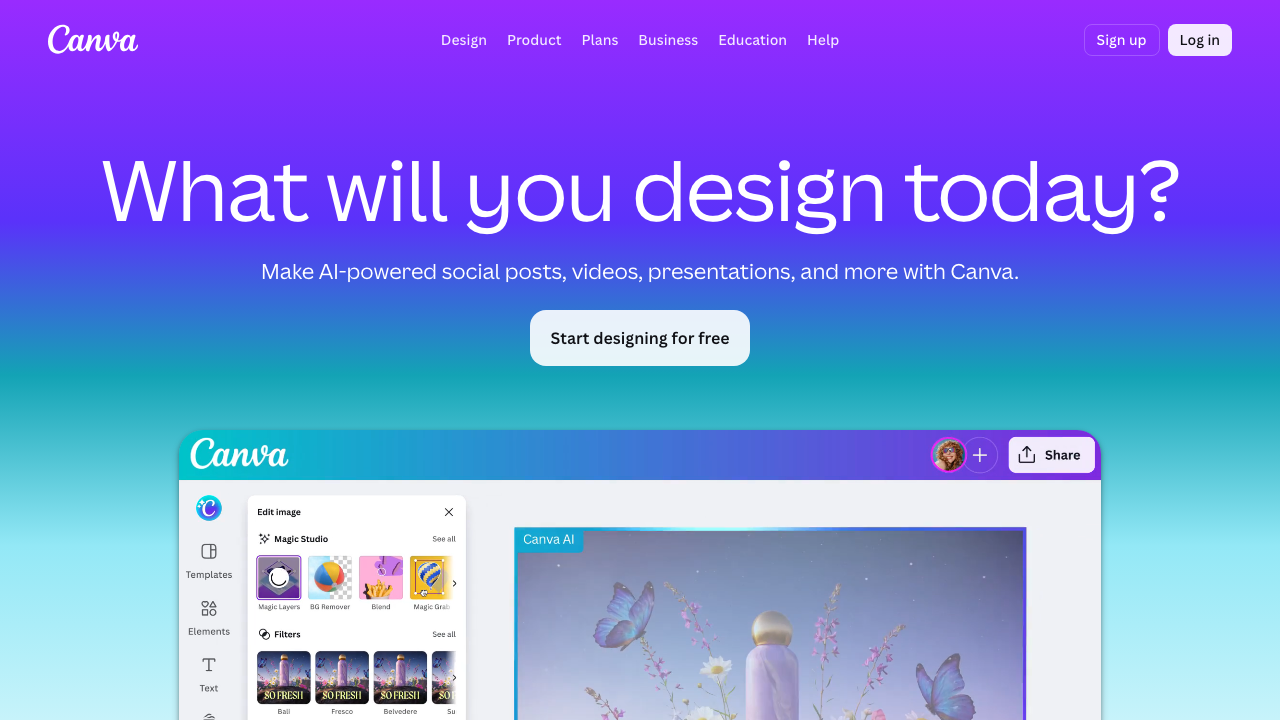
What it is: Canva is the swiss army knife of content creation for real estate agents. It handles everything from business cards to listing flyers to social posts, and includes a video editor, AI design features (Magic Design, text-to-image), and a massive template library.
Why it ranks #5: Canva earns its spot for sheer versatility. If you only want to pay for one design tool, Canva covers the most ground. The real estate templates are decent, and the AI features are improving rapidly. For agents who already use Canva for flyers and social posts, the video editor is a natural extension.
The weakness for real estate specifically: video quality is basic (simple zoom and pan, no beat-sync, no intelligent motion), and there are no listing-specific features like multi-format export or contact card overlays. For a deeper dive, read our full Reel-E vs Canva comparison.
Pros
- Massive template library across all content types
- Design flyers, posts, and videos in one tool
- Generous free tier for getting started
- AI design features (Magic Design) improving rapidly
Cons
- Basic video animations (zoom and pan only, no AI motion)
- No real estate-specific video features (beat-sync, multi-format)
- Max 1080p export quality
The best option if you want one tool for all your marketing materials. Video quality is average, but the design ecosystem is unmatched for agents who need flyers, social posts, and presentations alongside video.

6. Apply Design: Best AI Virtual Staging
Best Virtual Staging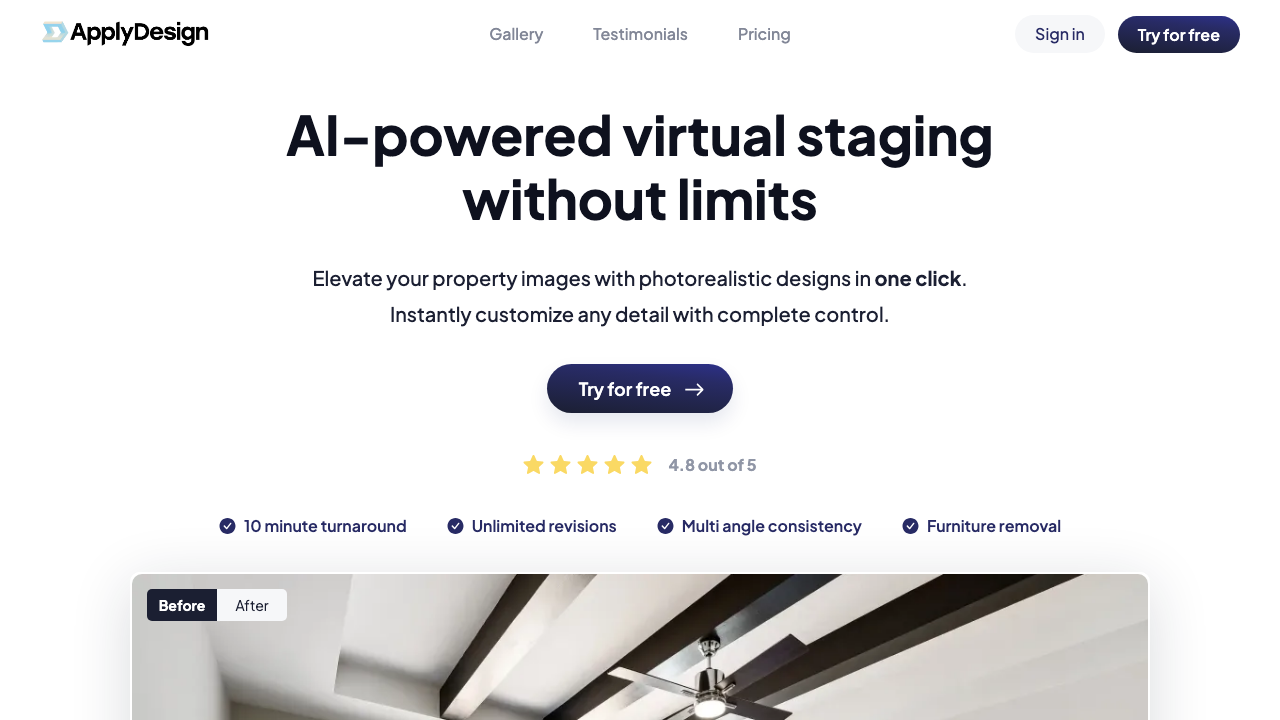
What it is: Apply Design uses AI to virtually stage empty rooms with furniture, decor, and finishes. You upload a photo of an empty room, select a style (modern, farmhouse, coastal, etc.), and receive a staged version in minutes. It also offers virtual renovation rendering for showing the potential of dated kitchens and bathrooms.
Why it ranks #1 for staging: Apply Design earns the top spot because its furniture placement is the most spatially aware. Sofas do not clip through walls. Rugs respect room boundaries. Scale is consistent. These sound like basic requirements, but a surprising number of AI staging tools still produce furniture that looks like it was copy-pasted from a catalog without understanding the room dimensions.
The $15/image price point is well-positioned. Physical staging costs $2,000-$5,000 per property. AI staging 8-10 rooms at $15 each ($120-$150 total) is 95% cheaper with zero logistics.
There is a disclosure consideration: many MLS systems now require that virtually staged photos be labeled as such. NAR guidelines recommend clear labeling. Agents should label staged photos appropriately.
Runner-up: Virtual Staging AI. Lower price point ($6/image on bulk plans) and faster processing. The quality gap has narrowed significantly in 2026.
Pros
- Spatially aware furniture placement (best in class)
- Wide variety of design styles (modern, farmhouse, coastal, Japandi)
- Virtual renovation for kitchens and bathrooms
- Fast turnaround (minutes, not hours)
Cons
- $15/image adds up for listings with many empty rooms
- Occasional artifacts on reflective surfaces (windows, mirrors)
- Cannot stage partially furnished rooms well
The best AI virtual staging for quality-conscious agents. Worth it for vacant listings where showing the space furnished meaningfully improves buyer engagement.

7. HouseCanary: Best AI Market Analysis
Best Analytics
What it is: HouseCanary provides AI-powered property valuations, market forecasts, and investment analytics. Its valuation model processes 400+ data points per property and claims median error rates below 3% nationally.
Why it ranks #1 for market analysis: Most agents use CMAs (comparative market analyses) built from recent comps. CMAs are useful but inherently backward-looking. HouseCanary adds forward-looking elements: predicted price appreciation for the neighborhood, renovation ROI modeling, and rental yield projections. For listing presentations, being able to show a seller not just what their home is worth today but where the neighborhood is headed over 12-24 months is a powerful differentiator.
The renovation ROI modeling is particularly useful for agents who work with fixers and value-add buyers. You can show a buyer: "this kitchen renovation will cost approximately $45,000 and increase the property value by approximately $72,000 based on comparable renovations in this ZIP code."
The honest caveat: HouseCanary is expensive for solo agents who only use it occasionally. The valuation data is most valuable for agents who do 15+ transactions per year or who specialize in investment properties.
Runner-up: Revaluate. Focuses specifically on identifying likely movers in your database by analyzing life events, financial signals, and behavioral data. Pairs well with Follow Up Boss for proactive outreach.
Pros
- Highly accurate property valuations (median error below 3%)
- Forward-looking market forecasts (not just backward-looking comps)
- Renovation ROI modeling for value-add scenarios
- Data depth: 400+ property-level data points
Cons
- Expensive for low-volume agents
- Custom pricing makes it hard to budget before committing
- Accuracy varies by market (urban outperforms rural)
Worth the investment for high-volume agents and investment property specialists. The forward-looking analytics give listing presentations a data edge that backward-looking CMAs cannot match.

8. Offrs: Best Predictive Lead Generation
Best Lead Gen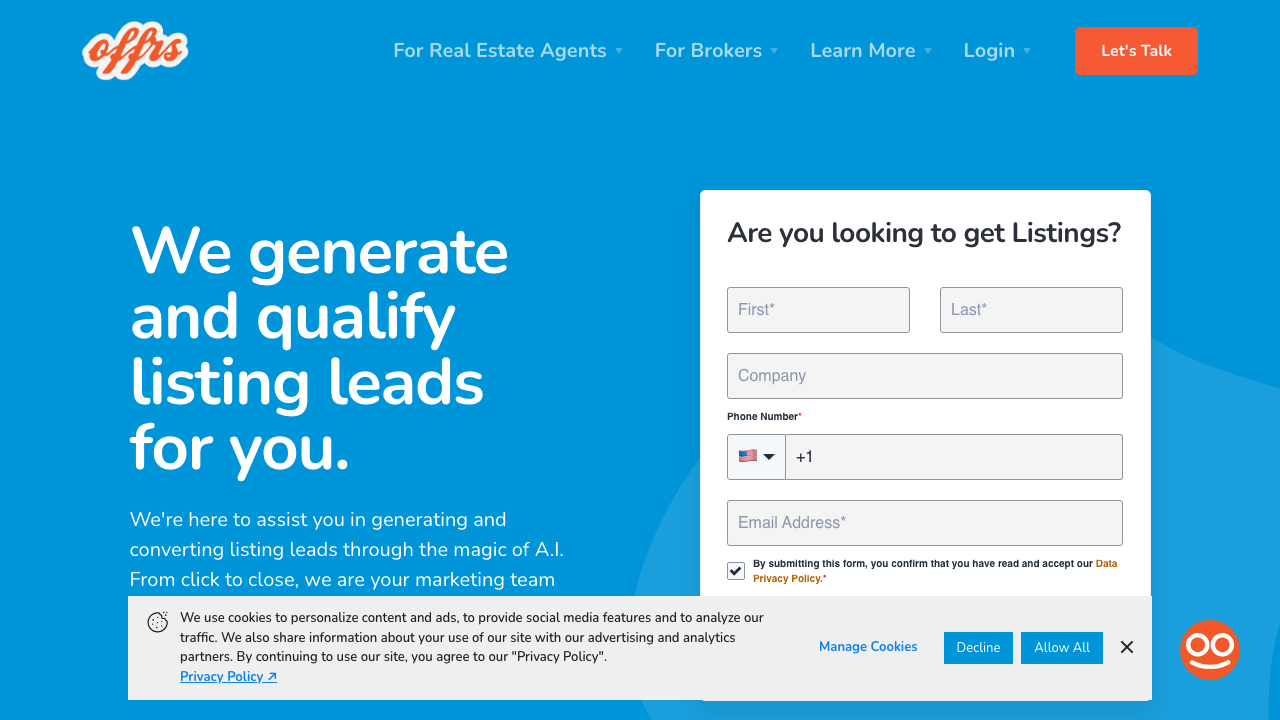
What it is: Offrs uses predictive AI to identify homeowners likely to sell within the next 12 months, based on public records, demographic data, behavioral patterns, and market indicators. It delivers ranked lists of potential sellers in your farm area so you can prospect proactively rather than reactively.
Why it ranks #1 for lead gen: Offrs earns the top spot because it has the longest track record (operating since 2014) and the largest data set for model training. Independent studies have shown it identifies actual sellers at roughly 3x the rate of random prospecting in the same area.
Here is the honest version of what that means: if you door-knock 100 random homes in your farm area, you might find 2-3 likely sellers. If you door-knock the top 100 Offrs predictions for the same area, you might find 6-9. That is a significant efficiency improvement for agents who prospect actively, and it is essentially meaningless for agents who do not prospect at all.
The $399/month price tag is the main barrier. For an agent closing 15+ deals per year with an average commission of $8,000-$12,000, one additional listing from Offrs-identified leads pays for the annual subscription. For an agent closing 5 deals per year, the math is tighter.
Runner-up: SmartZip. Similar predictive approach with marketing automation bundled (postcards, digital ads). SmartZip gives you data plus done-for-you marketing. Both are expensive.
Pros
- Predictive seller identification based on a large proprietary data set
- Territory exclusivity (your ZIP code, nobody else)
- ROOF program delivers leads via appointment setting
- Integrates with most major CRMs for lead import
Cons
- $399/mo is expensive for agents with lower volume
- Predictions are probabilities, not certainties
- Requires active prospecting effort to convert predictions
A tool that rewards volume. If you are closing 15+ deals per year and actively prospecting, the predictive data pays for itself. If you are closing 5 deals per year, the ROI math is harder to justify.

9. Hootsuite: Best AI Social Media Management
Best Social Media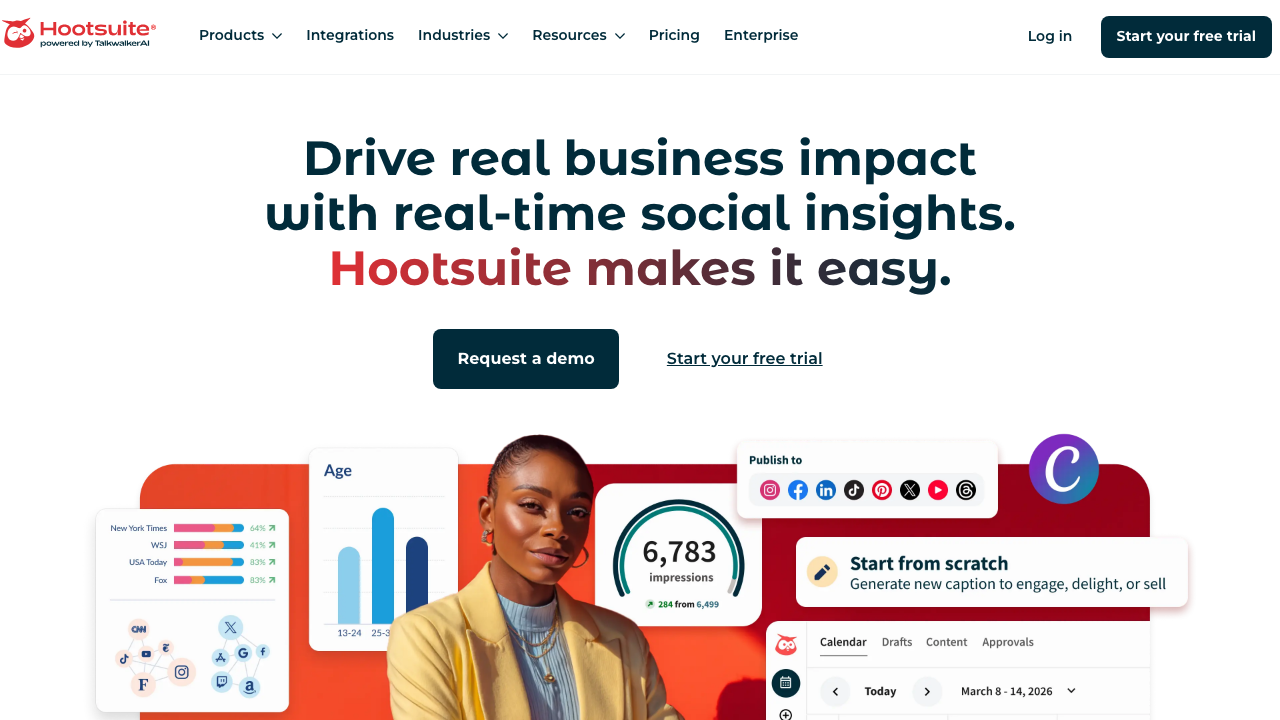
What it is: Hootsuite is the established social media management platform, now with OwlyWriter AI for generating post captions, suggesting hashtags, and repurposing top-performing content. It handles scheduling, publishing, and analytics across Instagram, Facebook, LinkedIn, X, and TikTok.
Why it makes the list: Hootsuite earns a spot for being the most mature social management platform with meaningful AI features. OwlyWriter generates post captions, suggests hashtags, and repurposes your top-performing content into new posts. If you already use Hootsuite for scheduling, the AI add-on is a natural extension rather than a new tool to learn.
The fundamental problem agents have with social media is not posting. It is consistently creating content that does not look like it was generated by a template. Hootsuite's AI layer helps by starting from content you already have and reformatting it for each platform.
For agents specifically focused on short-form video content for social, the combination of Reel-E's vertical video output plus a scheduling tool like Hootsuite is often more effective than an AI caption generator alone. Video posts consistently outperform text-and-image posts on Instagram and TikTok.
Alternative: Lately AI ($49/mo). More sophisticated voice learning that adapts to your writing style over time, but it requires existing content to repurpose and takes 3-4 weeks to get good.
Pros
- OwlyWriter AI generates captions and suggests hashtags
- Built-in scheduling and publishing to all major platforms
- Analytics on which posts perform best
- Most mature social management platform
Cons
- $49/mo for social scheduling feels steep vs Buffer ($6/mo)
- AI voice learning is less sophisticated than Lately AI
- Real estate-specific context is limited
Worth it for agents who need scheduling plus AI content generation in one platform. If you only need scheduling, cheaper tools exist. If you need AI captions and repurposing, Hootsuite delivers.

10. Jasper: Best AI Marketing Copy Platform
Best AI Copy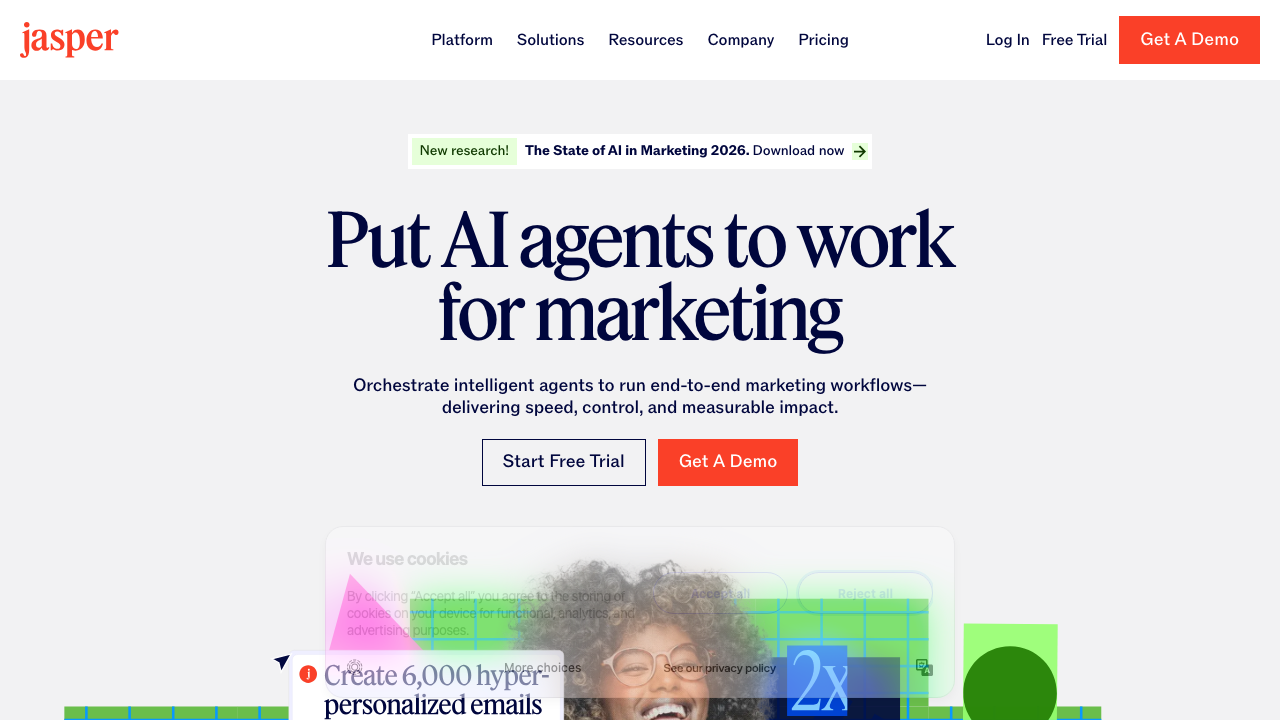
What it is: Jasper AI is a marketing copy platform built specifically for creating branded content. Unlike ChatGPT's general-purpose approach, Jasper offers pre-formatted templates for listing descriptions, social posts, email campaigns, and ad copy. It also includes brand voice settings that maintain consistency across all outputs.
Why it makes the list: Jasper bridges the gap between ChatGPT's flexibility and a fully templated system. For agents who find ChatGPT's blank-canvas approach overwhelming, Jasper's structured templates provide more guardrails. The real estate-specific templates are pre-formatted for listing descriptions, social posts, and email campaigns, so you spend less time prompting and more time reviewing output.
The brand voice feature is the standout. You teach Jasper your writing style, preferred terminology, and tone, and it maintains that consistency across every piece of content. For teams where multiple agents need to write in a consistent brand voice, this is more useful than ChatGPT's per-conversation approach.
The tradeoff versus ChatGPT: Jasper costs $49/mo for the Creator plan (vs ChatGPT Plus at $20/mo), and it is less flexible for non-marketing tasks. If you want maximum flexibility at lower cost, ChatGPT wins. If you want less prompting and more templates, Jasper is the better fit.
Pros
- Pre-built real estate marketing templates (listing copy, social, email)
- Brand voice settings for consistent output across a team
- Less prompting required than ChatGPT for common tasks
- Campaign-level content creation (not just single outputs)
Cons
- $49/mo is expensive vs ChatGPT at $20/mo
- Less flexible for non-marketing tasks
- Templates can produce formulaic output without customization
Best for agents or teams who want structured templates over ChatGPT's open-ended approach. The brand voice consistency is its strongest selling point for multi-agent brokerages.
How to Build Your AI Stack Without Overspending
Here is the mistake most agents make: they sign up for eight tools in the same week, use each one twice, and then pay for six months of subscriptions they forgot to cancel. The smarter approach is to layer tools in order of ROI, prove each one works for your business, and only add the next tool after the current one is producing measurable results.
The best AI stack is not about having the most tools. It is about connecting the right ones to a repeatable workflow.
The Essentials Stack (Under $100/month)
Start here. These three tools cover the highest-ROI workflows for most agents:
- ChatGPT ($20/mo): Listing descriptions, social captions, email drafts, client communication templates. The broadest time savings per dollar.
- Reel-E ($44/mo): AI listing video for every property. Four variants per upload covering MLS, website, Instagram, and TikTok. The highest-impact marketing asset most agents are not currently producing.
- BoxBrownie (pay-per-use, ~$24-40/listing): Photo enhancement and day-to-dusk for every listing. Costs less per listing than a large coffee, and the quality improvement in MLS photos is immediately visible.
Total: roughly $64/mo in subscriptions plus $24-40 per listing in photo editing. For an agent listing 4-5 properties per month, that is under $250/month total for writing, video, and photo enhancement. Compare that to hiring a videographer ($400/listing) and a photo editor ($50/listing) separately.
The Growth Stack ($200-$400/month)
Add these when you are closing 10+ deals per year and want to systematize lead management:
- Follow Up Boss ($69/mo): AI-powered CRM with lead scoring and automated follow-up. Worth it when your lead volume exceeds what you can manage with spreadsheets and memory.
- Hootsuite ($49/mo): Social media content generation and scheduling. Worth it when you are producing enough content (listings, market updates, blog posts) to repurpose at scale.
- Apply Design ($15/image as needed): Virtual staging for empty listings. Add it when you regularly list vacant properties and want to show buyers the potential.
The Enterprise Stack ($500+/month)
Add these when you are a top producer or team leader:
- Offrs ($399/mo): Predictive lead generation. Worth it when you need a steady pipeline of new listings and are willing to prospect actively against the predictions.
- HouseCanary (custom): Advanced market analytics. Worth it when you specialize in investment properties or need data-driven pricing strategy for luxury listings.
- Reel-E Pro ($599/mo): 4K video output with priority rendering and 50 listings per month. Worth it for teams producing high-volume content for luxury or commercial properties.
What Actually Changed in 2026
A year ago, "AI tools for real estate" mostly meant ChatGPT for writing and one or two photo editors. The category has expanded significantly, and the tools have gotten meaningfully better at real estate-specific tasks. Here is what actually changed versus what is just marketing noise:
Real Changes
- AI video quality crossed the professional threshold. The best AI real estate video tools now produce output that buyers cannot distinguish from professionally edited footage when scrolling social media. This was not true in 2024.
- CRM AI moved from novelty to utility. Lead scoring and automated follow-up sequences based on behavioral data are genuinely useful now, not just marketing features on a pricing page.
- Virtual staging quality improved dramatically. Furniture placement, lighting matching, and style variety are all significantly better than 18 months ago.
- Predictive analytics got more accessible. Tools like Offrs and SmartZip that were previously enterprise-only now have plans individual agents can afford (if the math works for their volume).
Mostly Marketing Noise
- "AI-powered CRM" often means auto-generated email subject lines. Check what the AI actually does before paying a premium for it.
- "AI lead generation" sometimes means scraping public data with a prettier interface. Predictive models that actually learn from outcomes are different from databases with a filter.
- "AI listing descriptions" from MLS platforms are improving but still generic. The built-in AI writers in some MLS systems produce acceptable but unremarkable copy. ChatGPT with a good prompt still beats them.
The broader trend is consolidation. Tools are starting to combine features that used to require separate subscriptions. Real estate video marketing tools now include branding and social formatting. CRMs now include AI writing. Photo editors now include virtual staging. In 2027, expect even more bundling, which should push prices down for agents willing to consolidate their stack.
Ready to add AI video to your stack?
Upload your listing photos, pick music, and get four cinematic videos in under 2 minutes.
Try Reel-E FreeFrequently Asked Questions
What are the best AI tools for real estate agents in 2026?
The most impactful AI tools for agents in 2026 are: Reel-E for AI listing video, ChatGPT for writing and listing copy, Follow Up Boss for CRM and lead follow-up, and BoxBrownie for photo editing. These four cover the highest-ROI workflows. Additional tools for virtual staging (Apply Design), lead generation (Offrs), social media (Hootsuite), and market analysis (HouseCanary) are worth adding as transaction volume grows.
How much should a real estate agent spend on AI tools?
Most solo agents can build an effective AI stack for $100-$250/month. The essentials (ChatGPT at $20/mo, Reel-E at $44/mo, plus BoxBrownie at $24-40/listing) cover writing, video, and photo editing. Add a CRM with AI features ($69/mo) and social tools ($49/mo) as your business grows. Avoid signing up for more than 2-3 new tools at once.
Do AI tools actually help real estate agents sell more homes?
The data supports it for specific use cases. Listings with video receive 403% more inquiries. AI-enhanced photos improve click-through rates on MLS by 20-40%. Agents using AI-powered CRM follow-up report 15-25% higher lead conversion rates. But the tools only work if you actually use them consistently. An AI tool you pay for but do not use has zero ROI.
Can AI replace a real estate photographer or videographer?
For most listings, AI tools can replace the videographer (listing video from photos) and supplement the photographer (enhancement, sky replacement, virtual staging). Professional photography is still valuable for capturing the raw images. The cost savings are most dramatic on video: AI video at $44/month replaces $400-$800 per listing in traditional videography costs.
What is the difference between AI tools built for real estate and general AI tools?
Real estate-specific AI tools are trained on property data, MLS conventions, and agent workflows. A general writing AI (ChatGPT) needs you to provide real estate context in every prompt. A real estate-specific video tool (Reel-E) already knows that listing videos need specific aspect ratios, music licensing, and branding formats. The tradeoff is that general tools are more flexible, while specialized tools require less configuration for real estate tasks.
Which AI tools work best for new real estate agents?
New agents should start with ChatGPT (free tier) for writing and Reel-E ($44/mo) for listing video. These two tools address the biggest time sinks for new agents: creating marketing content from scratch and producing professional-looking listing media. Add photo editing (BoxBrownie) once you are listing regularly, and add a CRM with AI features once your lead volume exceeds what you can manage manually.
Are there free AI tools that work for real estate?
ChatGPT's free tier is genuinely useful for writing tasks. Canva's free plan includes basic design and limited video editing. Google Gemini offers free AI writing assistance. For more specialized tasks (listing video, virtual staging, predictive analytics), the free tiers are typically too limited for professional use. Most free plans include watermarks, lower resolution, or severe usage caps that make them impractical for client-facing marketing.
How do I know if an AI tool is actually using AI or just marketing the term?
Ask two questions: (1) Does the output improve over time based on your usage? If yes, there is likely a real model learning from your data. (2) Does the tool produce results that would be impossible or extremely time-consuming without AI? If the tool just auto-fills templates or applies preset filters, it is not meaningfully "AI." Real AI tools do things like generate camera motion from a 2D photo, predict which leads will transact, or learn your writing voice from past content.
Should I use one all-in-one AI platform or multiple specialized tools?
For most agents, a small stack of specialized tools outperforms an all-in-one platform. All-in-one tools (like kvCORE) offer convenience but each individual feature is typically less polished than a best-of-breed alternative. The exception is if you genuinely use every feature in the all-in-one platform. If you only use the CRM and ignore the website builder and IDX search, you are paying for features that sit idle. Start specialized, consolidate only when it saves real time.
What AI tools help with real estate social media marketing?
For video content (the highest-performing format on every platform), Reel-E's vertical video output covers Instagram Reels, TikTok, and YouTube Shorts. For captions and scheduling, Hootsuite with OwlyWriter generates platform-specific posts from your existing content. For Instagram Reels specifically, the combination of vertical listing video plus AI-generated captions is the most efficient workflow.
How does the NAR settlement affect which AI tools agents need?
The commission changes from the NAR settlement are squeezing agent marketing budgets. This actually makes AI tools more important, not less. An agent who previously spent $400-$800 per listing on videography can now get comparable output from an AI video maker at $44/month. The agents adapting fastest to compressed margins are the ones replacing expensive per-listing services with AI subscriptions that cover all their listings at a flat monthly cost.
Are there AI disclosure requirements for real estate marketing?
Requirements vary by state and are evolving. California's AB 723 requires disclosure of AI-generated content in real estate marketing under certain circumstances. Some MLS systems now require labeling for virtually staged photos. For current AI disclosure rules, check both your state regulations and your local MLS guidelines. Best practice: label AI-generated or AI-enhanced content transparently. Buyers appreciate honesty, and it protects you from future regulatory changes.
Related Reading
- Best Real Estate Video Makers (Full Roundup)
- Best AI Real Estate Video Generators
- How to Turn Listing Photos into Video
- Do Video Listings Sell Faster? The Data Says Yes
- Real Estate Video Cost Comparison
- Real Estate Video Marketing Tools
- Reel-E vs Canva · Reel-E vs Pedra
- California AB 723: AI Disclosure Rules for Real Estate